Water Ice on the Moon: Mission History and Timeline (1961–2027)
How scientists found water ice on the Moon, from the 1961 cold-trap prediction and Lunar Prospector to Chandrayaan-1, LCROSS and SOFIA, and what VIPER
Latest Story
For most of the space age the Moon was described as bone dry. Today scientists agree that water ice on the Moon is real, trapped in polar craters that never see sunlight, and that traces of water are spread far more widely across the surface. This page traces the search from a 1961 prediction through India’s Chandrayaan-1, NASA’s LCROSS impact and SOFIA’s sunlit detection, to the setbacks and plans of 2024–2027: a cancelled and revived VIPER rover, a tipped-over drill, a lost orbiter and China’s delayed Chang’e-7. It also separates what has been confirmed from what is still only planned.
💡 Short Answer
Water ice on the Moon is confirmed. Chandrayaan-1’s NASA-built Moon Mineralogy Mapper found surface hydration in 2009, NASA’s LCROSS impact found about 5.6% ice in Cabeus crater the same year, and M³ data showed exposed polar ice in 2018. SOFIA detected sunlit water in 2020. No mission has yet measured ice in place; VIPER and Chang’e-7 are planned for 2027.
Water on the Moon: Key Questions
Lunar Water in Ten Points
- 1961: scientists predicted polar craters could trap ice for billions of years.
- Apollo: samples from 1969–72 looked dry; water in them was found only in 2008.
- 1994–98: Clementine radar and Lunar Prospector hydrogen gave the first polar clues.
- 2009: Chandrayaan-1’s M³ found surface hydration; LCROSS found ice in Cabeus.
- 2018: M³ data showed ice exposed at the surface near both poles.
- 2020: SOFIA found molecular water even in sunlight, at tiny concentrations.
- 2024: VIPER was cancelled; LRO data showed ice is more widespread than thought.
- 2025: the first ice drill landed on its side; Lunar Trailblazer was lost; VIPER was revived.
- 2026: new studies on ice age and seismic detection; Chang’e-7 slipped to 2027.
- Still open: how much ice, how deep, how pure, and whether it can be mined.
What Exactly Is “Water on the Moon”?
Not every detection means the same thing. The difference between a trace and a resource is the whole story.
| Type | What it means | Why it matters |
|---|---|---|
| Water ice | Frozen H₂O, concentrated in very cold, shadowed terrain | The only form that could be a practical resource, if deposits are rich and reachable |
| Molecular water in soil | H₂O trapped in or stuck to grains, even in sunlight | Shows water exists beyond cold traps, but at about 0.01–0.04% |
| Hydroxyl (OH) | One oxygen and one hydrogen, bound to minerals | Gives a similar 3-micron signal to water, so early data were ambiguous |
| Water in minerals or glass | Water chemically bound inside rock, glass or crystals | Tells the Moon’s history; hard to extract |
| Hydrogen signals | Neutron data showing hydrogen-rich soil | Strong clue to ice, but hydrogen can also come from the solar wind |
The search moved through distinct kinds of evidence. A 1961 theory said ice should survive in polar shadows. Radar and neutron data in the 1990s said something hydrogen-rich was there. Infrared spectra in 2009 showed water or hydroxyl at the surface, and LCROSS physically threw icy soil into view. In 2018 and 2020 instruments saw diagnostic signatures of ice and of molecular water. The step that matters for explorers, measuring ice in place with a drill, has not been achieved: the only attempt, in March 2025, ended with the lander on its side.
Before Spacecraft: Mapping a Dry-Looking World
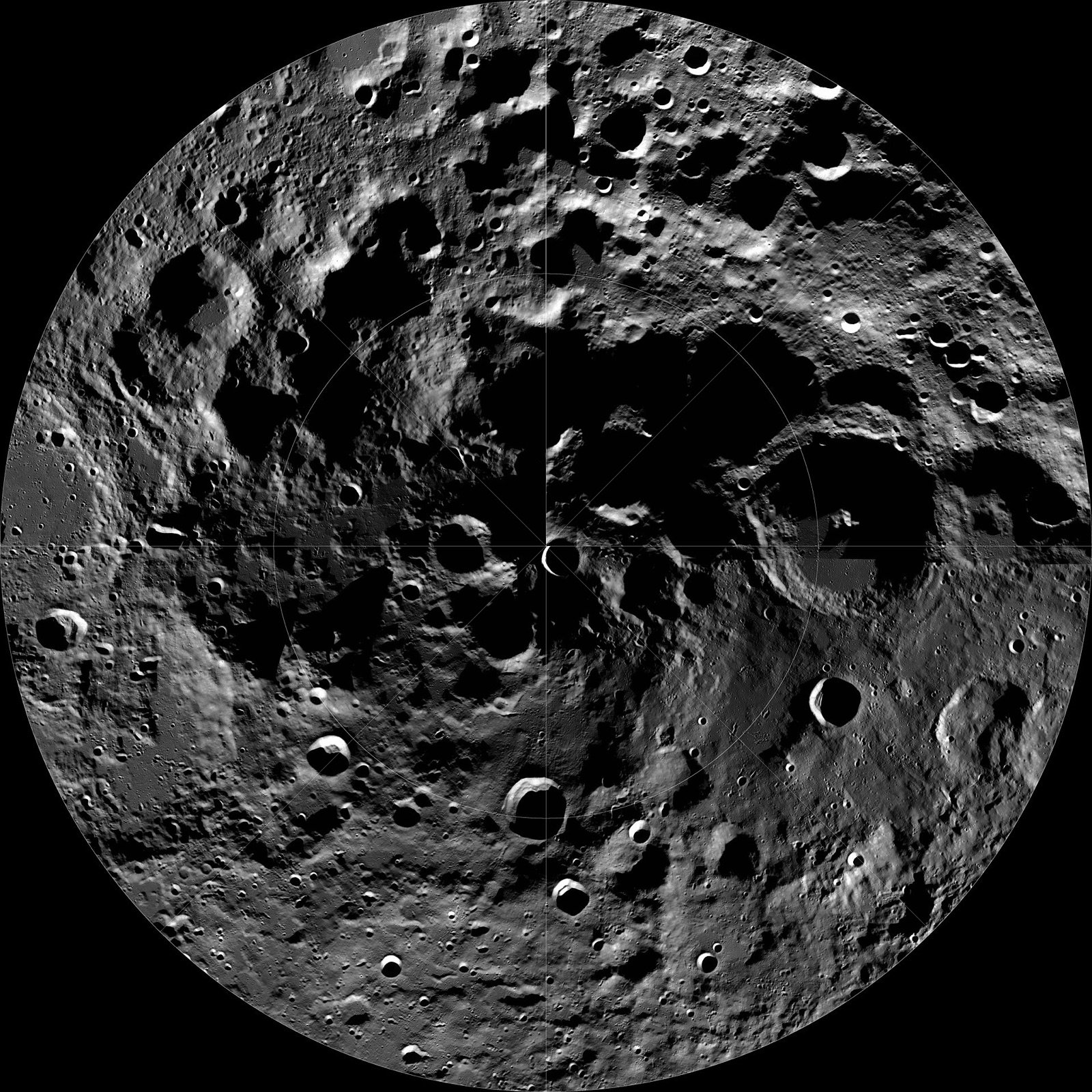
Telescope mapping of the Moon goes back to the seventeenth century; Michael van Langren’s 1645 map was one of the first to name lunar features. Telescopes could show craters and dark “seas”, but nothing about water: the maria are ancient lava plains, not oceans. The first scientific case for lunar ice came in 1961, when Kenneth Watson, Bruce Murray and Harrison Brown worked out that the Moon’s small axial tilt leaves some polar crater floors in permanent shadow, cold enough to hold water ice for the age of the Solar System.
Water Ice on the Moon: The Full Timeline, 1961–2027
Newest first. Tags separate confirmed results, evidence that still needs testing, setbacks, and plans.
2027
VIPER is due at the south pole Planned
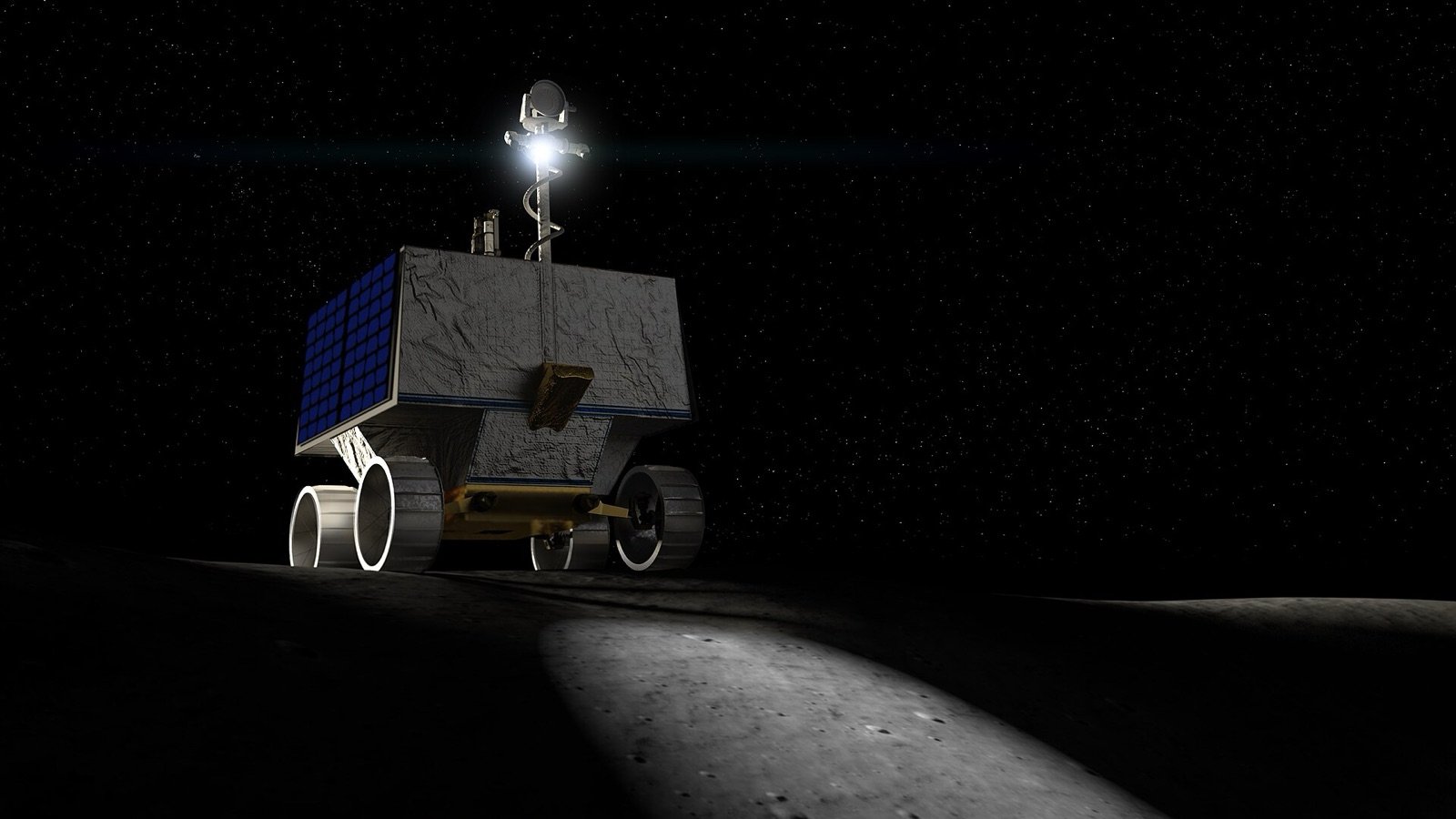
NASA’s Volatiles Investigating Polar Exploration Rover is scheduled to be landed by Blue Origin and drive in and out of shadowed areas with a one-metre drill and three spectrometers, mapping where ice sits, how deep and how concentrated. NASA will exercise the delivery option only after reviewing Blue Origin’s first Mark 1 pathfinder flight, so the date is a plan, not a promise.
(planned)
Chang’e-7 tries again Planned
China’s south-pole mission carries 21 payloads, six of them international. Its hopping probe is designed to jump into permanently shadowed ground with a water-molecule and hydrogen-isotope analyser: the first attempt to sample a cold trap directly.
2026
Chang’e-7 launch called off 2026 Setback
The rocket had rolled out on 19 August, but China’s space authorities said launch conditions were not met. Because landing on Shackleton’s rim needs specific lighting, the remaining 2026 windows were lost and the mission was moved to 2027.
2026
Moonquakes as an ice detector 2026 Evidence
Researchers show that seismic waves move two to three times faster through ice-rich soil than through dry soil and can bounce off buried ice. Seismometers placed by future missions could map ice and estimate its volume without drilling everywhere.
2026
The oldest craters hold the most ice 2026 Evidence
A modelling and data study finds that ice is patchy and that older cold traps contain more, implying the Moon has gathered water fairly continuously for 3 to 3.5 billion years rather than from one big impact. Haworth crater and the Malapert massif are named as promising targets.
Artemis II flies around the Moon 2026 Confirmed
The first crewed lunar flight since 1972 completes a free-return loop and lands safely. NASA later redefines Artemis III (crew named 9 June 2026) as a 2027 Earth-orbit test of the Starship and Blue Moon landers, making Artemis IV, as early as 2028, the first planned landing near the south pole.
2025
VIPER is revived Confirmed
Fourteen months after cancelling it, NASA gives the finished rover a ride. The contract is structured in stages to limit NASA’s risk, including a review of how VIPER will be offloaded on the surface.
2025
Lunar Trailblazer is declared lost Setback
The small orbiter was built to map the form, amount and daily changes of surface water. Misaligned solar arrays left its batteries uncharged, and after months of attempts NASA ended the mission. Its loss leaves the water-mapping gap that VIPER and Chang’e-7 hope to fill from the ground.
Chandrayaan-3 temperatures hint at more ice sites Evidence
Using the first temperature profiles measured near the south polar region (the Vikram lander sits near 69°S), scientists find that a sun-facing slope reached about 82 °C while flat ground a metre away peaked near 59 °C. Modelling suggests pole-facing slopes steeper than about 14° could keep ice centimetres below the surface, even away from the poles.
2025
PRIME-1 drills, but the lander tips over Setback
The first attempt to drill and sniff lunar soil for ice lands near Mons Mouton but on its side in a crater. The drill is operated and some data return before the batteries run down. No ice deposit is confirmed, and early gas readings are thought to include material from the spacecraft itself.
2024
LRO: ice is more widespread Evidence
A NASA Goddard team reports hydrogen signatures of ice in shadowed regions out to at least 77°S, not just at the pole, with roughly five litres of ice per square metre in the top metre of soil over the richest deposits, concentrated where temperatures stay below about 75 K.
2024
NASA cancels VIPER Setback
Citing cost growth, a delayed lander and the risk of further overruns, NASA says it will disassemble the rover and reuse parts unless a partner flies it. Scientists and members of Congress object. The decision is reversed in 2025.
2024
Water locked in a Chang’e-5 crystal Evidence
Chinese researchers report a hair-width hydrated mineral containing water and ammonium in soil returned from Oceanus Procellarum in December 2020. They say its chemistry and isotopes rule out contamination. It is the first molecular water reported in a returned lunar sample, but it is mineral-bound, not ice.
2023
Chandrayaan-3 lands near the south polar region Confirmed
India becomes the first country to soft-land at such a high southern latitude. The mission measures soil temperature, plasma and elements, including sulphur, but carries no instrument to detect ice directly. Its value for water research is the ground-truth temperature data and the landing capability itself.
2023
SOFIA maps water near the south pole Evidence
The first wide-area map of molecular water shows more water on the shadowed sides of craters and mountains, the way snow lasts longer on shady ski slopes. It helps explain how terrain and illumination control where water collects.
ShadowCam looks inside the dark craters Confirmed
A camera 200 times more sensitive than LRO’s narrow-angle camera starts imaging permanently shadowed regions using faint light reflected from nearby crater walls, searching for frost and mapping terrain that landers and rovers will need to cross.
2020
Water on the sunlit Moon Confirmed
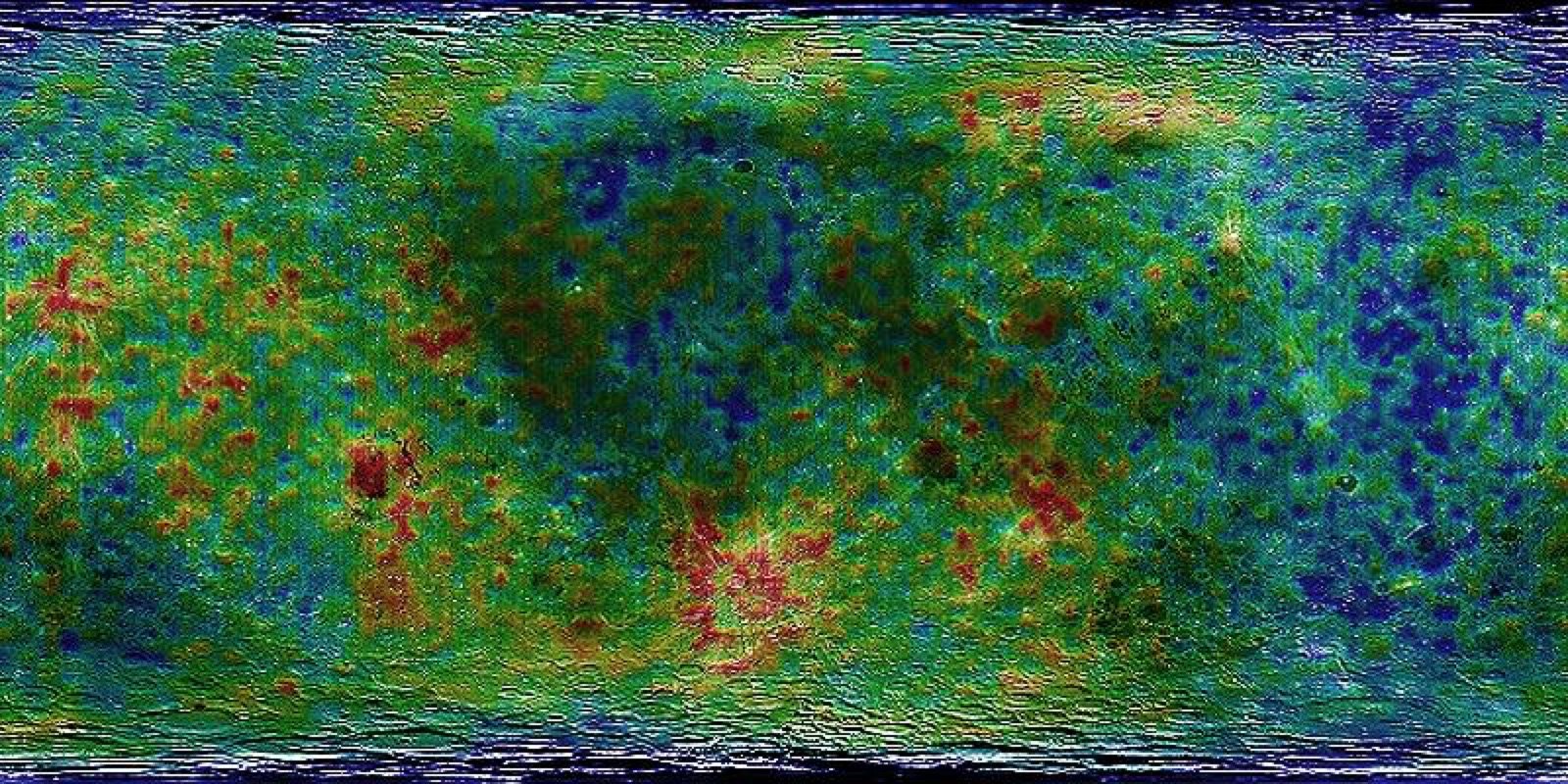
Using a 6-micron wavelength that only molecular water produces, NASA’s flying observatory detects H₂O in Clavius crater, roughly a 12-ounce bottle of water in a cubic metre of soil. The same day a separate study estimates micro cold traps covering about 40,000 km². Both suggest water is more widely available, in tiny amounts.
2018
Ice exposed at both poles Confirmed
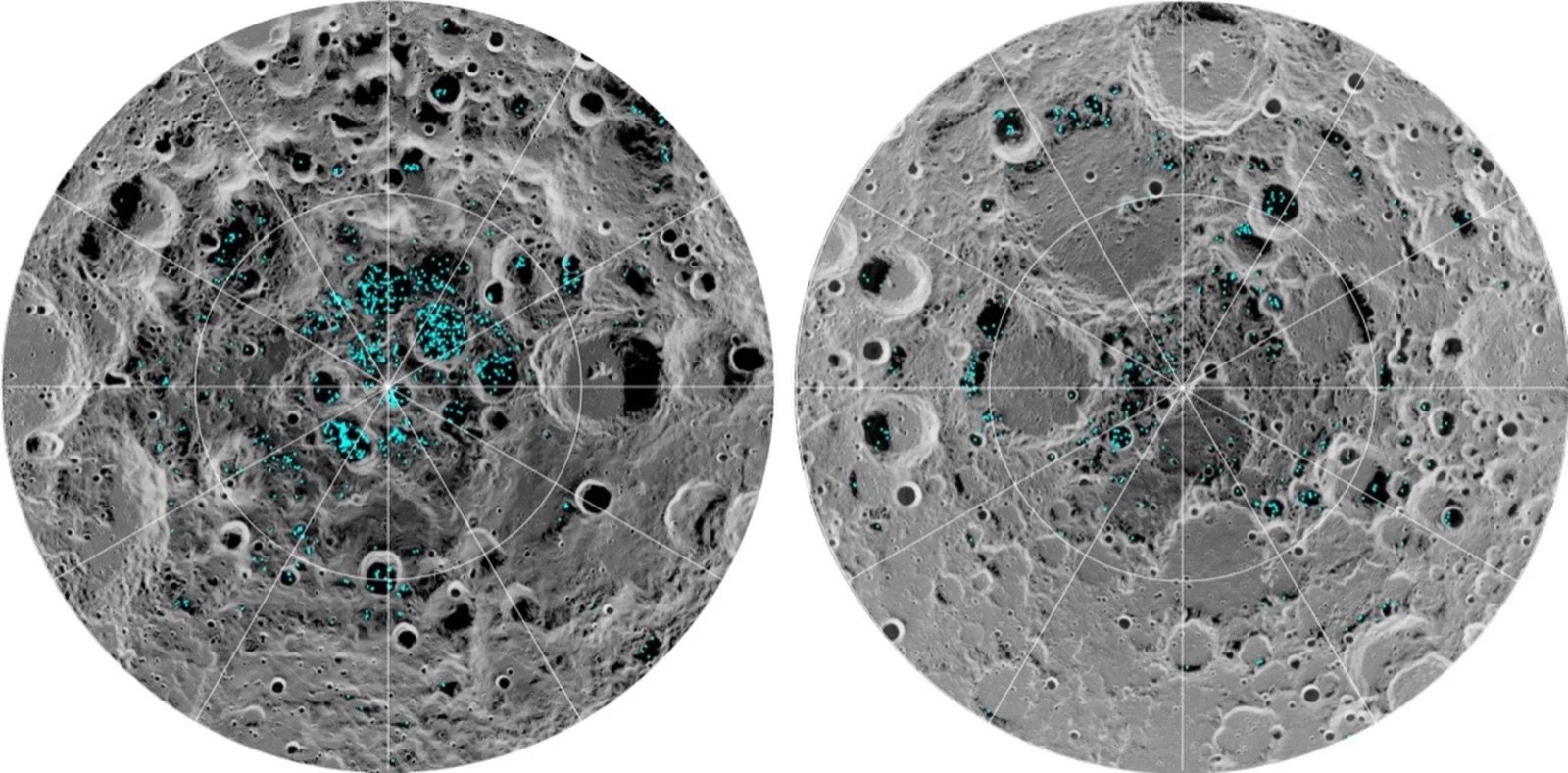
Re-analysing Chandrayaan-1 data, scientists find three infrared signatures that together are diagnostic of solid water ice, in shadowed spots within 20° of the poles. The south pole ice is clustered in craters; the north pole’s is sparser but more widespread. It is the first direct evidence of surface-exposed ice.
2013
Water from inside the Moon Evidence
M³ data from the central peak of Bullialdus, near the lunar equator, show hydroxyl in rock dug up from depth, evidence of magmatic water. Not all lunar water arrived from space.
2010
Radar finds ice-filled craters in the north Evidence
Radar signatures consistent with ice in more than 40 small permanently shadowed craters near the north pole lead to an estimate of at least 600 million tonnes of water ice, depending on its thickness.
2009
LCROSS hits Cabeus crater Confirmed
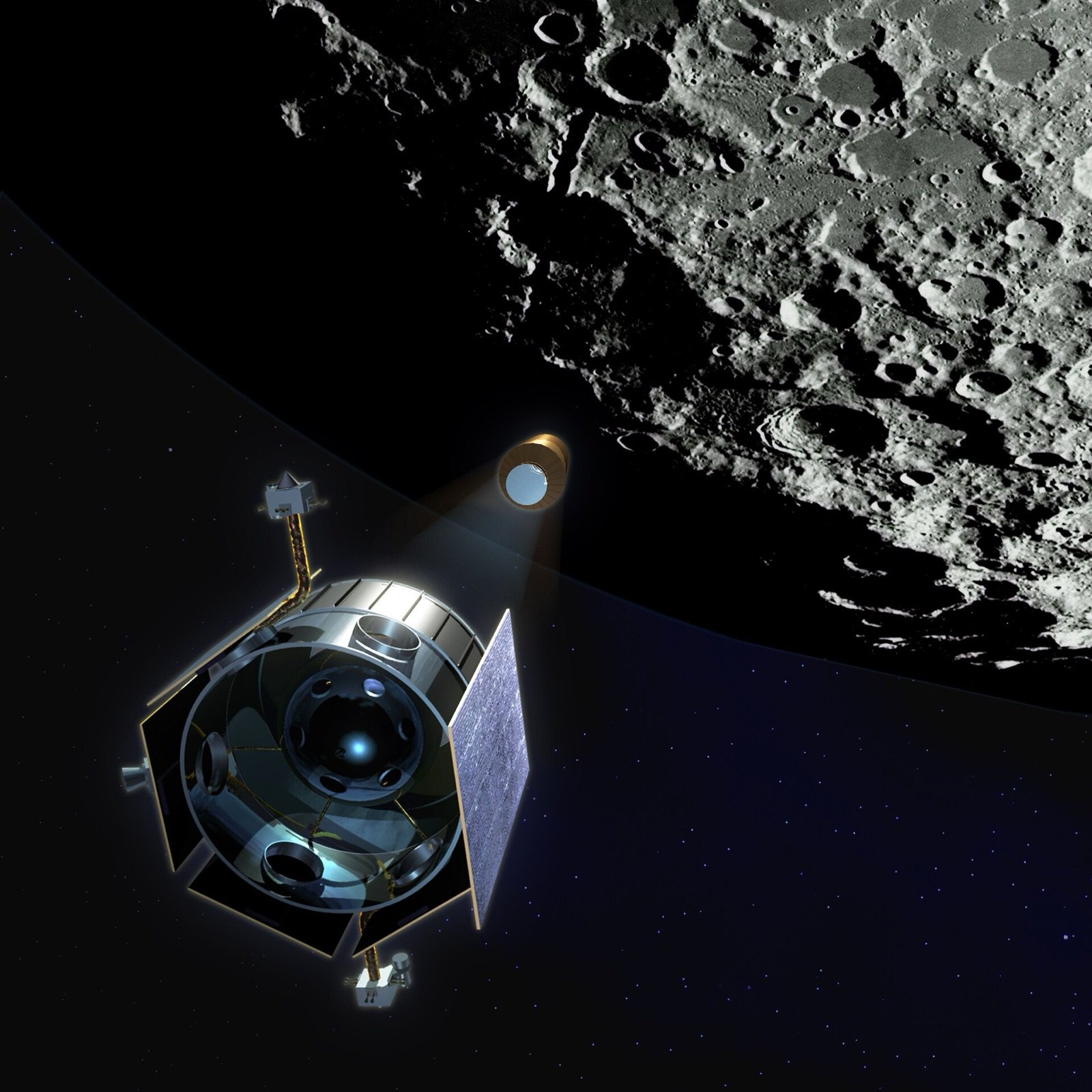
A spent rocket stage strikes a permanently shadowed crater near the south pole. The shepherding spacecraft flies through the debris before crashing itself. Analysis finds up to about 155 kg of water vapour and ice in view and roughly 5.6% (±2.9%) water ice by mass in the soil, plus volatiles such as carbon monoxide, ammonia and hydrogen sulphide.
2009
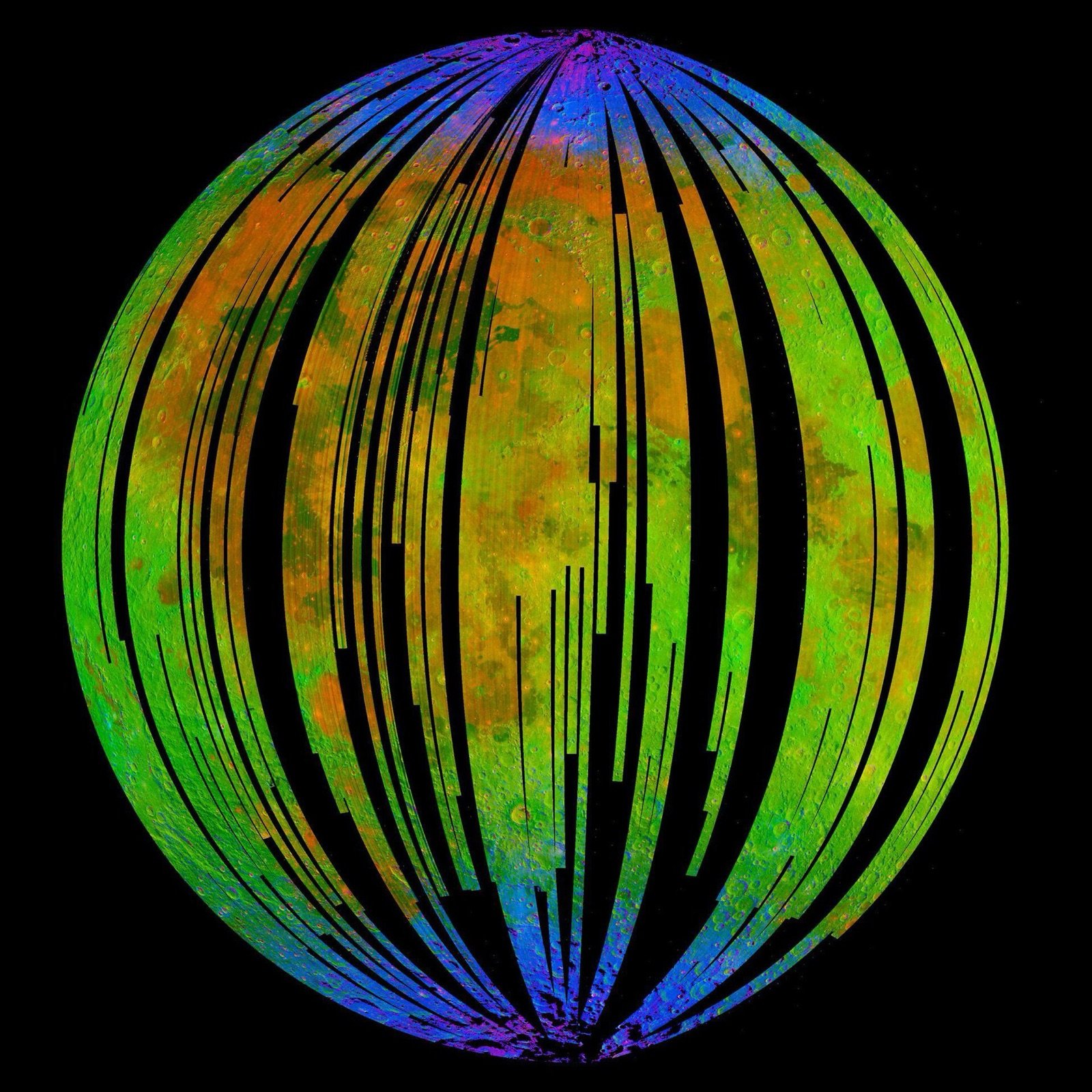
Chandrayaan-1 finds a hydrated Moon Confirmed
NASA’s Moon Mineralogy Mapper on India’s orbiter detects a 3-micron absorption from water and hydroxyl across much of the surface, strongest toward the poles; Cassini and Deep Impact data agree, and Deep Impact shows the signal varies through the day. Chandrayaan-1 had already gone silent on 29 August 2009.
2009
LRO and LCROSS launch together History
The Lunar Reconnaissance Orbiter begins a mission that is still running in 2026: mapping temperatures, terrain, lighting and hydrogen, and photographing every landing site. Its Diviner instrument later measures some of the coldest temperatures in the Solar System inside polar craters.
2008
India launches Chandrayaan-1 History
On 14 November 2008 its Moon Impact Probe dives to the south pole; ISRO later reports that its CHACE instrument sensed water in the thin lunar exosphere during the descent. The orbiter’s M³ and Mini-SAR results define the next two years of lunar water science.
2008
Water found in Apollo glass beads Evidence
A more sensitive ion probe detects water in volcanic glass beads collected nearly four decades earlier, overturning the ‘bone-dry’ view of the lunar interior.
1998
Lunar Prospector sees hydrogen at the poles Evidence
Excess hydrogen at both poles is consistent with water ice mixed into the soil. Hydrogen is not proof of water, and the end-of-mission crash into a shadowed crater produces no plume detectable from Earth, but the poles become the prime target.
1996
Clementine’s radar hint Evidence
A bistatic radar experiment at the south pole returns a signal some scientists read as ice. Others point out that rough terrain can produce the same echo. The debate shows why one technique is never enough.
1972
Apollo brings home a ‘dry’ Moon History
Samples from low and mid-latitudes contain almost no water, and traces that do appear are usually blamed on contamination from Earth. For three decades the Moon is treated as dry.
The cold-trap idea History
Caltech scientists Kenneth Watson, Bruce Murray and Harrison Brown argue that permanently shadowed polar craters should be cold enough to trap water for billions of years. Every polar ice search since starts from this prediction.
Every Mission in the Lunar Water Story
Planned dates are as of 9 October 2026 and may change.
| Mission | Agency | Year | What it did for lunar water | Outcome |
|---|---|---|---|---|
| Clementine | US DoD / NASA | 1994 | Radar echo at south pole | Contested hint |
| Lunar Prospector | NASA | 1998–99 | Polar hydrogen map | Strong clue |
| Chandrayaan-1 | ISRO (+ NASA M³, Mini-SAR) | 2008–09 | Surface hydration; north-pole radar; 2018 ice | Landmark |
| LCROSS | NASA | 2009 | Impact into Cabeus; ice in plume | Confirmed ice |
| LRO | NASA | 2009–now | Temperatures, hydrogen, terrain | Still operating |
| SOFIA | NASA / DLR | 2020–23 | Molecular water in sunlight; map | Confirmed; retired 2022 |
| Chang’e-5 | CNSA | 2020 (paper 2024) | Hydrated mineral in samples | Mineral water |
| Danuri / ShadowCam | KARI / NASA | 2022–now | Images inside shadowed craters | Operating |
| Chandrayaan-3 | ISRO | 2023 | Polar soil temperatures | Indirect, modelled |
| IM-2 / PRIME-1 | Intuitive Machines / NASA | 2025 | First lunar ice drill attempt | Lander tipped |
| Lunar Trailblazer | NASA | 2025 | Water-mapping orbiter | Lost after launch |
| Chang’e-7 | CNSA | 2027 (planned) | Hopper samples shadowed ground | Delayed from Aug 2026 |
| VIPER | NASA / Blue Origin | Late 2027 (planned) | Rover with 1 m drill | Conditional |
Choose your lunar base site
Each south-pole site trades water access against power, temperature and safety. Pick one to see the trade-offs. This is a simplified explainer; real site selection depends on measurements that have not been made yet. No answers are recorded.
Choose an option above
Why the South Pole Matters
Because the Moon’s axis is tilted only about 1.5 degrees, the Sun always skims the horizon at the poles. Deep crater floors stay dark and frigid, while some nearby peaks and rims are lit for much of the year. That pairing of ice and sunlight is why NASA’s Artemis candidate landing regions, China’s Chang’e-7 target on Shackleton’s rim and Chandrayaan-3’s high-latitude landing all cluster in the south.
The terrain is also hard: long shadows confuse cameras, slopes are steep, and radio contact with Earth comes and goes. A site with strong evidence of ice may be much harder to reach than a less promising one, which is why mapping work by LRO, ShadowCam and the 2026 crater-age study feeds directly into where landers go.
Could Lunar Water Support a Moon Base?
Potentially, but every use depends on extraction that has not yet been demonstrated.
Purify before use
Lunar ice is mixed with soil and other volatiles; LCROSS also saw ammonia, carbon monoxide and hydrogen sulphide. It would need extraction, filtering and testing.
Split by electrolysis
Water can be split into oxygen to breathe and hydrogen. That takes steady power, which is scarce in shadowed craters.
Liquid hydrogen and oxygen
Local propellant could cut launch mass from Earth, but mining, processing, liquefying and storing it at scale would be a major industrial project.
A record of the Solar System
Ice layers may preserve water from comets, asteroids and the solar wind over billions of years, a history that mining could destroy if not studied first.
Corrections and Updates to Common Claims
Checked against NASA, ISRO, peer-reviewed papers and reporting up to 9 October 2026.
“VIPER will launch in 2023”
VIPER was cancelled in July 2024 and revived in September 2025. It is now planned for late 2027, conditional on Blue Origin’s first Mark 1 flight.
“Chandrayaan-3 found water ice”
It carried no ice detector. Its temperature data supported a 2025 model suggesting ice could survive under steep pole-facing slopes.
“2009: Chandrayaan-1 detected water ice”
The 2009 M³ signal could not separate water from hydroxyl. Diagnostic evidence of surface ice in M³ data came in 2018.
The 1961 prediction and 2008 Apollo glass
The cold-trap theory set the target decades before spacecraft, and water in Apollo samples was found only in 2008.
“Artemis III will land astronauts in 2027”
Artemis III is now an Earth-orbit lander test. The first Artemis landing is planned on Artemis IV, as early as 2028.
Chang’e-7 and Lunar Trailblazer
China’s south-pole ice mission slipped from August 2026 to 2027; NASA’s water-mapping orbiter was lost in 2025.
The Biggest Unanswered Questions
- How much? Estimates range from traces to hundreds of millions of tonnes, depending on method and area.
- In what form? Surface frost, ice grains mixed into soil, or buried layers each need different mining methods.
- Where from? Comets, asteroids, the solar wind and the interior all likely contributed; the 2026 crater-age study points to slow, steady build-up.
- How deep? The top metre matters most for rovers and drills; seismic methods may help measure it.
- Can it be mined economically? Presence does not prove that extraction beats shipping water from Earth.
What to Watch Next
- Blue Moon Mark 1 pathfinder: its first landing decides whether NASA sends VIPER.
- Chang’e-7 (2027): the first planned hop into a permanently shadowed area.
- Artemis III (2027) and IV (as early as 2028): lander tests, then a crewed south-pole landing.
- LUPEX / Chandrayaan-5: the JAXA–ISRO polar rover planned for around 2028.
- New CLPS deliveries: smaller instruments such as L-CIRiS, planned for late 2027, to map surface temperatures.
Quick Quiz
1. Which crater did LCROSS strike in 2009?
2. Which NASA instrument flew on India’s Chandrayaan-1?
3. What did SOFIA find in 2020?
4. Why was Chang’e-7’s 2026 launch postponed?
5. When is VIPER now planned to land?
Explore More Timelines
People Also Ask
Frequently Asked Questions
From Discovery to Resource
The search for lunar water has moved from prediction to clues, from clues to confirmation, and from confirmation to mapping. India’s Chandrayaan-1 showed the surface is hydrated, LCROSS proved polar craters hold ice, and SOFIA showed traces exist even in sunlight. The years since 2024 have been a reminder of how hard the next step is: one drill landed on its side, one orbiter was lost, one rover was cancelled and revived, and China’s polar mission slipped a year.
The discovery was a scientific breakthrough. Turning the Moon’s water into something astronauts can drink, breathe or burn will be an engineering challenge, and it begins with the first instrument that measures the ice where it lies.
Related AiTimeline Stories
⚠️ Editorial Note
Last updated 9 October 2026. Future mission dates are plans and may change. The page distinguishes water ice, molecular water, hydroxyl and hydrogen signals; it does not claim that Chandrayaan-3 or PRIME-1 confirmed a usable ice deposit. Concentrations come from the cited mission teams and papers and are not directly comparable. Images are NASA/ISRO public-domain releases. Sources are listed below.