Marshall Plan: Rebuilding Post-War Europe with US Aid
Explore the Marshall Plan timeline, from George Marshall's 1947 proposal to $13.3 billion in US aid that helped rebuild Western Europe after World War II.
Latest Story
The Marshall Plan, officially the European Recovery Program, was the US programme that provided roughly $13.3 billion to 16 European countries between 1948 and 1951 to help them recover from the Second World War. Secretary of State George C. Marshall proposed it at Harvard on 5 June 1947; Truman signed it into law on 3 April 1948. The Soviet Union walked out of the Paris talks and the plan became a Western European one. This page dates every milestone, shows where sources disagree, and separates the authorised $17 billion from the $13.3 billion actually provided. For the same period, see AiTimeline’s timelines of the Berlin Airlift, the end of the Bretton Woods gold link and the Soviet collapse.
💡 Short Answer
The Marshall Plan was a four-year US programme, roughly $13.3 billion, mostly grants, that helped 16 European countries buy food, fuel, machinery and raw materials. Marshall proposed it on 5 June 1947, Truman signed it on 3 April 1948, and it wound down around the end of 1951. The Soviet Union refused to take part. Historians still debate how much of Europe’s recovery it explains.
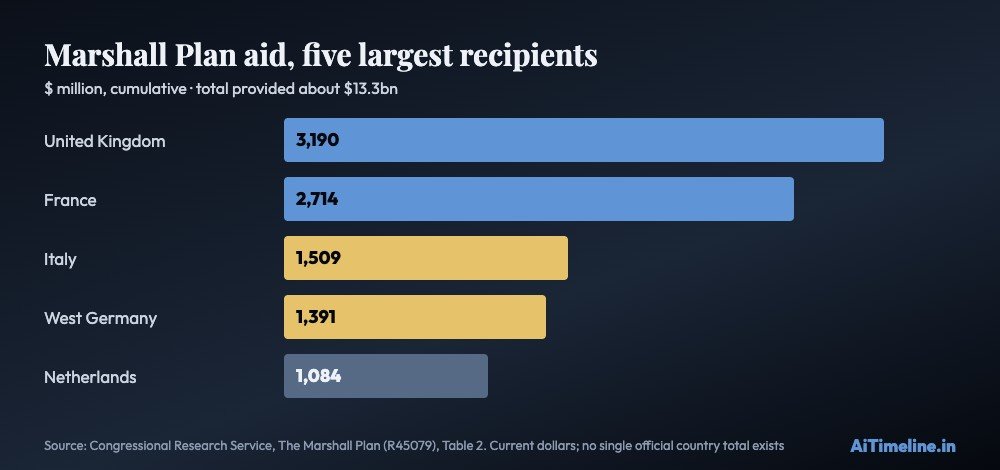
Which Countries Got the Most Marshall Plan Aid?
Last updated: 25 October 2026. Cumulative aid by recipient, current dollars.
| Country | Aid ($ million, CRS) | Share of $13.3bn (AiTimeline calc.) |
|---|---|---|
| United Kingdom | 3,189.8 | 24.0% |
| France | 2,713.6 | 20.4% |
| Italy | 1,508.8 | 11.3% |
| West Germany | 1,390.6 | 10.5% |
| Netherlands | 1,083.5 | 8.1% |
| Top five | 9,886.3 | 74.3% |
How to read the table. The figures are from Table 2 of the Congressional Research Service report (CRS); the percentage column is AiTimeline’s division by the $13.3 billion total. The five largest recipients took about three quarters of the money. Other sources give slightly different shares, because no single official country total exists, and the 16 founding participants are listed in the April 1948 entry below.
Marshall Plan: Key Questions
The Marshall Plan in Ten Points
- Origin: a Harvard speech on 5 June 1947 that asked Europeans to agree their needs together.
- Frame: the Truman Doctrine of 12 March 1947 came first, with $400 million for Greece and Turkey.
- Split: Molotov left Paris on 2 July 1947; the Soviet Union and its allies stayed out.
- Law: Truman signed on 3 April 1948, authorising $17 billion over four years.
- Money: roughly $13.3 billion was actually provided, over 90% as grants.
- Top recipients: UK, France, Italy, West Germany and the Netherlands.
- Institutions: a US agency (ECA) and a European body (OEEC, later the OECD).
- End: around 30–31 December 1951, replaced by the Mutual Security Act.
- Results: industrial output 35% above 1938 by 1951; agriculture only 11% above.
- Corrections: West Germany was not one of the 16 founders, and $17bn was a ceiling.
Marshall Plan Timeline, Latest First
Each entry is tagged and ends with why it matters. Where sources differ on a day, both are shown.
2025
A new “Marshall Plan Initiative” for Ukraine borrows the name Legacy
The German Marshall Fund launched a Marshall Plan Initiative for Ukraine on 9 July 2025, alongside the Ukraine Recovery Conference in Rome. It aims to promote transparent, accountable governance in Ukraine’s recovery and to embed anti-corruption standards in reconstruction (GMF).
The name is a reference, not a programme equivalent. This page found no official 2026 announcement of a new US-funded plan of the 1948 kind, and the 1948 programme’s structure (US grants, European-run needs assessment, counterpart funds) is a model people cite rather than a template anyone has adopted.
1953
George Marshall receives the Nobel Peace Prize in Oslo Legacy
Marshall was awarded the 1953 Nobel Peace Prize, presented on 10 December 1953 at the University of Oslo (Nobel Prize ceremony page). He learned of the award in October 1953 and, in his acceptance remarks, dedicated the honour to the American people. AiTimeline could not open the Nobel citation text, so this page does not quote the stated reason for the prize.
Marshall was a soldier turned diplomat: Army chief of staff in the Second World War, then Secretary of State from January 1947 to January 1949. The prize is usually linked to the recovery programme that carries his name.
1951
The Economic Cooperation Administration ends, six months early Results
The programme was scheduled to run to 30 June 1952, but it wound down about six months earlier (Congressional Research Service). Sources differ on the exact day. The Library of Congress lists 31 December 1951 as the end (LOC chronology); the Truman executive order implementing the Mutual Security Act set 30 December 1951 for the key economic transfers (Executive Order 10300).
The Congressional Research Service puts the total provided at roughly $13.3 billion to 16 countries, more than 90% of it grants rather than loans. Britain’s aid was suspended in December 1950, the first sign of the wind-down.
1951
Truman signs the Mutual Security Act, folding Marshall aid into a defence-first programme Law
President Truman signed the Mutual Security Act on 10 October 1951. It abolished the Economic Cooperation Administration and moved its functions to a new Mutual Security Agency; the Senate agreed 56–21 on 2 October and the House 235–98 on 5 October (Mutual Security Act). The Korean War and the Cold War arms build-up had shifted American priorities from reconstruction to rearmament.
West Germany joins the OEEC Results
The Library of Congress chronology dates the Federal Republic of Germany’s entry into the OEEC to 30 June 1949 (LOC), while a German federal chronicle gives 31 October 1949 (bpb). The two sources do not agree, so this page gives only the year. The western occupation zones had taken part in the recovery effort from the start; the new federal state, founded in May 1949, took over the seat.
West Germany went on to receive about $1.39 billion, fourth among recipients (CRS table).
Currency reform in the western zones starts the German recovery Results
The western German recovery effort began with a currency reform in June 1948, in the same year the aid programme started (Wikipedia: Marshall Plan). Industrial production in Germany returned to pre-war levels by the end of 1949, according to the same source. Aid and currency reform arrived together, which is one reason historians find it hard to credit the recovery to either alone.
1948
Sixteen governments sign the OEEC convention in Paris Origins
The European-run Organisation for European Economic Co-operation was set up in April 1948 to share out requirements and ensure participants met their joint obligations (CRS). The convention is usually dated 16 April 1948 (OECD history); the Library of Congress lists the first official meeting on 15 April (LOC). It later became the OECD, established in 1961.
The sixteen founding participants were Austria, Belgium, Denmark, France, Greece, Iceland, Ireland, Italy, Luxembourg, the Netherlands, Norway, Portugal, Sweden, Switzerland, Turkey and the United Kingdom, with the western zones of Germany represented separately. Spain was not invited (Wikipedia).
1948
Truman signs the Economic Cooperation Act Law
Congress completed passage on 2 April 1948 and Truman signed the Economic Cooperation Act on 3 April 1948 (LOC; RFE/RL). The Act authorised $17 billion over four years and created the Economic Cooperation Administration under businessman Paul G. Hoffman (RFE/RL). Vote tallies in secondary sources conflict, so none are given here.
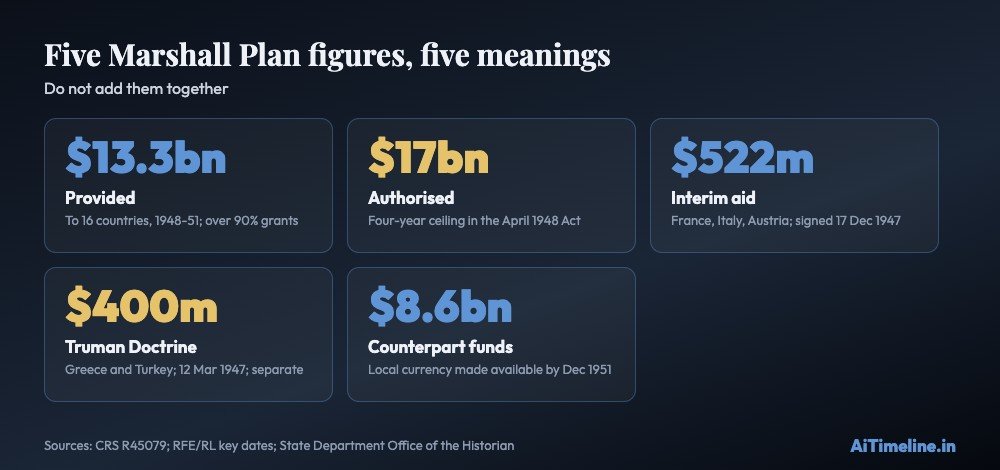
The authorised ceiling is not what was spent: the CRS counts about $13.3 billion actually provided. Each country also matched US grants in its own currency; about $8.6 billion in these counterpart funds had been made available by December 1951 (CRS).
Communist takeover in Czechoslovakia hardens opinion in Washington Cold War
A communist takeover in Czechoslovakia in February 1948 (LOC) reduced opposition in Congress to the aid bill, according to Wikipedia. Czechoslovakia had at first accepted the invitation to the Paris talks in 1947 before withdrawing under Soviet pressure.
1947
Interim aid first, then Truman asks Congress for a four-year plan Proposal
Congress met in emergency session from 17 November and Truman signed $522 million of interim aid for France, Italy and Austria on 17 December 1947. Two days later, on 19 December, he sent Congress a special message proposing a four-year European Recovery Program for 16 Western European countries (RFE/RL key dates).
1947
Sixteen countries deliver their joint report in Paris Proposal
The conference of European Economic Co-operation delivered its final report on needs and four-year costs on 22 September 1947 (RFE/RL). Sources disagree on the headline total, so this page gives no dollar figure for it. What matters is the method: the request came from Europe, as Marshall had asked.
1947
Molotov walks out of Paris and the Soviet Union stays away Cold War
Britain, France and the Soviet foreign minister Molotov met in Paris from 27 June. On 2 July 1947 Molotov ended the talks and refused Soviet participation. Britain and France convened the Conference of European Economic Co-operation on 12 July; the Soviet Union declined and pressed Czechoslovakia, Poland and Hungary to stay away (RFE/RL; LOC).
Every European country was invited except Spain, Andorra, San Marino, Monaco and Liechtenstein (Wikipedia). The Soviet alternative later became known as the Molotov Plan and Comecon.
1947
Marshall speaks at Harvard Proposal
On 5 June 1947 Marshall gave the Harvard commencement address calling for a programme to rebuild Europe (Office of the Historian; National Archives). He asked Europeans to agree their needs together and said the United States would help; he gave no spending figure. Britain and France invited 22 European nations to talks on 19 June (LOC).
1947
The Truman Doctrine sets the frame Origins
Truman asked Congress on 12 March 1947 for $400 million for Greece and Turkey and said it must be the policy of the United States “to support free peoples who are resisting attempted subjugation by armed minorities or by outside pressures” (Office of the Historian). Marshall’s plan followed three months later and is usually read as its economic counterpart.
Europe after the war: shortages, wrecked transport, and a US recovery loan Origins
Cities, transport and farms were damaged, and millions faced shortages of food, fuel and housing. The United States shipped 16.5 million tons of food, mainly wheat, to Europe and Japan between July 1945 and June 1946, and Britain received a $3.75 billion emergency loan; over $14 billion of post-war aid went out before the end of 1947, none of it counted as Marshall Plan money (Wikipedia).
Recovery was uneven. Europe needed foreign exchange, industrial inputs and working trade, not only buildings.
How Did the Marshall Plan Work?
A US agency and a European body, with local money alongside American grants.
1. Europeans set out their needs. Marshall asked for a joint request, and the Paris conference delivered one on 22 September 1947. 2. Congress authorised a ceiling. The April 1948 Act authorised $17 billion over four years. 3. The ECA administered it. The Economic Cooperation Administration under Paul Hoffman approved purchases and monitored use. 4. Governments bought what they needed. The aid supplied food, fuel, machinery and raw materials, mostly as grants. 5. Counterpart funds were created. Each country paid a matching amount of its own currency into a fund for local reconstruction; about $8.6 billion had been made available by December 1951. 6. The OEEC kept the participants accountable to each other and helped nearly double intra-European trade between 1947 and 1951.
The programme operated alongside other measures, so it should not be read as the sole explanation for European recovery.
Five Dollar Figures That Should Not Be Mixed Up
The same story is told in $12bn, $13.3bn and $17bn depending on the source.
| Figure | What it measures | Source |
|---|---|---|
| $13.3 billion | Roughly what was provided to 16 countries, 1948–51; more than 90% grants | CRS |
| $17 billion | Ceiling authorised over four years by the April 1948 Act; not the amount spent | RFE/RL |
| $522 million | Interim aid for France, Italy and Austria signed 17 Dec 1947, covering them to March 1948 | RFE/RL |
| $400 million | Truman Doctrine request for Greece and Turkey, 12 Mar 1947; a separate programme | State Dept |
| $8.6 billion | Counterpart funds made available by Dec 1951: European currency, not US money | CRS |
| Over $14 billion | Post-war aid before the end of 1947, not counted as Marshall Plan money | Wikipedia |
| Over $12 billion | The State Department’s lower round figure for the eventual funding | State Dept |
What Did the Aid Achieve?
Measured outcomes, then the debate.
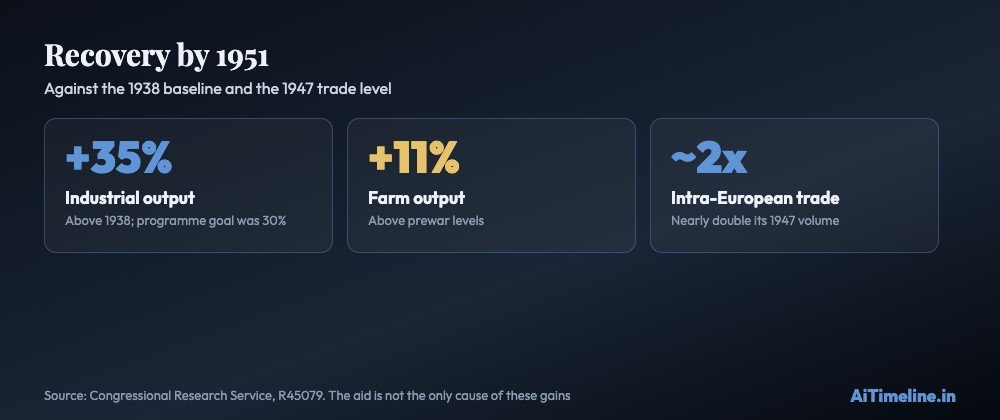
The CRS reports that industrial production by 1951 was 35% above 1938, beating the programme’s 30% goal, while agricultural production was only 11% above prewar levels, and intra-European trade volume was nearly double its 1947 level (CRS). Wikipedia notes every participant’s economy had surpassed pre-war levels by 1952.
Whether the aid caused this is disputed. Many consider it the most effective US foreign aid programme ever, but the CRS also records critics who say it was never more than 5% of recipients’ GNP and was not necessary; Wikipedia cites Milward, Eichengreen and Crafts for different estimates of its effect. West Germany’s June 1948 currency reform, domestic policy and trade recovery all coincided with it.
What Is Settled and What Is Debated, as of 25 October 2026
Kept apart from the timeline because totals, dates and causes are different kinds of evidence.
| Question | Position of the sources | Status |
|---|---|---|
| How much was provided? | Roughly $13.3bn (CRS); other sources say over $12bn or $12.4bn | Settled, with a range |
| When did it end? | 30 Dec 1951 (executive order) or 31 Dec (LOC); scheduled end 30 Jun 1952 | Differs by source |
| Day West Germany joined the OEEC | 30 Jun 1949 (LOC) or 31 Oct 1949 (German chronicle) | Differs by source |
| How much of the recovery was due to the aid? | Historians disagree; Wikipedia cites Milward, Eichengreen and Crafts for different estimates | Debated |
| Congress vote tallies, March–April 1948 | Secondary sources give conflicting counts | Not given here |
| Was the aid necessary? | The CRS says critics question it, while many call it the most effective US aid programme | Debated |
| Reason stated for the 1953 Nobel Prize | Nobel citation text not opened by AiTimeline | Unverified |
The Story at a Glance
Oldest first.
| Date | Event | Type |
|---|---|---|
| 1945–46 | Europe after the war: shortages, wrecked transport, and a US recovery loan | Origins |
| 12 Mar 1947 | The Truman Doctrine sets the frame | Origins |
| 5 Jun 1947 | Marshall speaks at Harvard | Proposal |
| 2–12 Jul 1947 | Molotov walks out of Paris and the Soviet Union stays away | Cold War |
| 22 Sep 1947 | Sixteen countries deliver their joint report in Paris | Proposal |
| 17–19 Dec 1947 | Interim aid first, then Truman asks Congress for a four-year plan | Proposal |
| Feb 1948 | Communist takeover in Czechoslovakia hardens opinion in Washington | Cold War |
| 3 Apr 1948 | Truman signs the Economic Cooperation Act | Law |
| 16 Apr 1948 | Sixteen governments sign the OEEC convention in Paris | Origins |
| Jun 1948 | Currency reform in the western zones starts the German recovery | Results |
| 1949 | West Germany joins the OEEC | Results |
| 10 Oct 1951 | Truman signs the Mutual Security Act, folding Marshall aid into a defence-first programme | Law |
| 30–31 Dec 1951 | The Economic Cooperation Administration ends, six months early | Results |
| 10 Dec 1953 | George Marshall receives the Nobel Peace Prize in Oslo | Legacy |
| 9 Jul 2025 | A new “Marshall Plan Initiative” for Ukraine borrows the name | Legacy |
| Term | Meaning | Why it matters here |
|---|---|---|
| ERP | European Recovery Program, the official name of the Marshall Plan | The label in the 1948 Act |
| ECA | Economic Cooperation Administration, the US agency | Run by Paul G. Hoffman; abolished 1951 |
| OEEC | Organisation for European Economic Co-operation | European-run body; became the OECD in 1961 |
| CEEC | Conference/Committee of European Economic Co-operation (Paris, 1947) | Produced the joint report of 22 Sep 1947 |
| Counterpart funds | Local-currency deposits matching US grants | About $8.6bn by Dec 1951 |
| Mutual Security Act | Law signed 10 Oct 1951 | Replaced the ECA; put defence aid first |
| Molotov Plan | The Soviet alternative for its bloc | Later associated with Comecon |
Who Is Who
George C. Marshall
Gave the Harvard address on 5 June 1947; Secretary of State from January 1947 to January 1949; 1953 Nobel Peace Prize.
Harry S. Truman
Announced the Truman Doctrine on 12 March 1947 and signed the Economic Cooperation Act on 3 April 1948.
Paul G. Hoffman
Businessman who headed the Economic Cooperation Administration from April 1948.
V. M. Molotov
Ended the Paris talks on 2 July 1947 and refused Soviet participation.
Ernest Bevin and Georges Bidault
British and French foreign ministers who invited 22 nations on 19 June 1947.
Robert Marjolin
French economist who headed the European body set up in 1948.
The Popular Story vs the Record
| Popular version | What the record shows |
|---|---|
| The US handed Europe a $13bn cheque | It was a programme of goods, grants (over 90%) and matched local-currency counterpart funds, run through a US agency and a European body |
| The Marshall Plan rebuilt Europe on its own | Aid mattered, but currency reform, domestic policy and trade recovery did too, and economists still disagree on its share |
| The Soviet Union was excluded | The invitation reached Moscow; Molotov left the Paris talks on 2 July 1947 and the Soviet Union declined |
| Germany received the most | The UK was first at about $3.19bn; West Germany was fourth at $1.39bn |
| Sixteen countries including West Germany joined in 1948 | The sixteen founders did not include the Federal Republic, which joined the OEEC in 1949 |
| $17 billion was spent | $17bn was the authorised ceiling; about $13.3bn was provided |
| The Marshall Plan and the Truman Doctrine are the same thing | The Doctrine (12 Mar 1947) asked $400m for Greece and Turkey; the plan came three months later |
Explore More Timelines
People Also Ask
Frequently Asked Questions
Why the Marshall Plan Still Matters
The Marshall Plan combined humanitarian aid, economic strategy and Cold War politics in one programme, and the line between them is why it is still cited. It provided roughly $13.3 billion, gave Europeans the job of agreeing their own needs, and hardened the divide with a Soviet Union that chose not to take part. It did not rebuild Europe alone, and its exact share of the recovery is still argued over. Its name is now shorthand for large, conditional reconstruction aid.
Related AiTimeline Stories
⚠️ Editorial Note
Last updated 25 October 2026. The source brief was corrected and expanded: it counted West Germany among the sixteen participants in 1948, but the Federal Republic joined the OEEC in 1949; it called $13.3 billion the amount “appropriated,” whereas the Act authorised $17 billion and about $13.3 billion was provided; it gave one end date, whereas sources give 30 or 31 December 1951 and a scheduled end of 30 June 1952; and it omitted the Paris conference, Molotov’s walkout, the December 1947 interim aid, the Mutual Security Act, the grant/loan split and counterpart funds. Congress vote counts were left out because sources conflict. Country shares are AiTimeline’s division of CRS totals. The OECD history page and the Nobel citation could not be opened directly, so the OEEC date relies on the OECD page’s standard dating and the prize reason is not quoted. No photographs are used because their licences could not be verified.
Sources & further reading
Every dated entry above was checked against these references. Last reviewed 25 October 2026.
- US National Archives: Marshall Plan (1948), milestone document
- US Department of State, Office of the Historian: The Marshall Plan, 1948
- Library of Congress: Marshall Plan chronology
- National Museum of American Diplomacy: The Marshall Plan
- OECD: History of the Organisation for European Economic Co-operation
- Congressional Research Service: The Marshall Plan (R45079)
- RFE/RL: Key dates in the development of the Marshall Plan
- Office of the Historian: The Truman Doctrine, 1947
- Harry S. Truman Library: Executive Order 10300 (Mutual Security Act)
- Nobel Prize: The Nobel Peace Prize award ceremony 1953