Chauri Chaura Anniversary: How Gandhi’s Non-Cooperation Movement Changed in 1922
Chauri Chaura incident timeline: the 4 February 1922 clash, Gandhi's suspension of non-cooperation on 12 February, and the 1923 trial with 19 hangings.
Latest Story
The Chauri Chaura incident took place on 4 February 1922 in the Gorakhpur district of the United Provinces, now Uttar Pradesh. A procession of nationalist volunteers clashed with police, who fired, and the crowd set the police station on fire; three civilians and between 21 and 23 policemen died, depending on the source. Eight days later, on 12 February, the Congress Working Committee suspended Gandhi’s civil-disobedience plan, and the trial that followed ended in 19 hangings. This page follows the Chauri Chaura incident timeline, flags where the figures differ, and ties the 1923 trial numbers to the record they come from. For related reading, see AiTimeline’s timelines of Gandhi Jayanti, Sardar Patel and the princely states and Netaji Subhas Chandra Bose.
💡 Short Answer
On 4 February 1922 police fired on a crowd at Chauri Chaura, killing three, and the crowd burned the police station, killing the policemen inside (21, 22 or 23 by source). Gandhi announced on 10 February that he would stop civil disobedience, and the Working Committee suspended it on 12 February. The Sessions Court sentenced 170 men to death in January 1923; the High Court confirmed 19, commuted 110, acquitted 38 and convicted 3 of rioting only.
What Happened at Chauri Chaura, and How Many Died?
Last updated: 26 October 2026. Three civilians and 21–23 policemen. The sources differ and are shown side by side.
| Source | Policemen killed | Civilians killed | Note |
|---|---|---|---|
| GandhiServe chronology | 21 “policemen and watchmen” | Not stated | GandhiServe |
| Wikipedia | 22 named; some accounts 23 | 3 (police fire) | Wikipedia |
| Source brief, citing Gorakhpur district administration | 23 | 3 | District page could not be opened by AiTimeline |
| Constable Raghuvir Singh | Counted dead in the FIR, found alive later | — | Sole witness at trial; explains 22 vs 23 |
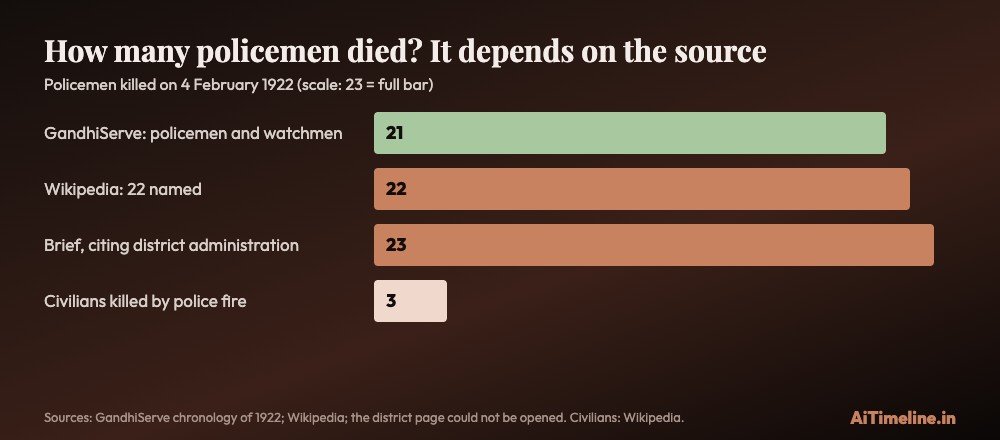
How to read the table. The brief gave 23 policemen and three civilians as the Gorakhpur district administration’s record, and noted that some accounts say 22. AiTimeline could not reach the district page, so 23 is shown as the brief reports it. The 22 and the three civilians come from Wikipedia, and 21 policemen and watchmen from the GandhiServe chronology. The difference is partly explained by Constable Raghuvir Singh, listed dead in the FIR but found alive and later the sole witness at the trial.
Chauri Chaura: Key Questions
Chauri Chaura in Ten Points
- Date: 4 February 1922; suspension on 12 February.
- Toll: three civilians; policemen 21, 22 or 23 by source.
- Trigger: volunteers were beaten and arrested at Gauri Bazaar on 2 February.
- Decision: Gandhi announced it on 10 February, a day before the committee met.
- Penance: a five-day fast from 12 February.
- Dispute: Nehru and others saw the suspension as hasty.
- Arrest: Gandhi, 10 March 1922; sentenced to six years on 18 March.
- Trial: 170 sentenced to death; 19 confirmed; 19 hanged.
- Return: the Salt March in 1930; independence in 1947.
- Unverified: the Hansard and district-administration pages could not be opened.
Chauri Chaura Incident Timeline, Latest First
Each entry is tagged and ends with why it matters.
Centenary
The centenary: a stamp, a year-long programme and a re-reading of the story Memory
On 4 February 2021 Prime Minister Narendra Modi inaugurated the centenary celebrations by video conference and released a commemorative postage stamp (ETV Bharat). The state programme ran from that date until 4 February 2022 across all 75 districts of Uttar Pradesh (The Tribune; Deccan Herald).
The occasion shifted attention from Gandhi’s decision to the local participants and the men who were hanged. AiTimeline found no verified coverage of how the anniversary on 4 February 2026 was marked, so none is described here.
1947
India becomes independent Afterwards
India became independent more than 25 years after the Chauri Chaura incident. The route there ran through non-cooperation, the civil disobedience of 1930 and 1932, the Quit India movement of 1942, revolutionary activity, labour and peasant mobilisation, negotiation and the Second World War. No single event decided it.
Gandhi returns to mass civil disobedience with the Salt March Afterwards
Eight years after the suspension, Gandhi led the Salt March from Sabarmati to Dandi against the British salt tax (Wikipedia). The 1922 pause had not ended mass resistance; the movement came back with new tactics and a different organisation, while Gandhi kept non-violence as the guiding principle.
1923
Nineteen men are hanged Trial
The 19 men whose death sentences the High Court confirmed were hanged between 2 and 11 July 1923 (Wikipedia; Law and Business News). Today a memorial at Chauri Chaura lists their names.
1923
The British Parliament is told the appeal figures Trial
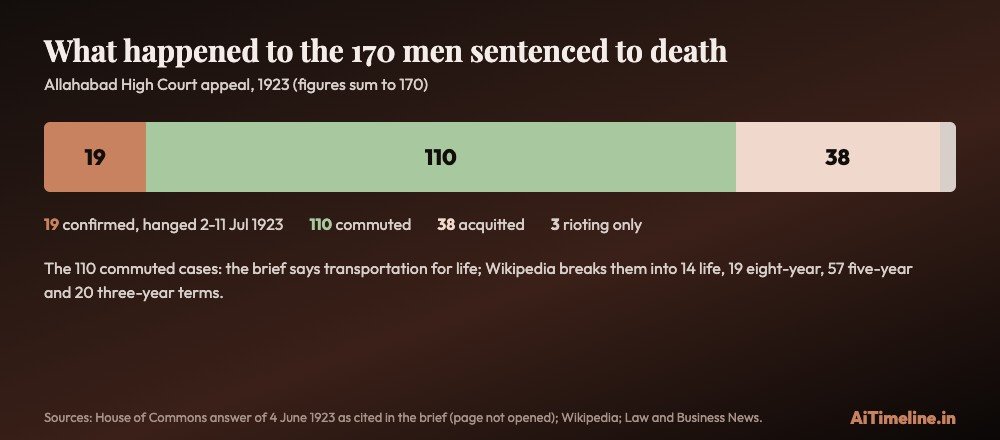
The source brief cites a Commons answer of 4 June 1923 (Hansard) that the High Court dealt with 170 men sentenced to death: 19 sentences confirmed, 110 commuted, 38 acquitted and 3 convicted of rioting only, which adds up to 170. AiTimeline could not open the Hansard page (HTTP 403), so these figures are quoted as given in the brief. They match the High Court breakdown in secondary sources.
1923
Allahabad High Court decides the appeals Trial
Madan Mohan Malaviya argued for the condemned men for four days (Law and Business News). The High Court confirmed 19 death sentences and acquitted 38. Secondary sources break down the 110 commuted cases as 14 life terms, 19 of eight years, 57 of five years and 20 of three years, and the 3 convicted of rioting only received two years (Wikipedia). Sources give 20 or 30 April as the judgment date; AiTimeline uses 30 April, the date in both of them.
1923
Gorakhpur Sessions Court sentences 170 to death Trial
Of about 225 people tried, six died in custody, two received two years, 170 were sentenced to death and 47 were acquitted (Wikipedia). Some accounts say 172 and some say 228 were tried; the sources are inconsistent and AiTimeline uses the figures that agree in two places. The communist leader M. N. Roy called the verdicts “legalised murder” (Roy, 1923).
1922
Gandhi is arrested and sentenced to six years Gandhi
Gandhi was arrested at 10 p.m. on 10 March 1922 and charged with promoting disaffection through his Young India writings. On 18 March the Sessions Court sentenced him to six years (GandhiServe chronology). He was released in February 1924 on health grounds after an operation.
1922
“The Crime of Chauri Chaura” in Young India Gandhi
Gandhi wrote that the killing of the policemen could not be defended by the cause (GandhiServe chronology). Critics, including Congress colleagues in jail, thought a single local outbreak should not halt a national campaign. Jawaharlal Nehru and others described the suspension as hasty; the dispute is still argued by historians.
1922
The Working Committee suspends civil disobedience; Gandhi fasts Gandhi
The Working Committee met at Bardoli on 11 February and on 12 February resolved to suspend civil disobedience in view of Chauri Chaura (GandhiServe chronology; INFLIBNET). The emphasis moved to constructive work: spinning, communal unity and the removal of untouchability (Publications Division). Gandhi began a five-day fast the same day as penance. The AICC adopted the resolutions, with modifications, on 25 February.
1922
Gandhi tells workers at Bardoli he will stop the movement Gandhi
On 8 February Gandhi had sent a confidential circular to Working Committee members asking whether civil disobedience should be suspended. On 10 February, at Bardoli, he told Congress workers he would stop it at once (GandhiServe chronology). The brief dates the announcement to 10 February; the formal resolution followed on 12 February.
1922
Bardoli waits as the news arrives Gandhi
The brief says news reached the leadership between 5 and 7 February. The chronology shows Gandhi still in Bardoli, giving interviews about the district’s fitness for civil disobedience on 5 February; the Government replied to his 1 February letter on 6 February and he issued a rejoinder on 7 February (GandhiServe chronology). The turn came on 8 February with the circular.
1922
The crowd burns the Chauri Chaura police station Incident
A procession of roughly 2,000–2,500 people marched towards the bazaar to picket a liquor shop and protest the treatment of volunteers two days earlier. Warning shots angered the crowd, which threw stones. Sub-Inspector Prithvi Pal ordered fire, which killed three civilians. The police fell back into the station and the crowd set it alight; the men inside died (Wikipedia).
The toll for policemen is disputed: 22 named in Wikipedia, 23 in the brief (attributed to the Gorakhpur district administration, whose page AiTimeline could not reach) and 21 “policemen and watchmen” in GandhiServe. One reason given for 23 is Constable Raghuvir Singh, recorded dead in the FIR but later found alive and the sole witness at trial.
1922
Volunteers are beaten back at Gauri Bazaar Incident
Volunteers led by Bhagwan Ahir, a retired army soldier, protested high food prices and the sale of liquor. Police under Daroga Gupteshwar Singh beat them back and arrested several leaders, who were held at the Chauri Chaura station (Wikipedia). The brief says only that “tensions had been building”; this is the concrete grievance.
1922
Gandhi warns the Viceroy: Bardoli will begin Gandhi
Gandhi wrote that mass civil disobedience would begin at Bardoli unless the Viceroy clearly declared non-interference with non-violent activities (GandhiServe chronology). The Publications Division describes this as a decision taken under pressure from colleagues (Publications Division).
Background
Non-cooperation: boycotts, titles, khadi Background
Born of anger at the Rowlatt Acts, the Jallianwala Bagh massacre and the Khilafat issue, the movement asked Indians to withdraw from colonial institutions through boycotts of selected schools, courts and councils, the return of titles, and the promotion of khadi (Wikipedia). Students, lawyers, merchants, peasants and workers joined, and local grievances shaped how it unfolded.
Why Did Gandhi Withdraw the Non-Cooperation Movement?
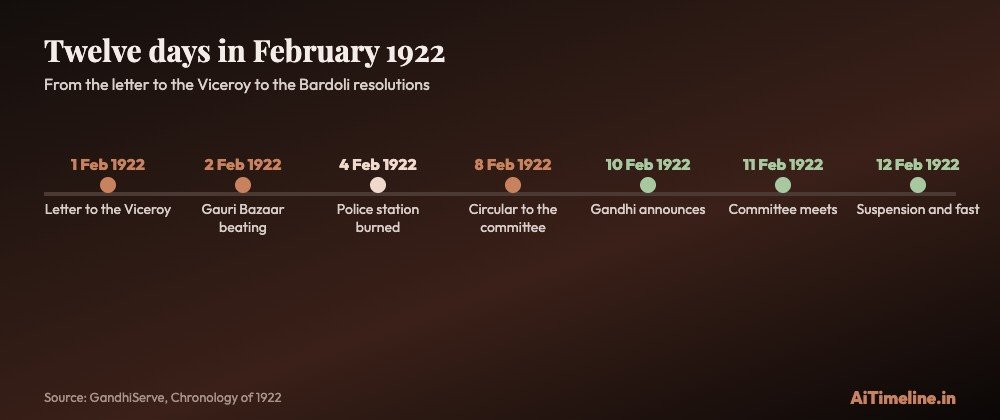
The eleven days between the letter to the Viceroy and the Bardoli resolutions.
| Date (1922) | What happened | Source |
|---|---|---|
| 1 Feb | Gandhi warns the Viceroy that Bardoli civil disobedience will start | GandhiServe |
| 4 Feb | Chauri Chaura police station burned | Wikipedia |
| 8 Feb | Confidential circular to Working Committee on suspending civil disobedience | GandhiServe |
| 10 Feb | Gandhi tells workers at Bardoli he will stop it immediately | GandhiServe |
| 11 Feb | Working Committee meets at Bardoli | INFLIBNET |
| 12 Feb | Committee resolves to suspend; Gandhi begins five-day fast | GandhiServe |
| 16 Feb | “The Crime of Chauri Chaura” in Young India | GandhiServe |
| 25 Feb | AICC adopts the Bardoli resolutions with modifications | GandhiServe |
Gandhi’s reasoning was that non-violence was not a tactic to be used when convenient but the basis of the struggle. He feared that a nationwide civil-disobedience campaign could produce more violence if participants were not prepared to keep discipline. His critics saw it differently: the movement had reached unprecedented numbers, and stopping it would demoralise supporters and let the government recover.
The disagreement had three layers. Strategy: should a national movement continue after a local outbreak of violence? Leadership: how far is a leader responsible for participants’ actions? Principle: can non-violence remain a firm condition under colonial repression? Historians still give different answers.
What Happened in the Chauri Chaura Trial?
From the Sessions Court to the gallows, 1923.
| Stage | Date | Outcome | Source |
|---|---|---|---|
| Gorakhpur Sessions Court (Judge H. E. Holmes) | 9 Jan 1923 | About 225 tried: 170 sentenced to death, 47 acquitted, 6 died in custody, 2 got two years | Wikipedia |
| Allahabad High Court appeal (Malaviya for the defence) | 30 Apr 1923 | 19 death sentences confirmed; 110 commuted; 38 acquitted; 3 rioting only | Law and Business News, Wikipedia |
| House of Commons written answer | 4 Jun 1923 | Same four figures: 19 + 110 + 38 + 3 = 170 | Cited in the brief; Hansard page not opened (403) |
| Executions | 2–11 Jul 1923 | 19 men hanged | Wikipedia |
Two accounts of the 110. The brief describes the 110 commuted men as sentenced to transportation for life, later reduced in specified cases. Wikipedia’s breakdown of the High Court judgment puts 14 at life imprisonment, 19 at eight years, 57 at five and 20 at three years, which also adds up to 110. The two do not match, and AiTimeline does not choose between them. What they share is 19 confirmed, 38 acquitted and a total of 170.
The trial belongs to the Chauri Chaura story as much as Gandhi’s decision does. It was a local tragedy followed by an extensive prosecution, and the people who bore its consequences were villagers of the district.
Why Is Chauri Chaura Historically Significant?
A debate about method, not a turning point that decided the outcome.
Chauri Chaura matters because it forced a question the Congress had avoided: whether a mass movement can stay non-violent once it is mass. Supporters of Gandhi’s decision argue it protected the moral authority of the struggle. Critics argue it squandered a moment of mobilisation and disappointed participants; some add that the movement’s momentum had already begun to change before February 1922.
Later campaigns, from the Salt March of 1930 to independence on 15 August 1947, show the freedom struggle continued in a different form. Its memory has also changed: from the incident that ended non-cooperation to a story of local mobilisation, colonial repression and cost, marked in the 2021–22 centenary programme.
What Is Settled and What Is Open, as of 26 October 2026
Kept apart from the timeline because figures from different sources are different kinds of evidence.
| Question | Position of the sources | Status |
|---|---|---|
| Date of the incident | 4 February 1922 in every source | Settled |
| Date of suspension | 10 Feb announced; 11 Feb committee met; 12 Feb resolved | Settled |
| Civilian deaths | Three, killed by police fire (Wikipedia; brief) | Settled, two sources |
| Police deaths | 21, 22 or 23 depending on source | Disputed |
| Sessions Court death sentences | 170 in most sources; 172 in some | Mostly settled |
| High Court outcome | 19 confirmed and 38 acquitted agree; the 110 commuted are described as life terms in the brief, a mix of terms in secondary sources | Partly open |
| The Hansard record of 4 June 1923 | Cited in the brief; AiTimeline could not open the page | Not independently opened |
| Gorakhpur district administration figures | Page unreachable from AiTimeline; used only as the brief attributes it | Unverified |
| How the 4 February 2026 anniversary was marked | No coverage found | Not given |
The Story at a Glance
Oldest first.
| Date | Event | Type |
|---|---|---|
| 1920–21 Background | Non-cooperation: boycotts, titles, khadi | Background |
| 1 Feb 1922 | Gandhi warns the Viceroy: Bardoli will begin | Gandhi |
| 2 Feb 1922 | Volunteers are beaten back at Gauri Bazaar | Incident |
| 4 Feb 1922 | The crowd burns the Chauri Chaura police station | Incident |
| 5–9 Feb 1922 | Bardoli waits as the news arrives | Gandhi |
| 10 Feb 1922 | Gandhi tells workers at Bardoli he will stop the movement | Gandhi |
| 12 Feb 1922 | The Working Committee suspends civil disobedience; Gandhi fasts | Gandhi |
| 16 Feb 1922 | “The Crime of Chauri Chaura” in Young India | Gandhi |
| 10 Mar 1922 | Gandhi is arrested and sentenced to six years | Gandhi |
| 9 Jan 1923 | Gorakhpur Sessions Court sentences 170 to death | Trial |
| 30 Apr 1923 | Allahabad High Court decides the appeals | Trial |
| 4 Jun 1923 | The British Parliament is told the appeal figures | Trial |
| 2–11 Jul 1923 | Nineteen men are hanged | Trial |
| 1930 | Gandhi returns to mass civil disobedience with the Salt March | Afterwards |
| 15 Aug 1947 | India becomes independent | Afterwards |
| 2021 Centenary | The centenary: a stamp, a year-long programme and a re-reading of the story | Memory |
| Term | Meaning | Why it matters here |
|---|---|---|
| Non-Cooperation Movement | A 1920 campaign to withdraw cooperation from colonial institutions | The movement Gandhi suspended |
| Bardoli | A taluk in Gujarat chosen for mass civil disobedience | Where the 1922 plan was cancelled |
| Civil disobedience | Open, non-violent breach of unjust law, including refusing taxes | The next phase planned for February 1922 |
| Satyagraha | Gandhi’s method of truth-force and non-violent resistance | The principle he said had been violated |
| Constructive programme | Spinning, communal unity, ending untouchability | What Congress concentrated on after 12 Feb |
| Sessions Court | The trial court that heard the case at Gorakhpur | Sentenced 170 to death |
Who Is Who
Mahatma Gandhi
Wrote to the Viceroy on 1 February, announced suspension on 10 February, fasted for five days from 12 February and was arrested on 10 March 1922.
Madan Mohan Malaviya
Appeared for the condemned men in the Allahabad High Court and argued for four days.
Bhagwan Ahir
Retired soldier who led the volunteers beaten at Gauri Bazaar on 2 February.
Gupteshwar Singh and Prithvi Pal
The Daroga and the Sub-Inspector named in accounts of the 4 February firing.
H. E. Holmes
Presided over the Gorakhpur Sessions Court that sentenced 170 to death on 9 January 1923.
Jawaharlal Nehru
In jail at the time; described in accounts as seeing the suspension as hasty.
Common Claims vs the Record
| Common claim | What the record shows |
|---|---|
| Gandhi stopped the whole freedom movement | He suspended the mass civil-disobedience phase; he returned to it in 1930 |
| The mob killed 23 policemen, full stop | The toll is 21, 22 or 23 by source; three civilians also died |
| Gandhi was arrested for Chauri Chaura | He was arrested on 10 March 1922 for sedition over his Young India writings |
| Chauri Chaura was the last time Gandhi led a mass movement | He launched the Salt March in 1930 |
| Gandhi decided only after the Congress voted | He announced it on 10 February, a day before the committee met |
| 170 men were hanged | 170 were sentenced to death; 19 were hanged |
Explore More Timelines
People Also Ask
Frequently Asked Questions
A Local Confrontation With National Consequences
On 4 February 1922 a confrontation killed civilians and policemen. Eight days later Gandhi and the Congress leadership suspended the mass campaign. The decision divided nationalists: for Gandhi non-violence was inseparable from freedom; for critics it sacrificed momentum. Remembering Chauri Chaura means remembering that debate, and also those who died and the 19 who were hanged.
Related AiTimeline Stories
⚠️ Editorial Note
Last updated 26 October 2026. The source brief was checked against the sources it cites and others. Corrections and additions: the brief’s 5–7 February entry was replaced with the dated sequence from the GandhiServe chronology (circular on 8 February, announcement on 10 February); the 23-policeman figure is attributed to the district administration as the brief reports it, but the page could not be opened, and 21 and 22 are also shown; the brief’s description of the 110 commuted sentences as life terms conflicts with a breakdown in secondary sources, and both are shown; the 4 June 1923 Hansard page returned HTTP 403, so its figures are quoted from the brief. The brief omitted the 2 February beating, the 9 January 1923 Sessions Court verdict, the 1 February letter to the Viceroy, Malaviya’s defence and the dates of the hangings; these were added. No verified coverage of the 4 February 2026 anniversary was found. No photographs of the people or the site are used.
Sources & further reading
Every dated entry above was checked against these references. Last reviewed 26 October 2026.
- Wikipedia: Chauri Chaura incident
- GandhiServe: Chronology of 1922
- Law and Business News: Famous trials from the British era, the Chauri Chaura case
- UK Parliament, Hansard: India, 4 June 1923 (cited in the brief)
- Publications Division, Government of India: Khilafat and Non-Cooperation Movement
- INFLIBNET: Non-Cooperation Movement
- Gorakhpur District Administration: Shaheed Smarak, Chauri Chaura
- The Indian Express: When the violence of Chauri Chaura prompted Gandhi to suspend non-cooperation
- ETV Bharat: PM Modi inaugurates Chauri Chaura centenary celebrations
- M. N. Roy: Legalised murder, 1923