Israel Election 2026: Polling, Results and Government Formation
Israel election 2026 live: final polls, past Knesset results, the main parties and how President Herzog and the Knesset will form the next government.
Latest Story
Israel’s 2026 election is being held today, 27 October 2026, the first general election since the Hamas-led attack of 7 October 2023. Voters choose party lists for the 120-seat Knesset, not a prime minister, and a government needs the confidence of the Knesset, which in practice means a coalition near 61 seats. The final pre-election polls put Gadi Eisenkot’s Yashar ahead of Benjamin Netanyahu’s Likud, but gave neither bloc a majority, so smaller parties, Arab-led lists and the 3.25% threshold could decide who governs. This page separates pre-election polls, exit polls, official results and coalition talks, and will be updated at each stage.
Last updated: 27 October 2026, 4 p.m. Israel time (polls open). Voting is under way and closes at 10 p.m. Israel time (1:30 a.m. IST on 28 October). Turnout was 31.5% by noon.
- Exit polls: not yet published. They will be added here after polls close, clearly labelled as estimates.
- Official results: not yet available. The Central Elections Committee is due to confirm them on 4 November 2026; this page will link the official results table once it is published.
- Government formation: President Herzog’s consultations begin only after official results.
💡 Short Answer
Israel votes on 27 October 2026 for a 120-seat Knesset. The last polls before the blackout, on 23 and 24 October, gave the anti-Netanyahu “change bloc” 52 to 56 seats and Netanyahu’s coalition 50, with Arab-led lists on 14 to 16: no side reached 61. Exit polls come at 10 p.m.; official results are due on 4 November. President Isaac Herzog then consults the parties and tasks one member with forming a government, who has up to 42 days.
Final Pre-Election Polls: Neither Bloc at 61
Pre-election estimates, not results. These figures will stay labelled as polls until verified results are available.
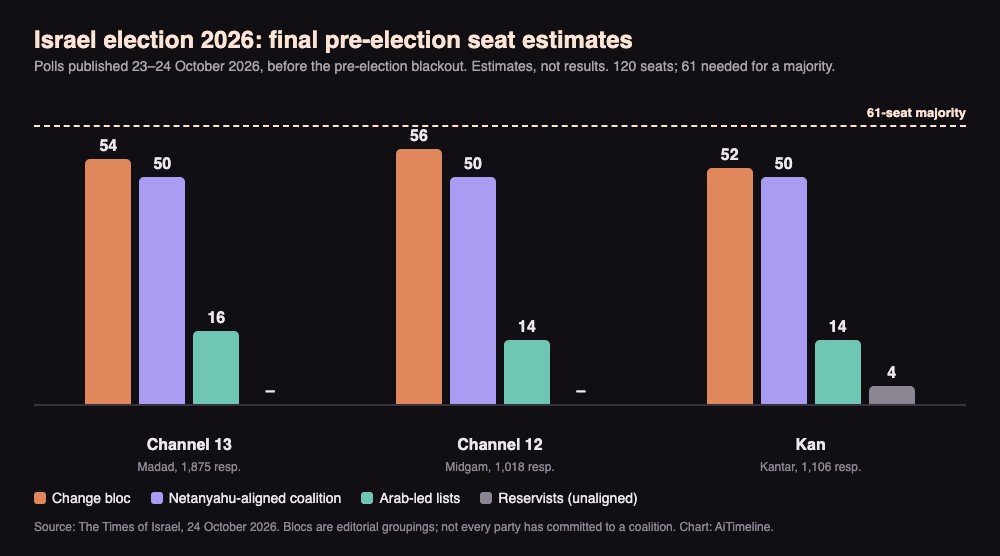
| Pre-election survey (not a result) | Change bloc | Netanyahu-aligned coalition | Arab-led lists | Unaligned | Yashar | Likud | Together |
|---|---|---|---|---|---|---|---|
| Channel 13 (Madad, 1,875 resp., ±2.3) | 54 | 50 | 16 | — | 22 | 19 | 14 |
| Channel 12 (Midgam, 1,018 resp., ±4.4) | 56 | 50 | 14 | — | 23 | 21 | 15 |
| Kan (Kantar, 1,106 resp., ±3.0) | 52 | 50 | 14 | 4 (Reservists) | 22 | 20 | 14 |
| Majority | 61 | 61 | — | — |
Party by party, the three surveys agreed on the order at the top: Yashar first, Likud second, Together third. The bloc labels are editorial groupings used by Israeli media; Yisrael Beiteinu and the Arab-led lists, in particular, have not committed to any coalition (The Times of Israel).
| List | Channel 13 | Channel 12 | Kan | Bloc |
|---|---|---|---|---|
| Yashar (Gadi Eisenkot) | 22 | 23 | 22 | Change |
| Likud (Benjamin Netanyahu) | 19 | 21 | 20 | Coalition |
| Together / B’Yachad (Naftali Bennett, with Yair Lapid) | 14 | 15 | 14 | Change |
| The Democrats (Yair Golan) | 10 | 10 | 8 | Change |
| Joint List | 9 | 9 | 9 | Arab-led |
| Yisrael Beiteinu (Avigdor Lieberman) | 8 | 8 | 8 | Change |
| Otzma Yehudit (Itamar Ben-Gvir) | 8 | 8 | 8 | Coalition |
| United Torah Judaism | 8 | 7 | 8 | Coalition |
| Religious Zionism (Bezalel Smotrich) | 8 | 6 | 7 | Coalition |
| Shas | 7 | 8 | 7 | Coalition |
| Ra’am | 7 | 5 | 5 | Arab-led |
| Reservists (Yoaz Hendel) | Below | Below | 4 | Unaligned |
| Amcha Yisrael (Ofer Winter) | Below | Below | Below | — |
Israel Election 2026: Key Questions
The Election in Nine Points
- Date: 27 October 2026, the first general election since 7 October 2023.
- System: 120 seats, one nationwide constituency, 3.25% threshold.
- Final polls: change bloc 52-56, coalition 50, Arab-led lists 14-16.
- Leader in polls: Eisenkot’s Yashar, ahead of Netanyahu’s Likud.
- New alliance: Bennett and Lapid run together as Together (B’Yachad).
- Threshold risk: Amcha Yisrael and the Reservists polled near 3.25%.
- Results: exit polls at 10 p.m.; official confirmation due 4 November.
- Mandate: Herzog tasks a member within 7 days of official results.
- Deadline: 28 days for a coalition, plus up to 14 more.
Israel Election 2026 Timeline, Latest First
From today’s vote back to the first Knesset election in 1949. Each entry is tagged and ends with why it matters.
2026
Israelis vote for the 26th Knesset Live
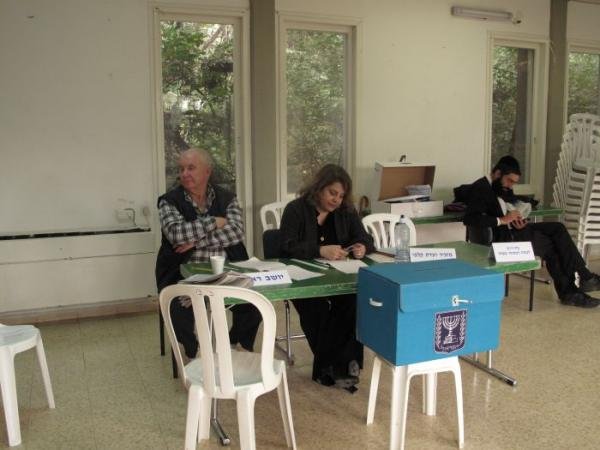
Voting is under way. About 7.3 million Israelis are eligible to vote, and polls close at 10 p.m. Israel time, when exit polls are due on six television channels (Jewish Insider). The Central Elections Committee put turnout at 31.5% by noon, which reports called the highest at that hour in decades (Israel National News). Thirty-eight lists are on the ballot (Wikipedia summary).
This is the first general election since the Hamas-led attack of 7 October 2023. Voters choose party lists for the 120-seat Knesset, not a prime minister. No exit poll or result is included on this page yet.
2026
Final polls: neither bloc reaches 61 Pre-election poll
The last three mainstream surveys all put Gadi Eisenkot’s Yashar first, with 22 or 23 seats, ahead of Likud on 19 to 21. Channel 12 gave the change bloc 56 seats and the coalition 50; Channel 13 gave 54 and 50; Kan gave 52 and 50. Arab-led lists had 14 to 16, and Kan alone put Yoaz Hendel’s Reservists in the Knesset, with 4 (The Times of Israel; Ynet).
Ofer Winter’s Amcha Yisrael fell just under the 3.25% threshold in all three. These are pollsters’ estimates, with margins of error of 2.3 to 4.4 points, not results.
2026
Supreme Court restores the Joint List Campaign
The Central Elections Committee barred the Joint List from running on 23 September 2026; the Supreme Court overturned that decision on 2 October, so the list is on the ballot. The Joint List has a surplus-vote agreement with Ra’am (Wikipedia summary).
2026
Knesset dissolves; election set for 27 October Election process
The 25th Knesset voted in its final readings to dissolve itself, with no votes against, confirming 27 October as election day; the coalition had agreed the date on 12 July. Before the vote the coalition passed a law keeping compulsory military service for men at 32 months (JNS). Netanyahu’s coalition became the first Israeli government in decades to serve a full four-year term.
2026
Dissolution bill passes a preliminary reading Election process
The Knesset backed a bill to dissolve itself in a preliminary reading by 110 votes to 0, after ultra-Orthodox parties withdrew support from Netanyahu over the stalled military-draft exemption law (Israel Hayom). A first reading in June left the date open, but elections had to be held by 27 October in any case.
2026
Bennett and Lapid form ‘Together’ Campaign
Former prime ministers Naftali Bennett and Yair Lapid announced a joint list, Together (B’Yachad), led by Bennett and including Lapid’s Yesh Atid (JNS; Israel Democracy Institute). Yesh Atid therefore does not run separately in 2026.
2025
Gadi Eisenkot launches Yashar Campaign
Eisenkot, who had served in Benny Gantz’s party and resigned from the Knesset in June 2025, founded the centrist Yashar (“straight” or “upright”) (Jewish Virtual Library). By the final week of the campaign it led every mainstream poll.
Ultra-Orthodox parties quit over the draft law Campaign
Both United Torah Judaism factions resigned from the coalition over stalled conscription legislation, and Shas withdrew its ministers soon after (Wikipedia summary). A 2024 Supreme Court ruling had ended blanket exemptions for yeshiva students (European Parliament Research Service).
2024
Gantz and Eisenkot leave the emergency government Campaign
Benny Gantz and Gadi Eisenkot, who had joined an emergency government and war cabinet after the 7 October attack, quit it in June 2024 (Wikipedia summary).
2023
Hamas-led attack reshapes politics Campaign
The Hamas-led attack on southern Israel became the backdrop to the 2026 campaign. Opposition parties call for an independent state commission of inquiry; the government has favoured a panel it would appoint, with narrower powers (European Parliament Research Service).
2023
Judicial overhaul announced Campaign
Justice Minister Yariv Levin unveiled plans to curb the Supreme Court’s powers, setting off mass protests through 2023 (European Parliament Research Service). Netanyahu’s corruption trial, which he denies, continued alongside.
2022
Netanyahu returns with 64 seats Past election
Likud won 32 seats and formed a coalition of right-wing and religious parties with 64 of 120 seats, Israel’s fifth election in under four years (Wikipedia: 2022 election).
2021
Knesset elects Isaac Herzog president Past election
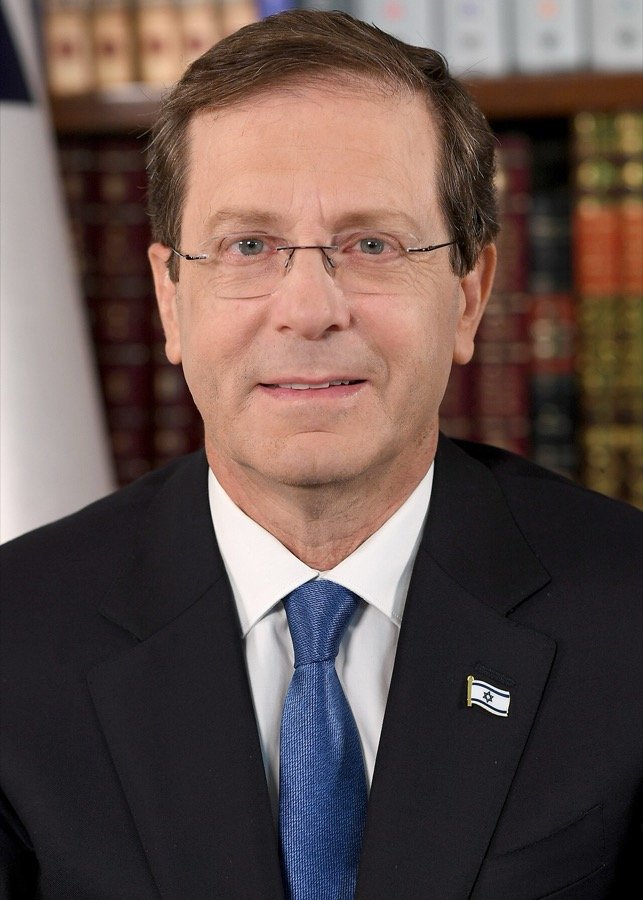
The Knesset elected Isaac Herzog, a former Labour leader, as Israel’s 11th president for a single seven-year term (Wikipedia: 2021 presidential election).
2021
Largest party, but out of power Past election
Likud finished first with 30 seats but could not form a government. Eight parties, including the Arab-led Ra’am, then formed a coalition led first by Naftali Bennett and, from July 2022, by Yair Lapid (Wikipedia: 2021 election).
2020
A third election, then a unity deal Past election
Likud won 36 seats to Blue and White’s 33. After weeks of deadlock during the Covid-19 outbreak, Netanyahu and Benny Gantz formed a rotation government (Wikipedia: 2020 election).
2019
Two elections, no government Past election
Likud and Blue and White tied on 35 seats in April. No government was formed, and in September Blue and White won 33 to Likud’s 32 (Wikipedia: April 2019 election).
1996
Israel’s first direct vote for prime minister Past election
Voters cast separate ballots for prime minister and Knesset, and Netanyahu narrowly beat Shimon Peres. The split ballot weakened large parties and was abandoned after the 2001 vote (Wikipedia: 1996 election).
1949
The first election Past election
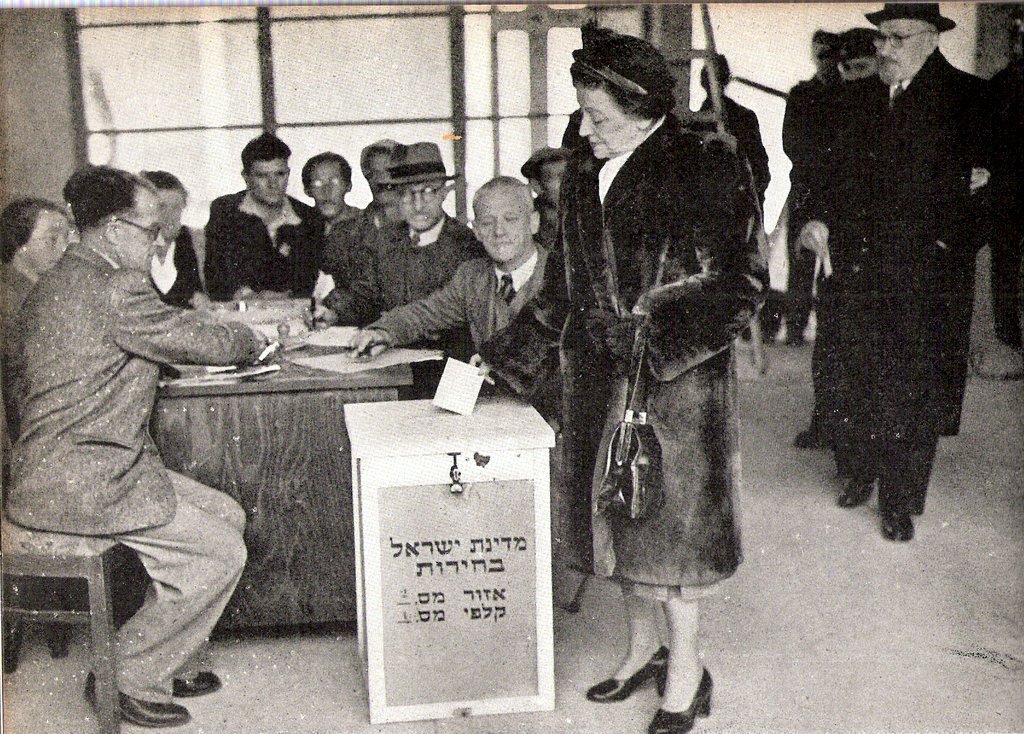
Israel elected a 120-member Constituent Assembly, which became the First Knesset, using nationwide proportional representation (Wikipedia: 1949 election).
Past Results: Coming First Is Not the Same as Governing
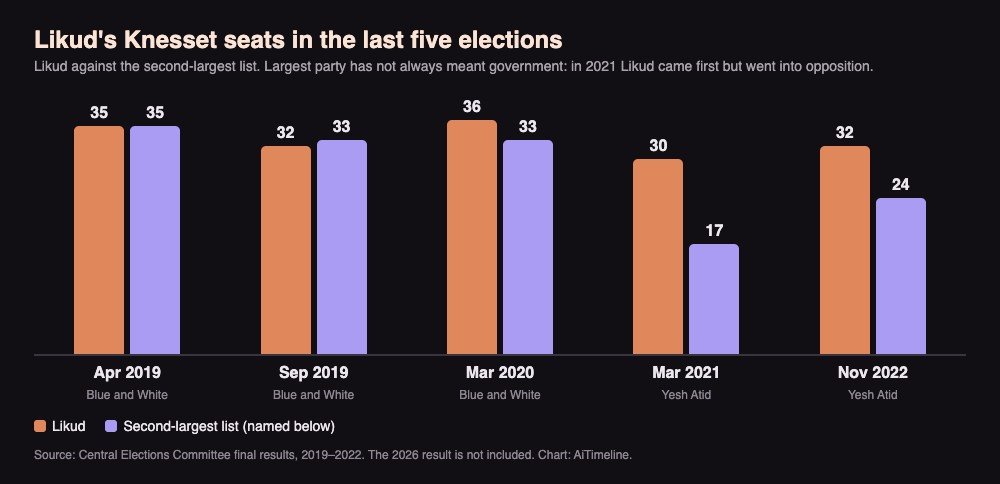
Five elections between 2019 and 2022, from official results.
| Election | Largest list (seats) | Runner-up (seats) | Government that followed |
|---|---|---|---|
| 9 Apr 2019 | Likud 35 / Blue and White 35 (tie) | — | None; repeat election |
| 17 Sep 2019 | Blue and White 33 | Likud 32 | None; repeat election |
| 2 Mar 2020 | Likud 36 | Blue and White 33 | Netanyahu-Gantz rotation, May 2020 |
| 23 Mar 2021 | Likud 30 | Yesh Atid 17 | Bennett-Lapid, 13 Jun 2021 (Likud in opposition) |
| 1 Nov 2022 | Likud 32 | Yesh Atid 24 | Netanyahu, 64 seats, 29 Dec 2022 |
| 27 Oct 2026 | Pending | Pending | Pending |
How Israel’s Election System Works
1. Voters choose a party list. The whole country is a single constituency. Each voter picks one list; there are no local seats and no separate vote for prime minister.
2. Lists must cross 3.25%. A list below the threshold wins no seats, and its votes are effectively lost to its bloc. That is why parties polling near four seats matter so much.
3. Seats are shared proportionally. The 120 seats go to qualifying lists according to their vote share, with surplus-vote agreements between pairs of lists deciding some of the last seats.
4. Parties negotiate a coalition. No party has won a majority alone in Israel’s history, so a government rests on a coalition agreement and a Knesset confidence vote (Basic Law: The Government).
What Happens After Polls Close
Six steps, each with its own legal clock.
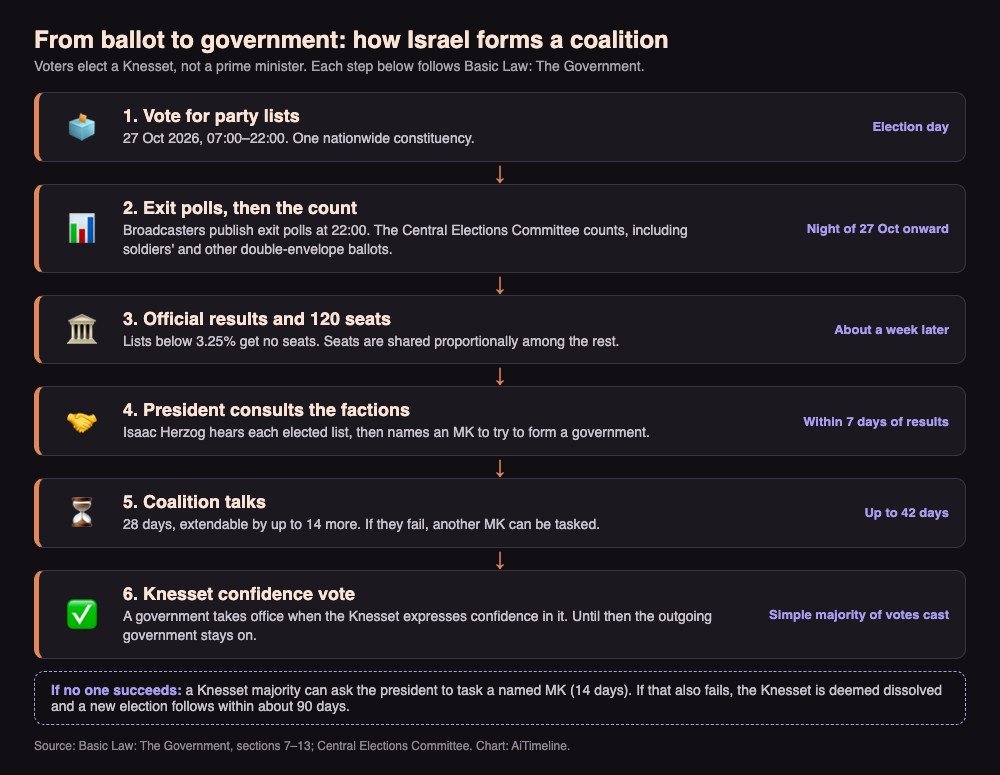
Exit polls are published by broadcasters at 10 p.m. They are estimates and can differ from the count, particularly for lists near the threshold. The count by the Central Elections Committee continues into the next day, when soldiers’ and other double-envelope ballots are added. Official results are due to be confirmed on 4 November.
Within seven days of the official results, the president consults every elected list and tasks one member with forming a government. That member has 28 days, extendable by up to 14. If they fail, the president can task another member, or a majority of the Knesset can ask him to name a specific member, who then gets 14 days. If no government emerges, the Knesset is deemed dissolved and a new election is held. The new government takes office once the Knesset votes confidence in it; until then the outgoing government stays in place (Basic Law: The Government, sections 7-13; Knesset).
What Role Does Israel’s President Play?
President Isaac Herzog is head of state; the prime minister heads the government. Herzog is not on the ballot: the Knesset elected him on 2 June 2021 for a single seven-year term (Wikipedia). His role after the election is procedural but consequential. He must consult the elected lists and give the first mandate to the member he judges best placed to win the Knesset’s confidence, usually the one recommended by the most members. He does not choose the government himself, and any government still needs the Knesset’s vote.
The Main Political Players
Benjamin Netanyahu
Israel’s longest-serving prime minister; leads the outgoing coalition and remains in office as caretaker until a new government is sworn in.
Gadi Eisenkot
Former IDF chief of staff; launched Yashar on 16 September 2025. It led all three final mainstream polls.
Naftali Bennett
Prime minister 2021-22; heads the joint list formed with Yair Lapid on 26 April 2026.
Yair Lapid
Prime minister in 2022; his Yesh Atid runs inside Together rather than as a separate list.
Yair Golan
Centre-left leader; his party polled 8 to 10 seats.
Avigdor Lieberman
Secular right-wing former Netanyahu ally, now a critic; polled 8 seats in each final survey.
Ra’am and the Joint List
Polled 14 to 16 seats together. Ra’am sat in the 2021 government; the Joint List was reinstated by the Supreme Court on 2 October.
Isaac Herzog
Head of state since 7 July 2021. Not on the ballot; he tasks a Knesset member with forming the government.
Explore More Timelines
People Also Ask
Frequently Asked Questions
The Vote Is Only the First Stage
Today’s vote decides the shape of the 26th Knesset. Who governs depends on what comes next: exit polls tonight, the verified count, official results on 4 November, President Herzog’s consultations and as many as 42 days of coalition bargaining. The question to watch is not only who wins the most seats, but who can assemble 61.
Related AiTimeline Stories
⚠️ Editorial Note
Live page, last updated 27 October 2026, 4 p.m. Israel time (polls open). Poll figures are pre-election estimates and are labelled as such; no exit poll or official result had been published at the time of writing. Bloc groupings are editorial. The source brief was corrected on several points: Yair Lapid’s Yesh Atid is not a separate list in 2026 but runs inside Bennett’s Together, formed on 26 April 2026; the 20 May 2026 vote was only a preliminary reading, and the Knesset formally dissolved on 17 July 2026; official results are scheduled for 4 November. The Reuters and Associated Press links in the brief could not be opened from our location, so the facts they were cited for are sourced to other reports. Israeli-government pages on the Knesset site were geo-blocked; the government-formation rules are cited to the published text of Basic Law: The Government. AiTimeline has no timelines yet on Netanyahu, Israel’s presidents or the 2022 election; related stories are linked instead.
Sources & further reading
Every dated entry above was checked against these references. Last reviewed 27 October 2026.
- The Times of Israel: Final polls before election show both blocs short of majority (24 October 2026)
- Ynet: Final Israel election polls put Eisenkot's Yashar ahead of Likud (23 October 2026)
- European Parliament Research Service: Israel's 2026 legislative election (October 2026)
- Jewish Insider: What to watch on Israel's Election Day (27 October 2026)
- JNS: Knesset votes to dissolve, formally sets 27 October election date (17 July 2026)
- Israel Hayom: Knesset dissolution vote set to kick off election countdown (20 May 2026)
- JNS: Bennett, Lapid unite ahead of 2026 elections (April 2026)
- Basic Law: The Government (2001), sections 7-13, via Jewish Virtual Library
- Central Elections Committee for the Knesset (official results)
- Wikipedia: 2026 Israeli legislative election