Manipur Violence: Timeline of Ethnic Conflict in India
What began as a protest over Scheduled Tribe status in May 2023 escalated into a devastating ethnic conflict in Manipur. More than three years later
Latest Story
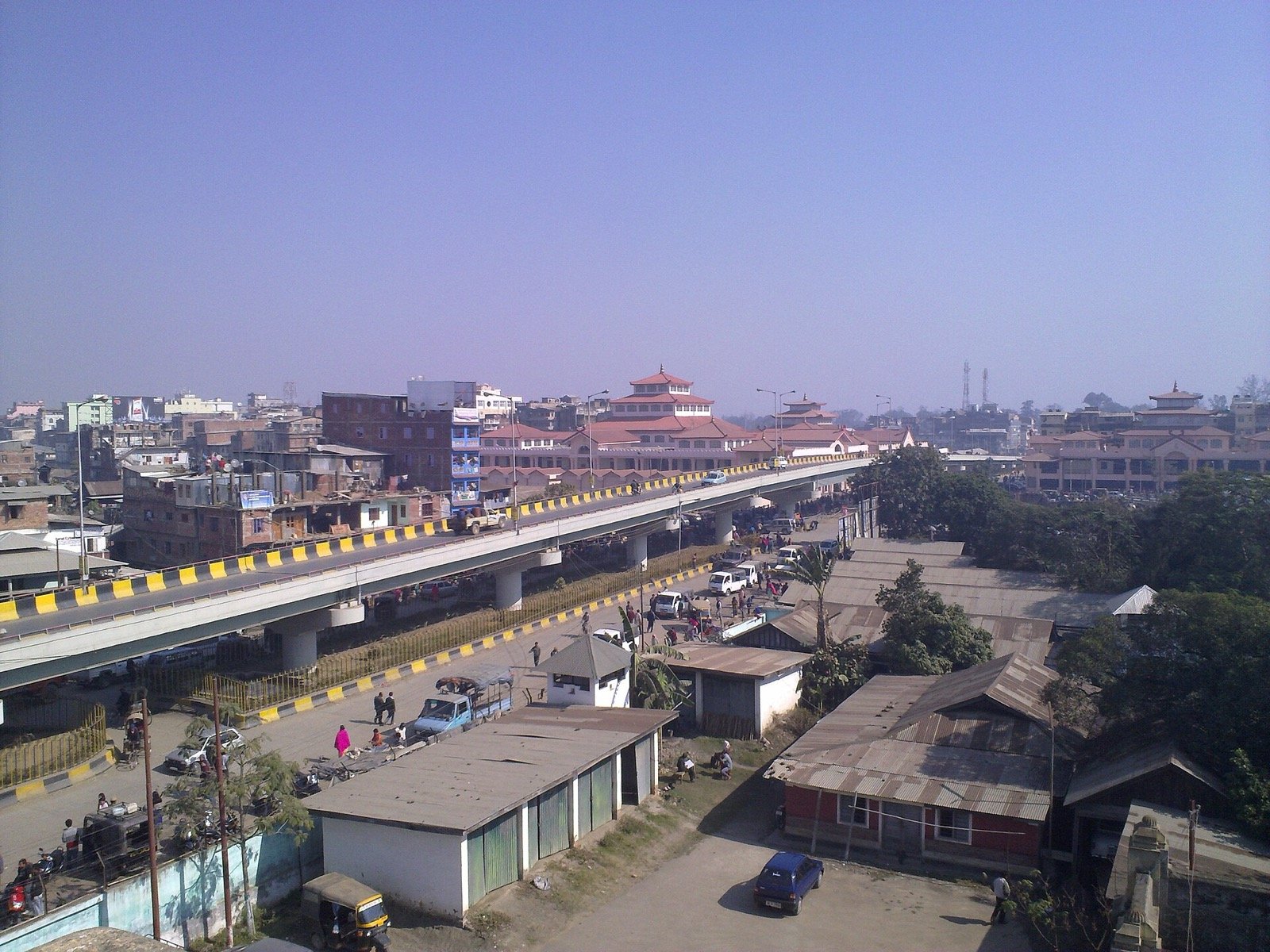
This Manipur violence timeline traces the ethnic conflict that began on 3 May 2023 between the Meitei community of the Imphal Valley and the Kuki-Zo communities of the surrounding hills. The immediate trigger was a protest against a court direction on Scheduled Tribe status for Meiteis; the deeper causes lie in land, representation, identity and security. By 31 August 2026 the state government counted 306 people killed and 49 missing. The crisis brought President’s Rule from February 2025 to February 2026, and in 2026 a separate Naga–Kuki-Zo conflict flared in the hills. As of 29 October 2026, the official inquiry had not reported.
Inquiry: the Commission of Inquiry’s deadline is 20 November 2026. No submission of its report had been reported as of 29 October 2026.
- Official toll: 306 killed and 49 missing since 3 May 2023, as of 31 August 2026 (ThePrint, PTI).
- Latest attack: three Meitei villagers killed on 19 October 2026 (Reuters).
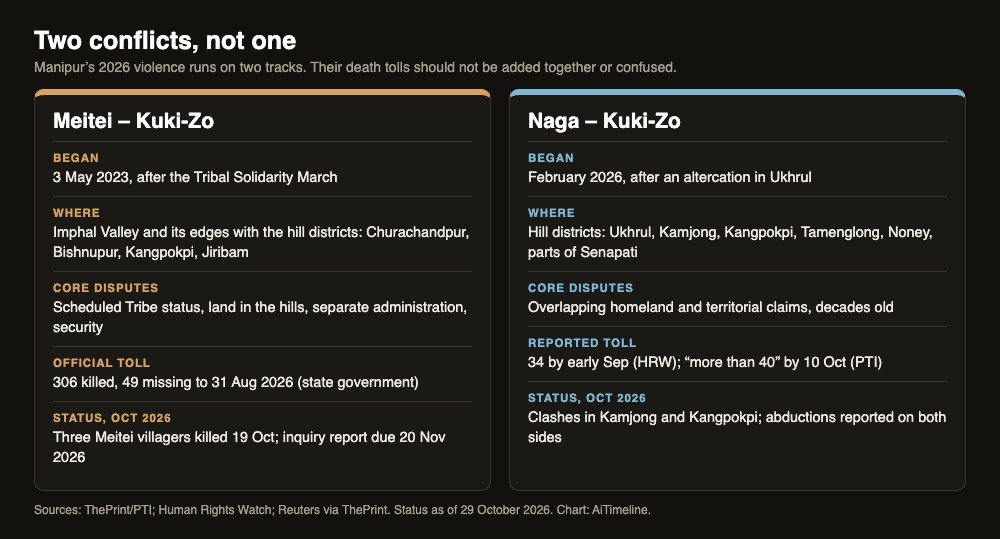
- Second conflict: Naga–Kuki-Zo clashes in the hill districts since February 2026, counted separately.
- Next update: after the 20 November deadline, or earlier if the report is submitted or the deadline is extended again.
💡 Short Answer
Manipur’s ethnic violence began on 3 May 2023 after a tribal march against Scheduled Tribe status for Meiteis. Clashes between Meiteis and Kuki-Zo communities killed 306 people, with 49 missing, by 31 August 2026, and displaced more than 60,000. Chief Minister N. Biren Singh resigned in February 2025 and President’s Rule followed until 4 February 2026. Attacks continued in 2026, including on 19 October. A Commission of Inquiry is due to report by 20 November 2026.
Manipur Violence: Key Questions
The Manipur Violence in Nine Points
- Trigger: a 27 March 2023 High Court direction on ST status for Meiteis, and the 3 May march against it.
- Parties: Meiteis in the Imphal Valley and Kuki-Zo communities in the hills.
- Toll: 306 killed and 49 missing by 31 August 2026, per the state government.
- Displacement: more than 60,000 people.
- Courts: the Supreme Court intervened from May 2023 and moved CBI trials to Guwahati.
- ST order: the contested paragraph was deleted on 21 February 2024.
- Politics: President’s Rule from 13 February 2025 to 4 February 2026.
- 2026: new attacks in the valley’s fringes and a separate Naga–Kuki-Zo conflict in the hills.
- Still open: the inquiry report, due 20 November 2026, and the first trial verdicts.
⚠️ Two conflicts, kept separate
The Meitei–Kuki-Zo conflict that began in May 2023 and the Naga–Kuki-Zo clashes that began in February 2026 are related to Manipur’s wider tensions, but they are not the same conflict. Their death tolls are reported separately and should not be added together. Allegations of responsibility are labelled as allegations unless a court has ruled.
Manipur Violence Timeline: Key Events, Latest First
From the inquiry deadline in 2026 back to the High Court order of March 2023. Each entry is tagged and ends with why it matters.
2026
Inquiry deadline three weeks away; no report yet Pending
The Commission of Inquiry into the 2023 violence must report to the Centre “not later than” 20 November 2026 (gazette notification). As of 29 October 2026, no submission of its report had been reported, and no further extension had been announced. Human Rights Watch noted in September that the panel had not yet reported (HRW).
The commission’s findings should not be presumed. It examines causes, the sequence of events and possible lapses by authorities; it does not try individuals, which is the job of the criminal courts. This entry will be updated after 20 November.
2026
Ceasefire pact with Kuki-Zo groups confirmed lapsed Government
The tripartite Suspension of Operations pact between the Centre, the state and Kuki-Zo armed groups, renegotiated for a year on 4 September 2025, expired on 4 September 2026. State Home Minister Govindas Konthoujam said on 23 October that it had not been renewed (SATP analysis via Eurasia Review; Organiser).
On the same day police searched the Sinai designated camp in Kangpokpi district. Of 18 people found there, only one was verified as a registered cadre; the other 17 were detained for questioning (Siasat). Meitei and Naga civil-society groups have sought the pact’s abrogation; Kuki-Zo groups say camp weapons are regularly inspected and accounted for.
2026
Three Meitei villagers killed while collecting firewood Violence
Gunmen fired on a group of Meitei villagers cutting and carrying firewood, killing three and injuring four, police told Reuters (Reuters via ThePrint). Protesters placed two of the bodies outside the Chief Minister’s residence in Imphal. Chief Minister Y. Khemchand Singh held a security review.
Meitei groups blamed Kuki militants; Kuki groups denied it. Police arrested three suspected Kuki militants in Imphal West on 20 October and said the arrests were linked to the killings (Eurasia Review). The arrests are not a finding of guilt. On 20 October a Kuki civilian was shot dead while collecting bamboo shoots in Kangpokpi district; village bodies blamed Naga armed groups, which was not independently verified.
2026
Naga–Kuki-Zo clashes spread in Kamjong and Ukhrul Violence
A 42-year-old woman, a mother of five, was shot dead in Chassad village in Kamjong district, setting off clashes in which a 22-year-old man was killed and ten houses were torched. A motorist was shot dead near Chepu Yaolen in Ukhrul. PTI reported that more than 40 people had been killed since the Naga–Kuki-Zo violence began in February 2026 (PTI via ThePrint).
2026
State tells Assembly: 306 killed, 49 missing Government
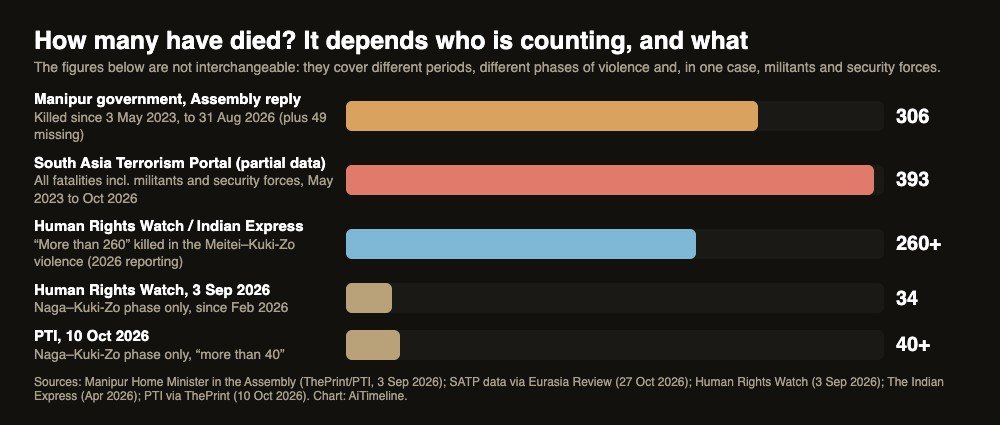
Answering a question in the Assembly, Home Minister Govindas Konthoujam said: “Since the violence started on May 3, 2023, 306 people have died, and 49 people are still missing as of August 31, 2026” (ThePrint, PTI).
This is the most recent official cumulative figure. It is higher than the “more than 260” that many reports still use, and lower than independent tallies that include militants and security personnel.
HRW reports renewed Naga–Kuki-Zo violence Violence
Human Rights Watch reported at least seven people killed in late August and 34 deaths since the current Naga–Kuki-Zo violence began in February (HRW). It traced the escalation to an altercation in Ukhrul in February and to the killing of three Kuki church leaders after a May meeting with Naga pastors. In May, armed groups on both sides reportedly abducted 48 people; six Naga hostages were found dead a day after 14 Kuki hostages were released.
2026
Inquiry commission deadline extended to 20 November Inquiry
The Home Ministry issued a gazette notification giving the commission until 20 November 2026 (gazette PDF; The Indian Express). Justice Ajai Lamba, the original chairman, had resigned in February 2026; former Supreme Court judge Justice Balbir Singh Chauhan took over from 1 March 2026. The members remain retired IAS officer Himanshu Shekhar Das and retired IPS officer Aloka Prabhakar.
2026
Two children killed in their home in Bishnupur; protests turn deadly Violence
A projectile struck a family’s home while they slept, killing two children; The Indian Express reported them as a four-year-old boy and his newborn sister, while other reports gave their ages as five years and five months. Their mother was critically injured (The Indian Express). In the protests that followed, officials said two civilians were killed when a crowd tried to storm a CRPF camp at Gelmol; later reports put the protest toll at three (Scroll).
Residents blamed Kuki militants firing from the hills; Kuki organisations denied it. The National Investigation Agency took over the case. Responsibility had not been established by a court as of October 2026.
2026
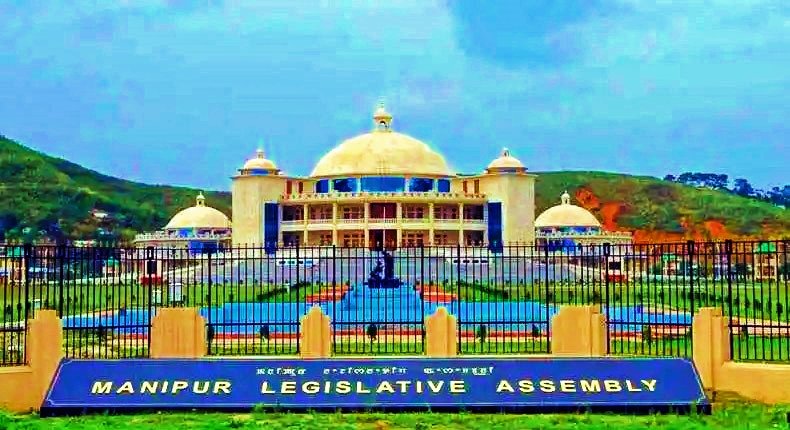
President’s Rule revoked; Y. Khemchand Singh becomes Chief Minister Government
President’s Rule ended after almost a year, and a BJP-led government under Yumnam Khemchand Singh was sworn in the same day (ThePrint). The Assembly’s term runs to 2027. For how central rule works and how courts have reviewed it, see the Uttarakhand President’s Rule case of 2016.
2026
First trial begins: charges framed in the B Phainom case Court
The Special CBI Court framed charges against six men in the case of three women who were paraded naked and sexually assaulted at B Phainom village, Kangpokpi district, on 4 May 2023; the father and brother of one of the women were murdered (The Indian Express). Charges include murder, gang rape, rape during communal or sectarian violence and offences under the SC/ST (Prevention of Atrocities) Act. All six pleaded not guilty.
It was the first CBI-investigated case from the violence to reach trial. A video of two of the women surfaced in July 2023. The court also noted that three people named by the victims had not been charged.
2025
President’s Rule imposed after Biren Singh resigns Government
Chief Minister N. Biren Singh resigned on 9 February 2025, after nearly two years of criticism over the handling of the violence. President’s Rule was imposed on 13 February and the Assembly placed in suspended animation rather than dissolved.
2024
Jiribam: ten killed in a clash, six Meitei hostages found dead Violence
Police said ten armed men were killed after attacking a CRPF camp and a police station at Borobekra on 11 November. Kuki-Zo groups disputed that they were militants, calling them village volunteers. The same day six members of a Meitei family, three women and three children, were abducted. Their bodies were recovered from rivers from 15 November (Deccan Herald), setting off protests in Imphal. The NIA took over the cases.
2024
High Court deletes its contested ST direction Court
On a review petition, the High Court deleted paragraph 17(iii) of its March 2023 order, which had directed the state to consider including Meiteis in the Scheduled Tribe list (LiveLaw). The judge cited the Supreme Court’s ruling in State of Maharashtra v. Milind that courts cannot alter the ST list.
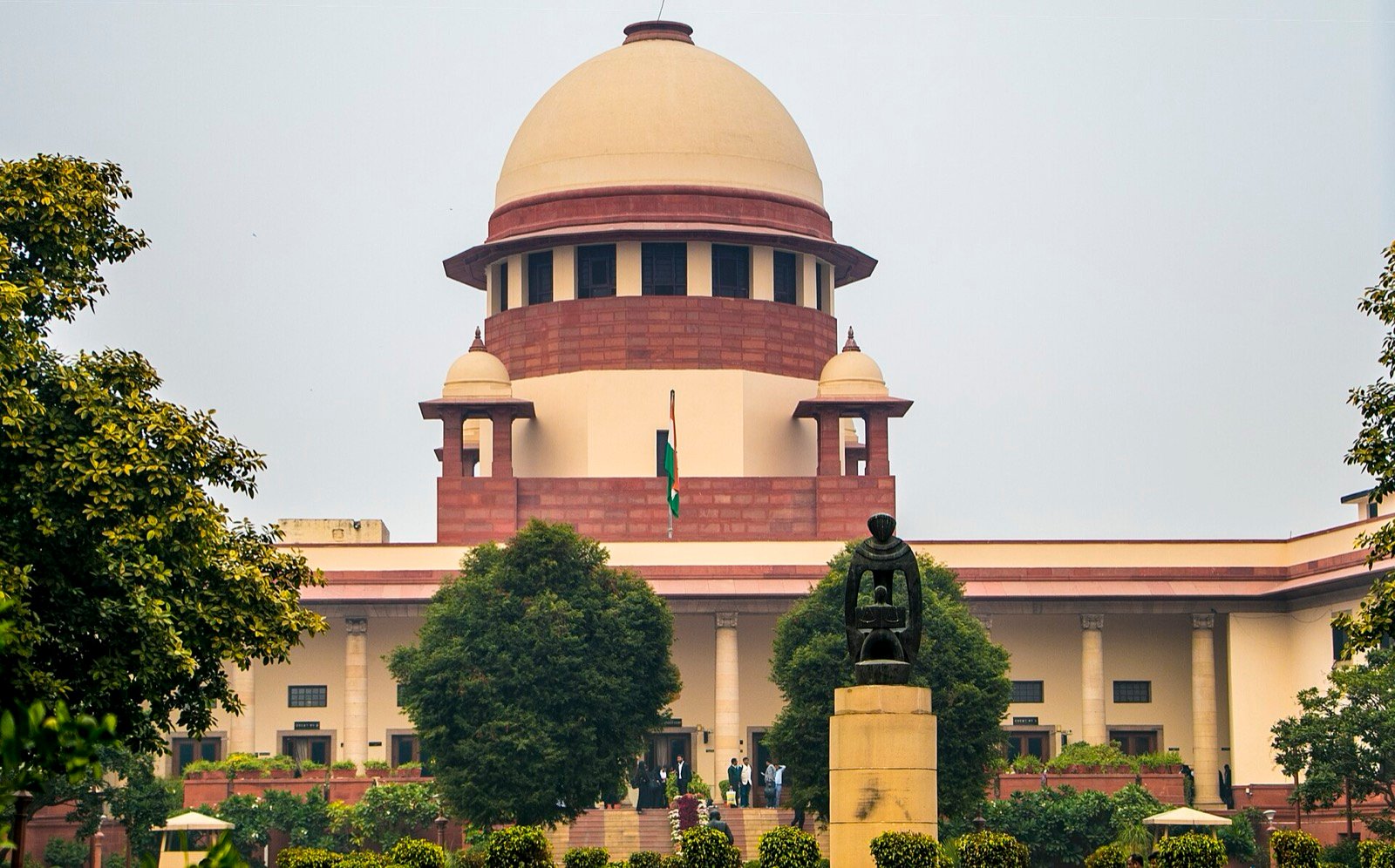
Viral video; Supreme Court steps in Court
On 20 July the Court took suo motu notice of a video of two women being paraded naked, saying it was “deeply disturbed” (LiveLaw). On 7 August it set up a committee of three former women High Court judges led by Justice Gita Mittal to oversee relief and rehabilitation, and appointed former IPS officer Dattatray Padsalgikar to monitor investigations (Morung Express). On 25 August it moved trials of CBI cases to Guwahati.
2023
Centre sets up the Commission of Inquiry Inquiry
The Home Ministry appointed a three-member commission headed by former Gauhati High Court Chief Justice Ajai Lamba, with Himanshu Shekhar Das and Aloka Prabhakar, to inquire into the causes and spread of the violence from 3 May 2023 and any lapses by authorities or individuals (PIB). It was asked to report within six months.
2023
Supreme Court hears first petitions on relief and the ST order Court
On 8 May a bench led by CJI D.Y. Chandrachud asked the Centre and state to step up security, relief and rehabilitation, and to protect places of worship (Outlook). On 17 May the CJI called the High Court’s ST direction “factually incorrect”, but did not stay it because an appeal was pending before a division bench (LiveLaw).
2023
Violence erupts after the Tribal Solidarity March Violence
Tribal groups held a Tribal Solidarity March in the hill districts against the Meitei demand for ST status. Clashes broke out near Torbung and spread across the state within hours, with homes, churches, temples and other buildings burned (India Today). Curfew was imposed, mobile internet was suspended and the Army and Assam Rifles were deployed. Within days, tens of thousands of people had fled to relief camps or across the valley–hill divide.
2023
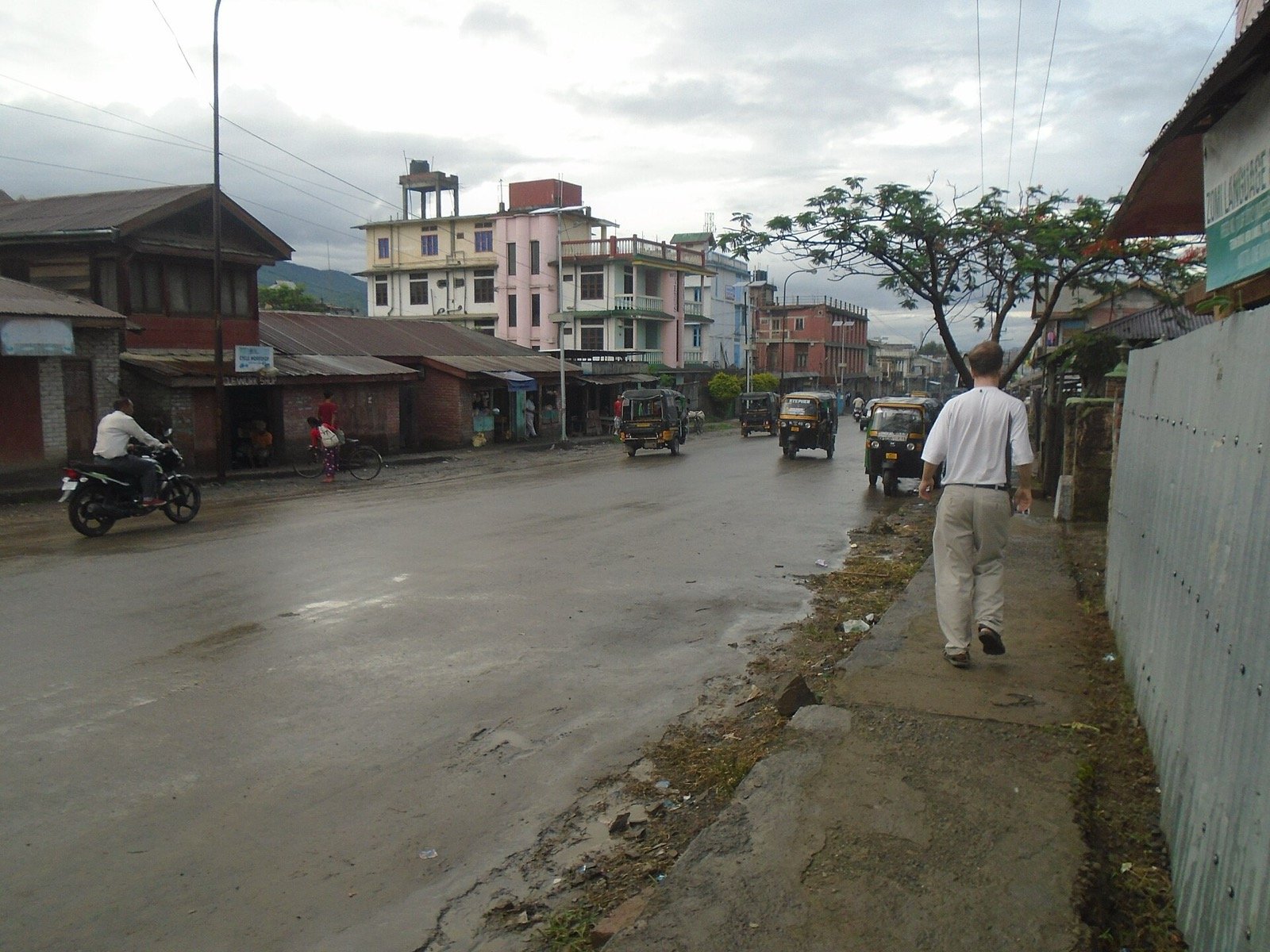
Tension in Churachandpur before the march Background
A crowd set fire to a gym that Chief Minister N. Biren Singh was due to open in Churachandpur, amid protests over eviction drives in reserved and protected forests and the demolition of churches the state said were unauthorised. A shutdown was called and the visit was cancelled.
2023
High Court tells the state to consider ST status for Meiteis Background
Hearing a petition by the Meitei Tribe Union, the High Court directed the state to consider including the Meitei community in the Scheduled Tribe list and to send a recommendation to the Centre. Tribal organisations said ST status for Meiteis, who make up about 53% of the population, would threaten their land protections and reserved jobs and seats. Meitei groups had sought recognition since at least 2012.
Why Did the Manipur Violence Begin?
No single event explains it. Four long-running disputes ran together.
1. The Scheduled Tribe status dispute
Meitei groups have sought ST status since at least 2012, arguing it would protect their identity and open access to land in the hills. Tribal groups, who already hold ST status, fear it would dilute their reserved jobs, seats and land protections. The March 2023 High Court direction brought the dispute to a head, but did not create it. For how India decides who gets reservation, see the Mandal Commission and the history of reservation policy.
2. Valley, hills and land
Meiteis, about 53% of the population, live mainly in the Imphal Valley, roughly a tenth of the state’s area. Under the Manipur Land Revenue and Land Reforms Act, 1960, non-tribals cannot buy land in the hill districts, home to Kuki-Zo and Naga communities. Forest eviction drives in early 2023 sharpened tribal grievances over land.
3. Identity and security fears
Each community describes itself as under threat. Migration from Myanmar since its 2021 coup and claims about illegal immigration and poppy cultivation feature in political debate. These claims are contested and are not, on their own, evidence for who carried out any particular attack. Similar arguments about identity and land run through indigenous protests elsewhere in the region; see the Arunachal Pradesh protests.
4. A collapse of trust in institutions
Mass looting of police armouries in 2023, allegations of partisan policing on both sides and slow prosecutions deepened mistrust. Kuki-Zo groups demand a separate administration; Meitei groups oppose any division of the state. Durable peace depends on credible investigations and trials as much as on security operations.
Human Impact: Deaths, Displacement and Justice
- Deaths and missing: 306 killed and 49 missing as of 31 August 2026, according to the state government (ThePrint).
- Displacement: more than 60,000 people displaced, many still in segregated relief camps in 2026 (HRW).
- Homes and places of worship: thousands of houses and many churches and temples were burned or damaged in 2023.
- Sexual violence: cases including the B Phainom case are on trial in Guwahati; allegations in other cases are still under investigation.
- Separation: the valley and the hills became largely closed to each other, disrupting work, schooling, health care and travel.
These are the consequences of a humanitarian crisis, not just a political contest. Responsibility for individual crimes still has to be established through investigation and trial. For how courts and commissions handled earlier episodes of mass violence in India, see the 1984 anti-Sikh riots and the 2020 Delhi riots.
Inquiry, Trials and Court Orders: Where Each Stands
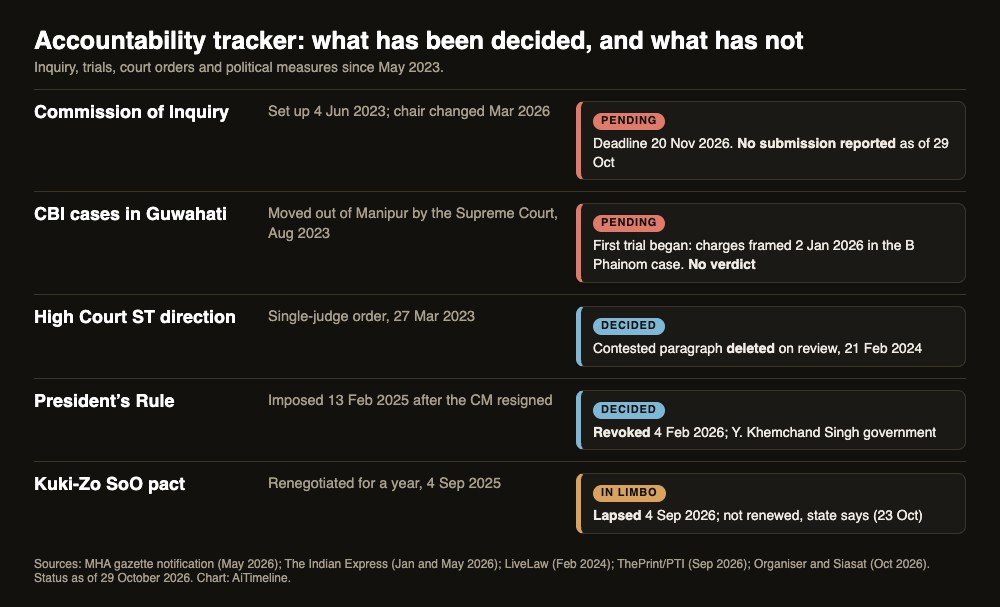
Decided, pending or in limbo, as of 29 October 2026.
| Process | Started | Latest step | Status, 29 Oct 2026 |
|---|---|---|---|
| Commission of Inquiry | 4 Jun 2023 (Lamba); Chauhan from 1 Mar 2026 | Deadline extended to 20 Nov 2026 (gazette) | Pending; no submission reported |
| CBI trials in Guwahati | Moved by Supreme Court, 25 Aug 2023 | Charges framed 2 Jan 2026 in B Phainom case (IE) | Trial under way; no verdict |
| Jiribam and Bishnupur cases | Nov 2024; Apr 2026 | Taken over by the NIA | Under investigation |
| High Court ST direction | 27 Mar 2023 | Paragraph deleted 21 Feb 2024 (LiveLaw) | Decided |
| Supreme Court oversight | May 2023 | Gita Mittal committee on relief; tenure extended in Jan 2026 | Continuing |
| President’s Rule | 13 Feb 2025 | Revoked 4 Feb 2026 | Ended |
| Kuki-Zo SoO pact | Renegotiated 4 Sep 2025 | Lapsed 4 Sep 2026; not renewed (state, 23 Oct) | In limbo |
What Happens Next in Manipur?
- The inquiry report: due by 20 November 2026. It may set out the sequence of events and possible administrative lapses, but its findings should not be assumed before it is submitted and made public.
- Criminal trials: the B Phainom trial and other CBI cases continue in Guwahati, with protection needed for victims and witnesses and fair trials for the accused.
- Security in the hills and foothills: preventing retaliatory attacks in both the Meitei–Kuki-Zo and Naga–Kuki-Zo conflicts, and a decision on the lapsed SoO pact.
- Return and rehabilitation: safe, voluntary options for the more than 60,000 displaced.
- Political dialogue: on land, identity, representation and the Kuki-Zo demand for a separate administration.
Explore More Timelines
People Also Ask
Manipur Violence: Frequently Asked Questions
More Than the Absence of Clashes
The Manipur violence began with a dispute over Scheduled Tribe status and became a much deeper crisis over land, identity, representation and security. It has cost hundreds of lives, displaced tens of thousands and raised serious questions about the protection of civilians and accountability. The return of an elected government in February 2026 was an important political change, but the killings that followed showed how fragile the situation remains.
The next phase depends on the inquiry’s findings, fair and timely trials, security for every community and sustained dialogue. Peace in Manipur will require rebuilding trust so that people in the valley and the hills can live safely and see a future in the state.
Related AiTimeline Stories
⚠️ Editorial Note
Last updated 29 October 2026. This article reports allegations as allegations unless a court has ruled, and keeps the Meitei–Kuki-Zo and Naga–Kuki-Zo conflicts and their tolls separate. Primary sources include the PIB release of 4 June 2023, the May 2026 gazette notification and the state Home Minister’s Assembly reply. The inquiry status was checked on 29 October 2026: no submission had been reported, and this entry will be updated after the 20 November 2026 deadline. We corrected the source brief in several places: the first Supreme Court hearing was on 8 May 2023, not 11 May; charges in the B Phainom case were framed on 2 January 2026 (10 January was a report date), and the case involves three women, two of whom appeared in the video; Justice Ajai Lamba resigned in February 2026, not earlier; the extension was notified on 14 May 2026; and later reports put the April 2026 protest toll at three, not two. We also added the Supreme Court’s July–August 2023 orders, the October 2026 Naga–Kuki-Zo clashes and the lapse of the SoO pact. AiTimeline has no dedicated pages yet on Scheduled Tribe status or the Northeast’s insurgencies; related coverage is linked above.
Sources & further reading
Every dated entry above was checked against these references. Last reviewed 29 October 2026.
- PIB, Ministry of Home Affairs: Commission of Inquiry on Manipur violence constituted (4 June 2023)
- Gazette of India: MHA notification extending the Commission of Inquiry to 20 November 2026 (May 2026, PDF)
- ThePrint (PTI): 306 killed, 49 missing since May 2023, Home Minister tells Assembly (3 September 2026)
- Human Rights Watch: India, renewed ethnic violence in Manipur (3 September 2026)
- ThePrint (Reuters): Three killed, four injured in violence in Manipur (19 October 2026)
- The Indian Express: MHA gives another extension to panel probing Manipur violence (May 2026)
- The Indian Express: First Manipur violence case probed by CBI reaches trial stage (January 2026)
- LiveLaw: Manipur High Court deletes direction on Meitei inclusion in ST list (February 2024)
- LiveLaw: Supreme Court takes suo motu cognizance of Manipur video (20 July 2023)