CD Timeline 1982-2026: How Compact Discs Rose, Fell and Came Back
Explore the CD timeline from 1982's first compact discs to the 1990s boom, Napster, iPod, streaming, physical-media revival and the 2026 CD comeback.
Latest Story
For years, the compact disc looked like a museum object from the pre-streaming internet. Then something strange happened. Younger listeners started buying albums they could hold, artists began releasing collectible CD editions again, and music fans rediscovered a format that once defined the sound of the 1990s. This CD timeline traces both halves of that story — how the compact disc rose from a 1982 lab experiment to the dominant music format on Earth, how MP3s and streaming nearly finished it off, and why, in 2026, it is quietly growing again.
🧠 Short Answer: Are CDs Making a Comeback in 2026?
Yes, but not in the same way they dominated the 1990s. CD sales remain far below their peak, and streaming still dominates music revenue, accounting for 82% of U.S. recorded music revenue in the first half of 2026, according to the RIAA. But 2026 data shows renewed demand for CDs, helped by collectible editions, K-pop and pop fandom, nostalgia, affordable prices and a broader revival of physical media — U.S. CD revenue rose 58.6% year-over-year in the first half of 2026, per RIAA figures.
CD Timeline: Key Questions
The CD story, in nine points
- Compact discs entered the commercial market on 1 October 1982 and became the dominant music format by the late 1980s and 1990s.
- CDs promised cleaner sound, durability, track-skipping and longer playing time compared with vinyl and cassette tapes.
- US CD sales peaked around 1999, with roughly 939 million units shipped that year, according to RIAA historical data.
- Napster (1999), the iPod (2001), the iTunes Store (2003) and streaming gradually broke the CD’s business model.
- Streaming overtook CDs and downloads combined as the top US revenue source in 2015, per RIAA figures.
- Vinyl overtook CDs in US revenue in 2020 for the first time since 1986, even though CDs still outsold vinyl in units that year.
- Streaming still dominates recorded music revenue globally — 69.6% of worldwide revenue in 2025, per the IFPI Global Music Report 2026.
- The 2026 CD comeback is real: US CD revenue rose 58.6% year-over-year in the first half of 2026, per the RIAA’s mid-year report.
- CDs are not replacing streaming. They are becoming a collectible, emotional and sometimes cheaper way to own music alongside it.
What Is a Compact Disc?
The optical format that redefined how music was stored and heard.
A compact disc, or CD, is an optical disc format developed by Philips and Sony to store digital audio. A laser reads microscopic pits pressed into the disc’s surface and converts that pattern into sound. CDs became popular because they offered cleaner playback than vinyl or cassette, let listeners skip directly to any track, resisted the wear and warping that degraded analog formats, and packed up to roughly 74 minutes of music — reportedly chosen so a single disc could hold a full performance of Beethoven’s Ninth Symphony.
The CD was once the sound of the future. Then it became clutter, crowding shelves and glove compartments long after most people had switched to phones and streaming apps. Now, for a growing number of listeners, it is becoming a keepsake — something to hold, gift and display rather than just play.
CD History: The Full Timeline, 1982-2026
From a Tokyo launch event to a 2026 sales chart nobody predicted.
The First Commercial CDs Arrive
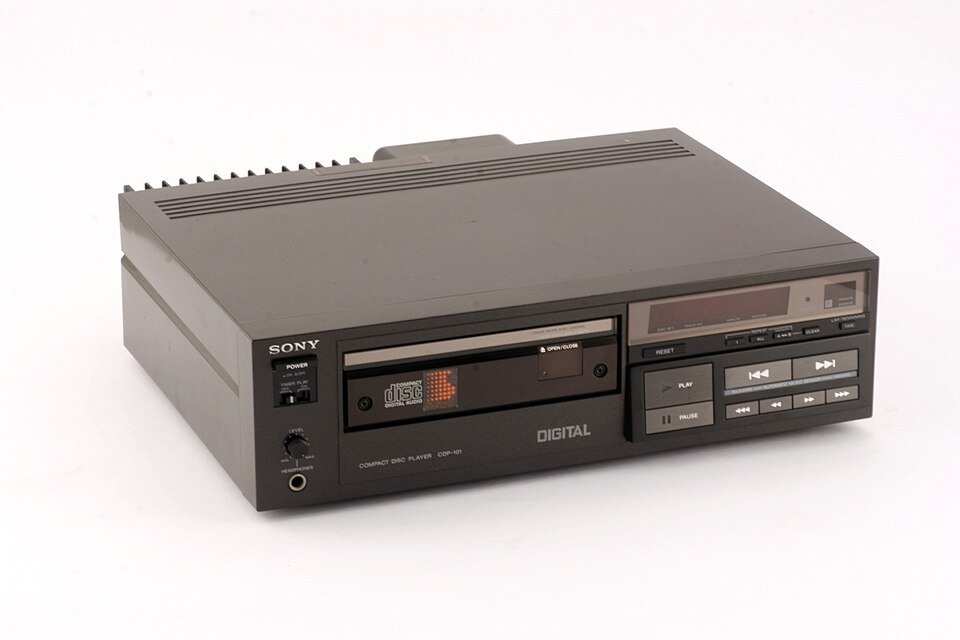
What happened: Sony and Philips launched the compact disc commercially in Japan, with Sony’s CDP-101 player going on sale for about 168,000 yen (roughly $730 at the time), alongside the first CD albums manufactured at Philips’s pressing plant in Germany.
Why it matters: Billy Joel’s 52nd Street is widely credited as the first CD commercially released to the public, though the very first disc ever pressed at Philips’s plant was ABBA’s The Visitors — a test pressing that predates general release.
CDs Launch in Wider Global Markets
What happened: CD players and discs began reaching the United States and Europe through 1983, sold mostly to audiophiles willing to pay a premium for the new format’s hardware and limited catalog.
Why it matters: Early adoption outside Japan was slow because players were expensive and few albums were available on disc, but it set up the format for the mainstream breakthrough later in the decade.
1980s
CDs Move From Luxury to Mainstream
What happened: As player prices fell and labels reissued classic albums on disc, CDs began replacing vinyl and cassette in ordinary households. Dire Straits’ 1985 album Brothers in Arms became one of the first releases explicitly produced and marketed around the CD format, and by 1988 CDs had overtaken vinyl records in US sales.
Why it matters: This is the moment the CD stopped being a gadget for enthusiasts and became the format ordinary music buyers expected on record-store shelves.
The CD Boom
What happened: The CD became the dominant music format of the decade. Retailers built entire store sections around jewel cases, labels resold back catalogs on disc, and US CD shipments climbed to roughly 939 million units in 1999, with industry revenue reaching well over $10 billion that year, according to RIAA historical data.
Why it matters: For record labels, this was one of the most profitable stretches in recorded-music history — profitable enough that the coming collapse felt, at the time, almost unimaginable.
Napster Changes the Rules
What happened: Shawn Fanning’s Napster launched in June 1999, introducing millions of listeners to free, song-by-song digital music shared over peer-to-peer networks.
Why it matters: The CD was still commercially powerful in 1999, but Napster cracked the economic foundation underneath it: once a song could be copied for free, the album-as-a-bundle business model was no longer guaranteed.
The iPod Arrives
What happened: Apple launched the original iPod on 23 October 2001, letting listeners carry a claimed “1,000 songs in your pocket” without a single physical disc.
Why it matters: Music started moving from shelves to pockets. A portable CD player skipped when jostled and held one album at a time; the iPod held a whole collection and didn’t.
iTunes Normalizes Digital Downloads
What happened: Apple opened the iTunes Music Store on 28 April 2003, selling individual songs for 99 cents through a legal, label-approved storefront.
Why it matters: Consumers no longer had to buy a full CD to get the one song they actually wanted, breaking the album-bundle economics that had made CDs so profitable through the 1990s.
Streaming Takes Over
What happened: Spotify launched in Sweden in October 2008 and entered the United States in July 2011, reshaping listening around access rather than ownership. By 2015, streaming revenue overtook CDs and downloads combined for the first time in the US, accounting for 34.3% of industry revenue versus 28.8% for physical formats, according to RIAA figures reported by Variety.
Why it matters: This is the year the CD stopped being a “declining format” and became a genuinely marginal one in revenue terms — the shift from owning music to renting access to all of it was now complete at the industry level.
Vinyl Revival Begins, CDs Keep Falling
What happened: Vinyl became newly fashionable among collectors and audiophiles through the 2010s, while CDs continued losing cultural status. Many listeners saw CDs as neither nostalgic enough like vinyl nor convenient enough like streaming.
Why it matters: This decade set up a strange split in physical media — one format (vinyl) gaining prestige while the other (CD) kept sliding, right up until 2020 flipped the revenue order between them.
Vinyl Revenue Overtakes CD Revenue
What happened: US vinyl revenue overtook CD revenue for the first time since 1986, with full-year 2020 figures showing $619.6 million from vinyl versus $483.3 million from CDs, per RIAA data. Notably, CDs still outsold vinyl in raw units that year.
Why it matters: This crossover became the headline “physical media is dying, except vinyl” story for several years — the same period in which CD collecting was quietly gathering its own smaller, less-covered following.
Physical Media Becomes Emotional Again
What happened: Pandemic-era collecting habits, artist merch bundles, K-pop album packaging and fan communities helped physical formats regain attention worldwide. By 2025, according to the IFPI Global Music Report 2026, global physical format revenue grew 8.0% year-over-year, with vinyl posting its 19th consecutive year of growth at +13.7%, while physical formats overall still made up 16.6% of global recorded music revenue — the second-largest share behind streaming.
Why it matters: This was the moment physical music stopped being framed purely as decline-with-one-exception (vinyl) and became a broader story about fans wanting something to hold, across multiple formats at once.
The CD Comeback Becomes Visible
What happened: US CD revenue rose 58.6% year-over-year to $171 million in the first half of 2026, with CD unit sales climbing 45.7% to 17.5 million, according to the RIAA’s mid-year report released 1 September 2026. Total US recorded music revenue reached $6.0 billion for the half, up 6.9%, with streaming still generating 82% of that total.
Why it matters: K-pop and collectible editions are a real driver, but reporting on the RIAA data notes CD sales still rose 6.7% even when K-pop titles are excluded — meaning this is a broader trend than one fandom, even as it remains small next to streaming.
Why Are People Buying CDs Again?
Streaming fatigue, fandom and a shelf you can actually see.
CDs are cheaper than vinyl. A new vinyl LP often costs two to three times what a CD does, and used CD bins remain some of the cheapest physical music available, making them an easy entry point for casual collectors.
Fans want something physical. After years of subscription libraries that can vanish when a license lapses or a service shuts down, owning a disc feels like a small guarantee that the music stays yours.
K-pop and pop artists made CDs collectible again. Album packaging with photocards, posters and numbered variants has turned the CD into a fandom object as much as a listening format, a trend widely credited in 2026 industry reporting with driving part of the RIAA’s mid-year growth.
Streaming libraries feel temporary. A playlist can be reshuffled or a track pulled overnight; a shelf of CDs cannot be quietly edited by an algorithm.
Gen Z likes “retro” technology. The same generation that revived film cameras and flip phones has started treating CDs as a tactile, slightly rebellious alternative to an all-digital life.
Cars, old stereos and used players are being rediscovered. Secondhand CD players and car stereos with built-in disc slots are cheap and plentiful, lowering the barrier to actually playing what gets bought.
Album artwork, booklets and liner notes still matter. A CD booklet gives credits, lyrics and art a physical home that a streaming app’s metadata page rarely replicates.
CD Comeback vs Vinyl Revival
Two different physical-media stories, often mistaken for one.
Compact Disc vs Vinyl Record
💡 Key Point
The CD comeback is not exactly the vinyl revival. Vinyl is often about ritual and analog warmth; it also carries higher collector status and a bigger price tag. CDs are more about affordability, nostalgia, fandom and simple ownership — a cheaper, smaller way to hold onto an album streaming can’t quite replace.
Streaming vs CDs: Who’s Actually Winning?
Not a rivalry — two layers of the same listening habit.
Streaming is still the center of the modern music economy. CDs are not “defeating” Spotify, Apple Music or YouTube Music — in the first half of 2026, streaming generated $4.9 billion of the US industry’s $6.0 billion in revenue, or 82% of the total, according to the RIAA. CD revenue over the same period was $171 million, a small fraction of that by comparison.
Instead, CDs are becoming a second layer of music consumption: fans stream casually for everyday listening, then buy physical editions of the artists or albums they care about most. That pattern — not a return to 1990s-style CD shopping — is what the 2026 numbers actually describe.

The Format Timeline, at a Glance
Seven decades of formats, one continuous listening habit.
Explore More Timelines
People also ask
Frequently asked questions
Direct answers on CD history, the format’s decline and its 2026 comeback.
⚠️ What This Article Does Not Claim
This article does not claim CDs are returning to 1990s sales levels, and it does not predict future sales trends beyond the data cited. Streaming remains, by a wide margin, the dominant source of recorded music revenue worldwide. The 2026 CD growth described here is real and sourced to RIAA and IFPI reporting, but it remains small relative to the overall market.
Related AiTimeline reading
⚠️ Editorial note & methodology
Author: The AI Timeline Editorial Team · Editor: AiTimeline Editorial · Last updated: 6 September 2026. Facts are drawn from the RIAA’s Mid-Year 2026 Revenue Report and historical shipment statistics, the IFPI Global Music Report 2026, Reuters and TechCrunch reporting on the 2026 CD sales increase, and historical accounts of the CD’s 1982 launch via Philips and Sony. This article is editorial and does not predict future sales trends. Corrections: corrections@aitimeline.in.
Sources & further reading
Every dated entry above was checked against these references. Last reviewed 15 September 2026.
- RIAA 2026 Mid-Year Revenue Report coverage — Billboard Pro
- IFPI Global Music Report 2026
- Music Business Worldwide — 10 takeaways from IFPI's Global Music Report 2026
- TechCrunch — CD sales are making an unexpected comeback amid a retro tech boom
- Variety — Streaming Overtakes Downloads, CDs as Top Music Revenue Driver (2015 data)
- Rolling Stone — RIAA data: vinyl revenue surpasses CDs (2020)
- Wikipedia — Sony CDP-101
- Ultimate Classic Rock — How Billy Joel's '52nd Street' Became the First Compact Disc Released