Trafalgar Day: Nelson’s Two-Column Attack That Broke the Franco-Spanish Line
Trafalgar Day timeline: how Nelson's two-column attack broke the Franco-Spanish line on 21 October 1805, which ships were captured and what the storm took.
Latest Story
Trafalgar Day, observed on 21 October, marks the day in 1805 when Admiral Horatio Nelson sent his fleet at the combined French and Spanish line in two columns instead of one parallel line. Nelson’s two-column attack exposed the leading British ships to heavy fire, but it split the allied formation and forced the close-range fight Nelson wanted. Seventeen allied ships struck their colours and one blew up, no British ship was lost, and Nelson died at about 16:30. Most of the prizes were then lost in the storm, and the war went on for another ten years. This page keeps those points apart.
💡 Short Answer
On 21 October 1805 Nelson attacked 33 allied ships of the line with 27 of his own, in two columns that cut the Franco-Spanish line at two points: Collingwood about one-third from the rear, Nelson just ahead of the centre. Seventeen allied ships were captured and Achille exploded, but only four prizes survived the storm that followed. Trafalgar confirmed British command of the sea; it did not end the Napoleonic Wars, and Napoleon’s invasion plan had already been abandoned.
Trafalgar Day: Key Questions
Trafalgar in Ten Points
- The fleets: 27 British ships of the line against 33 French and Spanish.
- The tactic: two columns, one hitting the rear and one just ahead of the centre.
- The cost of the approach: the lead ships were under fire before most of their guns could reply.
- The allied error: Villeneuve’s 08:00 turn left a stretched crescent in light wind.
- The signal: “England expects” was sent at about 11:45, before the first shot.
- The result on the day: 17 ships struck, Achille blew up, no British ship lost.
- The storm: only four of 17 prizes survived in British hands.
- Nelson: shot at about 13:15-13:30; died at about 16:30.
- Napoleon: the invasion plan was already abandoned; the Continental System followed.
- The caution: Trafalgar ended no war. It confirmed command of the sea.
Interactive Battle Map: Nelson’s Two-Column Attack
Step through the six decisions that shaped 21 October 1805. A schematic, not a chart of exact positions.
–
–
Two columns, 27 ships of the line in all. Royal Museums Greenwich places Collingwood’s break about one-third from the rear and Nelson’s just ahead of the centre; dispatches and later histories differ on exactly which ship each column struck.
Trafalgar Day Timeline, Latest First
Each entry is tagged by thread and ends with why it matters. Use the filter to isolate the road to battle, the fighting, the storm or the legacy.
The road to battle, the fighting, the storm or the legacy? Filter by thread.
–
The Royal Navy Museums mark Trafalgar Day with a digital series Legacy
Trafalgar Day is the annual commemoration of the 21 October 1805 victory. In 2024 the Royal Navy Museums launched a digital series covering Nelson’s life, the battle and its legacy (Royal Navy Museums).
The museum’s own summary of the tactic is short: two columns sailing straight at the enemy, Collingwood attacking the rear and Nelson smashing through the centre.
1815
Waterloo ends the Napoleonic Wars on land Legacy
Napoleon’s final defeat at Waterloo on 18 June 1815 closed the wars that Trafalgar had not ended (Wikipedia; Wikipedia). Wikipedia notes the naval battle had little effect on the War of the Third Coalition and that the wider conflict ran for about another decade (Wikipedia).
Trafalgar settled who controlled the sea. It did not decide who won on land.
1806
Napoleon answers with the Berlin Decree Legacy
Napoleon signed the Berlin Decree on 21 November 1806, declaring the British Isles in a state of blockade and banning trade and correspondence with Britain. It was a response to Britain’s own May 1806 blockade and was part of the Continental System (Wikipedia; Wikipedia).
With the sea closed to him, Napoleon turned to economic war on the continent.
1806
Gravina dies of his wounds in Cádiz Storm and aftermath
Admiral Federico Gravina was wounded by grapeshot that shattered his left arm at about 15:30 on 21 October 1805 aboard Príncipe de Asturias. He died of those wounds in Cádiz on 9 May 1806 (Wikipedia).
1806
Villeneuve is found dead at Rennes Storm and aftermath
Taken to England after Trafalgar and released on parole in late 1805, Villeneuve returned to France. He was found dead at the Hôtel de la Patrie in Rennes on 22 April 1806 with stab wounds, and a verdict of suicide was recorded (Wikipedia).
1806
Nelson is buried at St Paul’s after a state funeral Legacy
Nelson’s body lay in state at Greenwich from 5 January and was carried in procession to St Paul’s Cathedral for burial on 9 January 1806 (Wikipedia). Wikipedia notes that Villeneuve, a prisoner on parole, was in Britain at the time of the funeral (Wikipedia).
1805
Austerlitz shows where the war was being decided Storm and aftermath
Napoleon defeated Austria and Russia at Austerlitz on 2 December 1805 (Wikipedia). His army had left Boulogne for the continent on 27 August, before Trafalgar was fought (Wikipedia).
The invasion of Britain had already been abandoned when the fleets met. Trafalgar closed the door on reviving it rather than ending a plan still in motion.
1805
Dumanoir’s four escaped ships are captured at Cape Ortegal Storm and aftermath
Four French ships that broke away from the Trafalgar battle under Rear-Admiral Dumanoir (Formidable, Scipion, Duguay-Trouin and Mont Blanc) were captured by Strachan’s squadron on 4 November (Wikipedia; Wikipedia).
These four were not part of the 17 prizes taken on 21 October.
Oct 1805
The storm takes most of the prizes Storm and aftermath
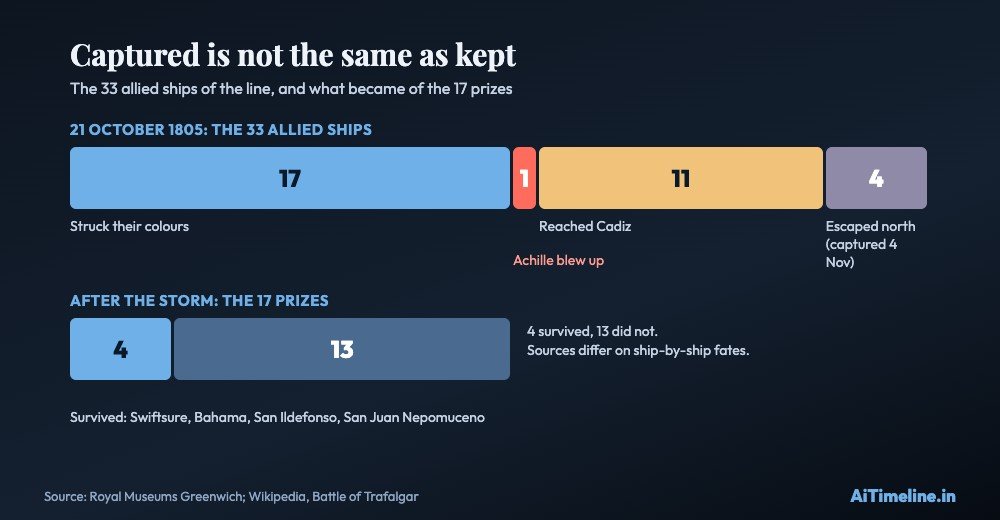
A gale followed the battle. Damaged prizes broke their tows, ran aground, foundered or were retaken. Wikipedia counts only four prizes that survived in British hands: Swiftsure, Bahama, San Ildefonso and San Juan Nepomuceno. The British burned or scuttled others (including Santísima Trinidad and Argonauta) to stop them being retaken. Berwick foundered on 22 October after French prisoners cut her tow, Monarca was wrecked, and Rayo was driven ashore on 26 October (Wikipedia).
Cosmao’s sortie from Cádiz retook two Spanish ships. Bucentaure was retaken by her French crew but wrecked on 23 October. These were losses after the battle, not captures lost in it. Sources differ on ship-by-ship fates, so AiTimeline gives the headline count only.
1805
Nelson dies at about 16:30 after learning of the victory The battle
Nelson died about three hours after being shot. The Royal Navy Museums record his last words as “Thank God I have done my duty” (Royal Navy Museums). Wikipedia gives his death as about 16:30 and notes another last-words tradition (“God and my country”) (Wikipedia).
Collingwood, as second in command, took over the fleet.
1805
The allied line collapses: 17 ships strike, one blows up The battle
After more than three hours of fighting, 17 allied ships had struck their colours and one had been blown up, according to Royal Museums Greenwich (Royal Museums Greenwich). Redoutable’s captain surrendered at about 13:55 with only 99 of 643 men fit for duty, and Santísima Trinidad surrendered after about three hours of isolation (Wikipedia). Achille exploded.
Eleven allied ships escaped to Cádiz, and Dumanoir’s four broke away to the north. No British ship was lost in the battle.
1805
Nelson is shot by a marksman on Redoutable The battle
Nelson was shot by a musketeer in the mizzentop of the French Redoutable, which was locked alongside Victory. The Royal Navy Museums put the time at about 13:15; Royal Museums Greenwich says “approximately 1.30 pm” (Royal Navy Museums; Royal Museums Greenwich). He was carried below so the men around him would not lose heart.
1805
Victory cuts the line between Bucentaure and Redoutable The battle
At about 12:45 Victory passed between Villeneuve’s flagship Bucentaure and Redoutable, delivering a raking broadside that dismasted Bucentaure (Wikipedia). Royal Museums Greenwich describes Nelson’s column engaging “just ahead of the centre” (Royal Museums Greenwich).
Official accounts differ on exactly which allied ship each British column struck. Collingwood’s dispatch, for example, counted differently from later histories.
1805
Royal Sovereign breaks the line first The battle
The French Fougueux fired first at about noon and Royal Sovereign broke the line astern of the Spanish Santa Ana (Wikipedia). Royal Museums Greenwich says Collingwood engaged about one-third from the rear of the enemy line (Royal Museums Greenwich).
This was the dangerous moment of the plan: the lead ships were under fire before most of their own guns could reply.
1805
The signal: “England expects that every man will do his duty” The battle
At about 11:45 Nelson’s signal was sent. Lieutenant Pasco suggested “expects” instead of “confides” and Nelson accepted (Wikipedia; Wikipedia).
The signal came before the first shots, not at the climax of the battle.
1805
Villeneuve wears the fleet, and the line becomes a crescent The battle
At about 08:00 Villeneuve ordered his fleet to wear together and return to Cádiz. The manoeuvre took nearly an hour and a half in light wind, and left an uneven crescent about five miles long with Dumanoir’s division, formerly the rear, now in the van (Wikipedia). Royal Museums Greenwich describes the fleet as a disordered single column in light wind (Royal Museums Greenwich).
The allied commander’s decision to turn back created the broken, stretched line that Nelson then attacked.
1805
Nelson commits to two columns from the west The battle
At about 05:40 the British were roughly 21 miles north-west of Cape Trafalgar, with the allied fleet between them and the cape. At about 06:00 Nelson ordered the fleet to prepare for battle, and by about 11:00 it was visible in two parallel columns (Wikipedia).
Nelson led the windward column in Victory; Collingwood led the leeward column in Royal Sovereign. Each column steered to cut the allied line at a different point rather than form a parallel line and trade broadsides. See the interactive battle map above.
Oct 1805
The combined fleet leaves Cádiz Road to battle
Villeneuve gave the order to sail on 18 October, partly because he had heard that he was to be replaced. It took two days to get the fleet out of port, and on the evening of 20 October Achille sighted 18 British ships in pursuit (Wikipedia; Wikipedia).
Some accounts give 20 October as the sailing date. The order and the departure were on different days.
1805
Nelson issues his memorandum on the plan of attack Road to battle
Royal Museums Greenwich holds a memorandum issued on 9 October 1805, with a copy issued to Captain Bayntun of HMS Leviathan; the catalogue entry is for microfilm only (Royal Museums Greenwich). Wikipedia summarises the plan as cutting the allied line in three and quotes the instruction that no captain can do very wrong if he places his ship alongside that of the enemy (Wikipedia).
AiTimeline has not read the memorandum itself and relies on the secondary summary for the wording.
1805
Nelson takes command of the fleet off Cádiz Road to battle
After a brief return to England Nelson took over the fleet blockading Cádiz in 1805, with HMS Victory as flagship (Wikipedia). Royal Museums Greenwich holds a letter he wrote from Victory dated 25 September 1805 (Royal Museums Greenwich).
The draft brief placed this command “in the Mediterranean”. The fleet Nelson joined was the one watching Cádiz.
1805
Cape Finisterre pushes Villeneuve toward Cádiz Road to battle
Vice-Admiral Calder with 15 ships of the line fought Villeneuve and Gravina with 20 off Cape Finisterre on 22 July 1805. The battle was inconclusive; two Spanish ships were captured. Villeneuve then withdrew to Vigo, A Coruña and eventually Cádiz instead of joining the fleet at Brest, and Wikipedia says this ended Napoleon’s hopes of invading England. Calder was court-martialled for not renewing the fight (Wikipedia).
1803
War resumes between Britain and Napoleonic France Road to battle
War between Britain and France resumed in 1803, and Napoleon assembled an army at Boulogne for a possible invasion while the Royal Navy blockaded French ports (Wikipedia; Wikipedia).
AiTimeline has no standalone Napoleonic Wars or French Revolution timeline yet.
Why Did the British Win at Trafalgar?
Plan, training and circumstance, none of them alone.
1. Force at chosen points. Rather than spread evenly along the enemy line, Nelson’s columns aimed at the rear and just ahead of the centre, so each break created a local advantage and separated parts of the allied fleet.
2. A formation already in trouble. Villeneuve’s 08:00 order to wear and run for Cadiz took about 90 minutes in light wind and left a crescent about five miles long, with Dumanoir’s division in the van, far from the fighting at the rear and centre.
3. Close combat. The Royal Navy Museums say Nelson believed his crews were better drilled and could fire faster. Close range suited that belief.
4. Initiative. Captains were told, in the words Wikipedia quotes from Nelson’s memorandum, that none could do very wrong placing a ship alongside an enemy. That mattered once smoke and damage made signals hard to read.
The result should not be reduced to “British sailors were better”. Allied crews fought hard, and the wind, the swell, the crescent, signals and leadership all played a part. The idea of breaking the line was also not new: Nelson applied it boldly and got an exceptionally decisive result. Compare other turning points in AiTimeline’s history coverage, such as the long arc of geopolitical conflicts and France’s protest history back to the Revolution.
Trafalgar Hour by Hour
Times are approximate and sources differ by a few minutes.
| Time (21 Oct 1805) | Event | Source |
|---|---|---|
| About 05:40 | British about 21 miles north-west of Cape Trafalgar | Wikipedia |
| About 06:00 | Nelson orders the fleet to prepare for battle | Wikipedia |
| About 08:00 | Villeneuve orders the fleet to wear for Cadiz; crescent forms | Wikipedia |
| About 11:45 | Nelson’s signal, “England expects…” | Wikipedia |
| About noon | Fougueux fires first; Royal Sovereign breaks the line | Wikipedia; RMG |
| About 12:45 | Victory cuts between Bucentaure and Redoutable | Wikipedia; RMG |
| About 13:15-13:30 | Nelson shot by a marksman on Redoutable | Royal Navy Museums; RMG |
| About 13:55 | Redoutable surrenders; 99 of 643 men fit | Wikipedia |
| About 15:30 | Gravina wounded aboard Príncipe de Asturias | Wikipedia |
| About 16:30 | Nelson dies | Wikipedia |
The Two Fleets Compared
Figures from Wikipedia’s summary of the cited sources.
| British | Franco-Spanish | |
|---|---|---|
| Ships of the line | 27 | 33 (18 French, 15 Spanish) |
| Frigates and smaller | 4 frigates, 1 schooner, 1 cutter | 5 frigates, 2 brigs |
| Guns (approx.) | 2,148 | 2,568 or 2,632 (Wikipedia gives both) |
| Men (approx.) | 17,000 | 30,000 |
| Killed / wounded | 458 / 1,208 (figures vary by source) | 4,395 / 2,541, plus 7,000-8,000 captured |
| Ships lost in the battle | None | 17 struck, 1 blew up |
| Commander | Nelson (killed); Collingwood took over | Villeneuve (captured); Gravina (mortally wounded) |
Captured, Destroyed or Lost in the Storm?
Three different outcomes that are often run together.
| Group | Ships | What happened | Counted as |
|---|---|---|---|
| Struck their colours | 17 | Captured by British ships on 21 October | Captured in the battle |
| Achille | 1 | Caught fire and exploded | Destroyed in the battle |
| Reached Cadiz | 11 | Escaped with Gravina; Wikipedia says only five were seaworthy | Escaped |
| Dumanoir’s division | 4 | Broke away north; captured 4 Nov at Cape Ortegal | Captured later, not at Trafalgar |
| Prizes that survived | 4 | Swiftsure, Bahama, San Ildefonso, San Juan Nepomuceno | Still British prizes after the storm |
| Prizes lost afterwards | 13 of the 17 | Scuttled, burned, wrecked, foundered or retaken (derived from the count above) | Lost after the battle, not in it |
Captured on the day: 17 ships. Destroyed on the day: one, Achille, which exploded. Lost afterwards: most of the prizes, in the gale of 22–26 October, by scuttling, burning, wrecking, foundering or recapture. AiTimeline gives the headline count only because sources differ on individual ships.
What Trafalgar Meant for Napoleon
The invasion was already off. After Cape Finisterre in July, Villeneuve withdrew to Cadiz instead of joining the fleet at Brest, and the army left Boulogne for the continent on 27 August. Trafalgar closed the door on reviving the plan.
The land war went on. Napoleon beat Austria and Russia at Austerlitz on 2 December 1805, less than two months later. Wikipedia says Trafalgar had little effect on that war.
The war moved to trade. The Berlin Decree of 21 November 1806 declared a blockade of the British Isles as part of the Continental System. See also AiTimeline’s story of another blockade, the Berlin Airlift, and of naval pressure in the Cuban Missile Crisis.
The end came on land. Waterloo, on 18 June 1815, finished what Trafalgar had not. AiTimeline has no standalone Napoleonic Wars, Waterloo, French Revolution or British Empire timeline yet.
The Story at a Glance
Dates from the sources listed below.
| Date | Event | Detail |
|---|---|---|
| May 1803 | War resumes | Britain and France |
| 22 Jul 1805 | Cape Finisterre | Inconclusive; Villeneuve withdraws to Cadiz |
| 27 Aug 1805 | Army leaves Boulogne | Invasion plan abandoned |
| 18-20 Oct 1805 | Fleet leaves Cadiz | Order 18 Oct; sailing complete 20 Oct |
| 21 Oct 1805 | Trafalgar | 17 ships struck, 1 blew up; Nelson dies |
| 22-26 Oct 1805 | The storm | Four prizes survive |
| 4 Nov 1805 | Cape Ortegal | Dumanoir’s four captured |
| 2 Dec 1805 | Austerlitz | Napoleon beats Austria and Russia |
| 9 Jan 1806 | Nelson’s funeral | St Paul’s Cathedral |
| 21 Nov 1806 | Berlin Decree | Blockade of the British Isles declared |
| 18 Jun 1815 | Waterloo | Napoleon’s final defeat |
The Human Cost of Trafalgar
Wikipedia gives 458 British killed and 1,208 wounded, against 4,395 allied killed, 2,541 wounded and 7,000 to 8,000 captured; other sources give slightly different British totals, so treat every figure as an estimate. The fighting was at close range, with cannon and musket fire, fires aboard and ships locked together. The storm made the fate of damaged ships and prisoners worse: Indomptable was wrecked off Rota with about 1,200 aboard and no more than 100 survived.
The legacy includes not only Nelson but the sailors and marines of all three navies. For a quieter reminder of how one day’s fighting is remembered, see Armistice Day: the final six hours of WWI.
| Term | Meaning | Why it matters here |
|---|---|---|
| Ship of the line | A large warship fit to fight in a line of battle | Both fleets are counted this way: 27 vs 33 |
| Van and rear | The front and back of a fleet in line | Collingwood hit the rear; Nelson, ahead of the centre |
| Weather and lee column | The column upwind (Nelson) and downwind (Collingwood) | Explains which column went where |
| To wear | To turn a ship by swinging its stern through the wind | Villeneuve’s 08:00 order to return to Cadiz |
| Raking fire | A broadside fired along the length of a ship from ahead or astern | Victory’s fire into Bucentaure |
| To strike colours | To lower the flag and surrender | Seventeen ships did so |
| Prize | A captured ship taken into the captor’s service or sold | Most prizes were lost in the storm |
Who Is Who in the Story
Horatio Nelson
Led the weather column in Victory; shot at about 13:15-13:30 and died at about 16:30.
Cuthbert Collingwood
Led the lee column in Royal Sovereign; took command of the fleet after Nelson’s death.
Pierre-Charles Villeneuve
Ordered the 08:00 turn; captured; found dead at Rennes on 22 April 1806.
Federico Gravina
Commanded part of the allied fleet; wounded about 15:30; died in Cadiz on 9 May 1806.
Pierre Dumanoir le Pelley
His division broke away north and was captured at Cape Ortegal on 4 November.
Robert Calder
Fought Villeneuve at Cape Finisterre in July; reprimanded for not renewing the fight.
Richard Strachan
His squadron captured Dumanoir’s four ships on 4 November 1805.
John Pasco
Suggested “expects” in place of “confides” in Nelson’s signal.
The Popular Story vs the Record
| Popular version | What the record shows |
|---|---|
| Trafalgar ended the Napoleonic Wars | No. Austerlitz came on 2 Dec 1805, and the wars ended at Waterloo on 18 Jun 1815 |
| Trafalgar stopped the invasion of Britain | The invasion plan had already been abandoned; the army left Boulogne on 27 Aug 1805. Trafalgar removed any chance of reviving it |
| Nelson fought the “French” fleet | The fleet was Franco-Spanish: 18 French and 15 Spanish ships of the line |
| The British took 17 prizes and kept them | Only four prizes survived the storm in British hands |
| Nelson invented breaking the line | Earlier commanders used related ideas. Trafalgar was a bold application and a very decisive result |
| The British were simply better sailors | Training mattered, but so did the wind, the stretched allied crescent, smoke, signals, leadership and luck |
| One signal won the day | The signal came before the first shot; the plan and the captains’ initiative did the work |
Explore More Timelines
People Also Ask
Frequently Asked Questions
Sources and Further Reading
- Royal Museums Greenwich: The Battle of Trafalgar, 21 October 1805: Beginning of the Action (Pocock painting, catalogue entry)
- Royal Museums Greenwich: The Death of Nelson at the Battle of Trafalgar (Drummond painting, catalogue entry)
- Royal Museums Greenwich: Nelson memorandum of 9 October 1805 (archive entry)
- Royal Navy Museums: Trafalgar Day, the Battle of Trafalgar
- Wikipedia: Battle of Trafalgar
- Wikipedia: Trafalgar campaign
- Wikipedia: Battle of Cape Finisterre (1805)
- Wikipedia: Battle of Cape Ortegal
- Wikipedia: England expects that every man will do his duty
- Wikipedia: Horatio Nelson
- Wikipedia: Cuthbert Collingwood
- Wikipedia: Pierre-Charles Villeneuve
- Wikipedia: Federico Gravina
- Wikipedia: State funeral of Horatio Nelson
- Wikipedia: Battle of Austerlitz
- Wikipedia: War of the Third Coalition
- Wikipedia: Berlin Decree
- Wikipedia: Continental System
- Wikipedia: Napoleonic Wars
- Wikipedia: Battle of Waterloo
Related AiTimeline Stories
⚠️ Editorial Note
Last updated 22 October 2026. This page keeps three things apart: ships captured on 21 October, ships lost afterwards in the storm, and the wars Trafalgar did not end. Corrections to the draft brief: the fleet Nelson commanded was blockading Cadiz, not the Mediterranean; the combined fleet was Franco-Spanish, not French alone; the two Royal Museums Greenwich links in the brief are catalogue pages for paintings, so they are cited only for what those pages say (17 ships struck and one blew up; Nelson hit at about 13:30); the invasion plan had already been abandoned before the battle; the allied fleet sailed on 19–20 October after an order on 18 October; and the time Nelson was shot differs by source (about 13:15 to 13:30). Two brief sources (the US Naval Institute article and the Royal Navy Trafalgar Night speech) could not be opened from our tools and were not relied on. Casualty totals are estimates. AiTimeline has no published Napoleonic Wars, Waterloo, French Revolution or British Empire timelines yet, so those links are not included.
Sources & further reading
Every dated entry above was checked against these references. Last reviewed 22 October 2026.
- Royal Museums Greenwich: The Battle of Trafalgar, 21 October 1805: Beginning of the Action (Pocock painting, catalogue entry)
- Royal Museums Greenwich: The Death of Nelson at the Battle of Trafalgar (Drummond painting, catalogue entry)
- Royal Museums Greenwich: Nelson memorandum of 9 October 1805 (archive entry)
- Royal Navy Museums: Trafalgar Day, the Battle of Trafalgar
- Wikipedia: Battle of Trafalgar
- Wikipedia: Trafalgar campaign
- Wikipedia: Battle of Cape Finisterre (1805)
- Wikipedia: Battle of Cape Ortegal
- Wikipedia: England expects that every man will do his duty
- Wikipedia: Horatio Nelson
- Wikipedia: Cuthbert Collingwood
- Wikipedia: Pierre-Charles Villeneuve
- Wikipedia: Federico Gravina
- Wikipedia: State funeral of Horatio Nelson
- Wikipedia: Battle of Austerlitz
- Wikipedia: War of the Third Coalition
- Wikipedia: Berlin Decree
- Wikipedia: Continental System
- Wikipedia: Napoleonic Wars
- Wikipedia: Battle of Waterloo