Radia Tapes Controversy: The Leaked Recordings That Put India’s Power Networks Under Scrutiny
Radia tapes controversy: the 2008-09 phone taps, the 2010 leaks, Ratan Tata's privacy petition and the CBI's 2022 no-criminality statement, step by step.
Latest Story
The Radia tapes controversy began in 2010, when recordings of corporate lobbyist Niira Radia’s phone calls, made during government-authorised surveillance in 2008 and 2009, reached the media. The conversations involved people in business, politics and journalism, and they became tied in public debate to the 2G spectrum allocation. They raised questions about lobbying, access and media conduct, and about privacy and the leak of intercepted calls. This page keeps three things apart: leaked excerpts and allegations, court steps, and investigative outcomes. For the case the tapes were debated alongside, see the 2G spectrum allocation timeline; for another time the Supreme Court itself was at the centre of a public dispute, see the 2018 Supreme Court judges’ press conference.
Tap a step. The key event is the November 2010 leak.
Choose a step above.
💡 Short Answer
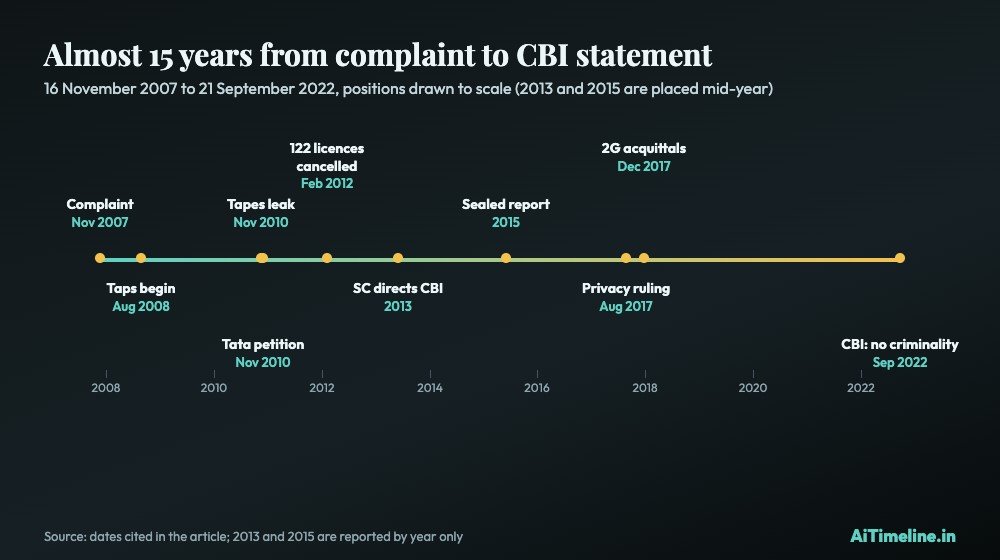
The Radia tapes are phone conversations recorded in 2008 and 2009 under government-authorised surveillance, about 5,800 in all. Excerpts were published in 2010. The Supreme Court heard Ratan Tata’s privacy petition and in 2013 directed a CBI inquiry. On 21 September 2022 the CBI told the Court its 14 preliminary enquiries found no criminality. That is an agency statement; the report is sealed, and a leaked excerpt is not proof of a crime.
Radia Tapes Controversy: Key Questions
The Radia Tapes in Ten Points
- The origin: a 16 November 2007 complaint to the Finance Minister led to authorised monitoring of Radia’s phones.
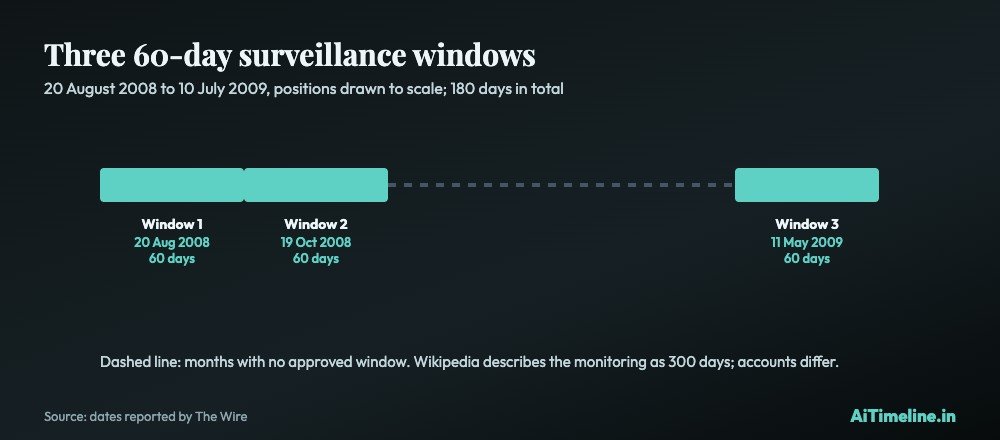
- The tap: three 60-day windows from 20 August 2008, 19 October 2008 and 11 May 2009, per The Wire.
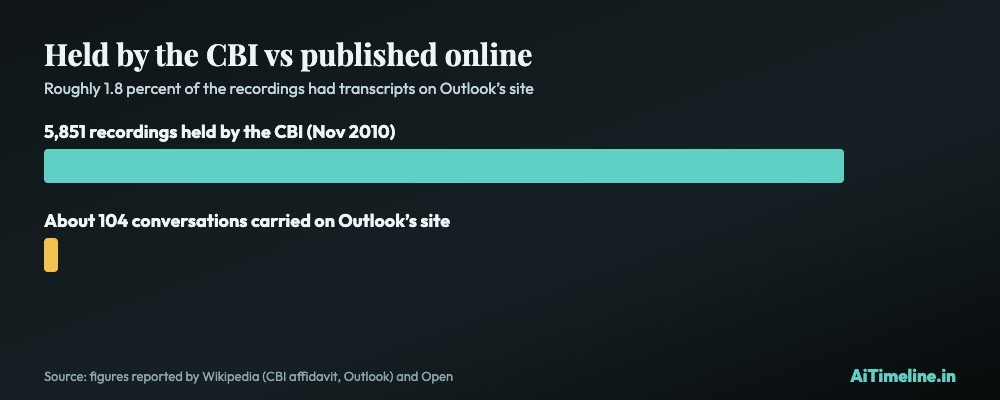
- The set: the CBI said in November 2010 that it held 5,851 recordings.
- The leak: Open and Outlook published transcripts in November 2010; only about 104 conversations were carried online.
- The source of the leak: not established; the government told the Court in August 2012 that it could not find it.
- The privacy case: Ratan Tata petitioned on 29 November 2010; notices issued on 2 December 2010.
- The inquiry: the Supreme Court directed a CBI inquiry on 17 October 2013.
- The outcome: 14 preliminary enquiries, a sealed 2015 report, and a 21 September 2022 statement that no criminality was found.
- The 2G link: the 2G trial ended in acquittals on 21 December 2017, and the Delhi High Court admitted the CBI’s appeal in March 2024; it is a separate case.
- The caution: leaked excerpts and allegations are not legal findings.
How the Controversy Unfolded: The Timeline, Latest First
Each entry is tagged as a surveillance record, a leak or allegation, a court step, a legal or investigative outcome, or context, and ends with why it matters.
Leaked excerpt, court step or investigative outcome? Filter the timeline by what kind of event each entry is.
–
The Delhi High Court admits the CBI’s appeal in the 2G case Court step
On 22 March 2024 the Delhi High Court granted the CBI leave to appeal against the 2017 acquittals of A. Raja and others, saying the agency had made out a prima facie case that needed a deeper examination of the evidence (LiveLaw). Leave to appeal is permission for the appeal to be heard on its merits; it is not a finding of guilt, and the acquittals stand unless reversed.
AiTimeline did not verify the appeal’s progress after 2024. Like the 2017 verdict, it concerns the 2G trial, not the Radia tapes inquiry.
The CBI tells the Supreme Court it found no criminality Legal or investigative outcome
At a hearing of Ratan Tata’s privacy petition on 21 September 2022, Additional Solicitor General Aishwarya Bhati told a three-judge bench headed by Justice D. Y. Chandrachud that the CBI had registered 14 preliminary enquiries after the Court’s 2013 direction and that “no criminality was found in those” (Scroll). The report on them had been placed before the Court in a sealed cover (The Wire).
She also told the Court that phone-tapping guidelines are now in place, and suggested the petition could be disposed of in light of the Court’s privacy judgment. The bench asked the CBI for an updated status report (DT Next). The Centre for Public Interest Litigation, represented by Prashant Bhushan, wants the transcripts made public (The Wire).
Keep the strands apart: this is the agency’s own account of what it found in the enquiries, as reported in court. AiTimeline did not find a published court judgment on the tapes, and the sealed report is not public.
The hearing was the first in about eight years; the matter had last been heard in 2014 (Business Today). The bench listed it again for 12 October 2022 (The Wire). Ratan Tata died on 9 October 2024 (NBC News). AiTimeline did not find a reported order on what became of his petition after the 2022 hearing, so its current status is not stated here.
A special court acquits all accused in the 2G case Legal or investigative outcome
On 21 December 2017 the special CBI court acquitted A. Raja, Kanimozhi and every other accused in the 2G spectrum cases, saying the prosecution had failed to prove the charges (The Wire, The News Minute). The CBI and the Enforcement Directorate said they would challenge the verdicts in the Delhi High Court (The Wire).
This was a different proceeding from the Supreme Court’s handling of the Radia tapes. The tapes were part of the public debate around the allocation, but the acquittal was decided on the evidence in the 2G criminal trial. See AiTimeline’s own 2G spectrum allocation timeline for that case.
The Supreme Court holds that privacy is a fundamental right Court step
In Justice K. S. Puttaswamy (Retd.) v. Union of India, a nine-judge bench held unanimously that privacy is a fundamental right under the Constitution (judgment). The ruling post-dated the leak of the tapes by almost seven years.
In 2022 the Centre told the Court that this privacy judgment could dispose of Ratan Tata’s petition (The Wire). The judgment did not itself decide the Radia tapes case.
The CBI files a sealed report in the Supreme Court Legal or investigative outcome
Following the Court’s 2013 direction, the CBI submitted a report on the outcome of its enquiries in a sealed cover in 2015, and the case was not taken up by the Court for years afterwards (DT Next).
Because the report is sealed, what it says is known only through what the CBI told the Court in 2022. Some 2015 press reports said the agency had cleared Radia; AiTimeline did not confirm those against a primary record.
The SFIO tells the Supreme Court it will prosecute Vaishnavi group companies Court step
In an affidavit reported in March 2014, the Serious Fraud Investigation Office said it had finished its investigation of Vaishnavi Corporate Communications and eight group companies, sent its final report to the Ministry of Corporate Affairs on 22 January, and that the ministry had sanctioned prosecution for alleged violations of the Companies Act (DNA). The reports were also sent to the CBI and the Income Tax Department.
These were alleged violations of company law, such as disclosure and related-party rules according to press reports. The company is reported to have said it was targeted by vested interests. AiTimeline did not find the outcome of any prosecution, so no finding of wrongdoing is stated here. This is also a different question from what any recorded conversation shows.
The Supreme Court directs the CBI to examine issues from the tapes Court step
On 17 October 2013 a bench headed by Justice G. S. Singhvi directed the CBI to inquire into criminal aspects of issues identified from the conversations by a team that had examined the transcripts (The Peninsula, Deccan Herald). The bench said that, prima facie, there was a “deep rooted malice by private enterprises in connivance with government officials” for extraneous purposes. That was a preliminary observation used to justify an inquiry, not a finding against any named person.
Reports differ on the number of issues sent to the CBI: six in one account, seven in another and fourteen in later reports (DT Next). One matter was referred to the Chief Justice of India and another to the vigilance wing of the Ministry of Mines (The Peninsula). The specific issues were not made public.
The CBI registered 14 preliminary enquiries. A preliminary enquiry is an early step to see whether a case should be registered; it is not an FIR or a charge. Earlier in 2013 a Business Standard report said a CBI and Income Tax team had started examining the recordings (PTI via Business Standard).
The government says it cannot trace the source of the leak Court step
In a sealed report reported on 24 August 2012, the government told the Supreme Court that it had been unable to find the source of the leak. As summarised by the bench, the report said it was difficult to find by which source the tapes were leaked. It also said that copies of the tapes in the government’s possession had been destroyed under the rules after the original was placed before the Court (Millennium Post). Prashant Bhushan, who sought disclosure of the full conversations, called this surprising.
The leak inquiry therefore produced no named source. Any claim about who leaked the tapes remains an account, not an official finding.
The Supreme Court cancels 122 telecom licences Court step
On 2 February 2012 the Supreme Court cancelled all 122 2G licences issued in 2008 and ordered future spectrum to be allocated by auction (Business Today, Deccan Herald). The judgment was about how the licences were allocated.
It was not a ruling on the Radia recordings. The tapes and the licences were linked in public debate, but they were decided in different proceedings with different evidence.
Radia closes her communications firms Context
Niira Radia announced on 30 October 2011 that she was leaving the corporate communications business, closing Vaishnavi Corporate Communications and its affiliates Noesis Strategic Consulting and Neucom Consulting (Business Today). Business Today reported that she had not been arrested or charged, and that she was listed as witness number 44 for the CBI in the 2G case. She later gave evidence as a prosecution witness in the special court.
Being a witness means a person is expected to give evidence; it does not make them an accused.
More excerpts appear and the government says the leak needs investigation Leak or allegation
On 2 December 2010 a bench of Justices G. S. Singhvi and A. K. Ganguly issued notices to the Home Secretary, the CBI, the Income Tax Department and the Finance Ministry on Ratan Tata’s petition, and made the magazines Open and Outlook parties; the Centre was asked to reply within ten days (Governance Now). In its reported affidavit the government said publication of Tata’s conversation was an issue between the media and the petitioner, but that the leak “requires investigation” (Governance Now).
Media outlets kept publishing excerpts; India Today ran a report on 10 December headlined as “new Radia tapes” on government and business ties (India Today). Wikipedia reports that the Prime Minister ordered an inquiry into the leak on 14 December (Wikipedia).
2010
Ratan Tata goes to the Supreme Court over the leak Court step
Ratan Tata petitioned the Supreme Court, arguing that publication of his recorded conversations with Radia infringed his right to privacy under Article 21. He argued that a tap authorised for a tax investigation could not be used for any other purpose, and asked for action over the leak and a halt to further publication (Legally India, The Wire).
His counsel said at the notice hearing that Tata was not seeking an injunction against the media, and that the concern was that audio of personal conversations not reach the public (Governance Now).
2010
Named journalists respond to the leaked excerpts Leak or allegation
NDTV rebutted on 18 November a suggestion about its journalist Barkha Dutt as “unsubstantiated, baseless and defamatory”, and the Hindustan Times said on 19 November that it could not ascertain the transcripts’ authenticity. Dutt said on 26 November that the tapes were edited and that she had not favoured A. Raja; Vir Sanghvi issued a clarification of his role on 27 November (Wikipedia).
These were the people’s own accounts. A journalist speaking to a source, even about the source’s agenda, is not by itself proof of a lapse in editorial independence, and several of those named disputed how the excerpts were read.
2010
The CBI says it holds 5,851 recordings Surveillance record
In an affidavit filed in the Supreme Court on 22 November 2010 the CBI said it held 5,851 recordings and that Radia would be approached “at an appropriate time”, with its probe to be complete by March 2011 (Wikipedia). The Enforcement Directorate questioned Radia on 24 November.
This is the first reported sign in the record that the recordings had reached investigators, although the date of the handover from the Income Tax Department is not confirmed in the sources AiTimeline checked.
Open and Outlook publish transcripts and the tapes become public Leak or allegation
In November 2010 Open magazine published transcripts of some of the conversations and Outlook published more, with Outlook’s site carrying transcripts and audio of 104 conversations (Wikipedia, Open). Only a fraction of the roughly 5,800 recorded conversations was ever published.
The excerpts involved lobbyists, ministers, executives and journalists. They were partial and selected for publication, and the full set stayed in official custody, so context was missing for readers. AiTimeline has not reproduced any excerpt.
2010
A. Raja resigns as telecom minister Context
Telecom minister A. Raja resigned on 14 November 2010 amid the controversy over the 2008 licence allocation. The resignation came before the Radia transcripts were widely published, so it was not caused by them. He was later tried in the 2G case and acquitted in December 2017.
Earlier reports about Radia and ministerial lobbying appear Leak or allegation
Wikipedia records that Mid-day reported on 29 April 2010 on taps of industrialists and journalists, and that India Today reported on 5 May 2010 that Radia had lobbied for Raja to be appointed telecom minister (Wikipedia). Conversations were thus partly in the public domain months before the Open and Outlook transcripts.
Surveillance is authorised a third time Surveillance record
The Wire reports that Radia’s phone was put under surveillance for a further 60 days from 11 May 2009, the third approved window in all (The Wire). This fell around the cabinet-formation period after the 2009 general election. Wikipedia describes the monitoring as lasting 300 days, so published accounts of the total differ.
Surveillance of Radia’s phone begins Surveillance record
According to The Wire, surveillance began on 20 August 2008 for 60 days, followed by a second 60-day window from 19 October 2008 (The Wire). The Income Tax Department tapped the lines after authorisation from the Union Home Secretary, during an investigation into possible tax evasion and related financial matters.
Authorised interception is lawful if the procedure is followed. The questions the controversy raised were about what happened to the recordings afterwards, not about whether the tap existed.
A complaint to the Finance Minister prompts scrutiny of Radia Leak or allegation
The Wire dates a complaint to the Finance Minister to 16 November 2007. It alleged that Radia had built a business empire worth Rs 300 crore in nine years (The Wire).
A complaint is an allegation, not a finding. It is the reason the Income Tax Department sought permission to monitor her phones.
What the Radia Tapes Showed, and What They Did Not
Four themes, each with the limit on what can be concluded.
Corporate lobbying and access. The published excerpts led readers to ask how lobbyists connect companies with policymakers. Lobbying is not illegal in India; it becomes a legal matter only if it involves an offence such as bribery or conspiracy. That is why investigators looked for specific offences, not for lobbying itself.
Media ethics. Some excerpts involved journalists speaking with Radia. Critics asked whether this showed too close a relationship with sources. The journalists named said they were doing normal reporting work and that excerpts were edited or out of context (Wikipedia). A recorded conversation does not by itself show that editorial independence was surrendered.
Telecom policy and 2G. The tapes surfaced in the middle of the 2G controversy and fed the debate on who influenced ministerial appointments. But the tapes inquiry and the 2G criminal trial had different evidence and different outcomes.
Privacy and surveillance. Even a lawful tap raises the question of who may disclose the recording. Tata’s petition put that question to the Court, and the later privacy judgment of 2017 strengthened the constitutional frame without deciding his case.
Leaked Excerpt, Allegation or Finding?
The same story, sorted by how strong each claim actually is.
| Statement | Where it came from | Type | What happened to it |
|---|---|---|---|
| Radia had built a Rs 300 crore business empire in nine years | Complaint to the Finance Minister, 16 Nov 2007 | Allegation | Led to the decision to monitor her phones; the allegation itself was never tested in public |
| Radia lobbied for A. Raja to become telecom minister | India Today report, 5 May 2010 | Press report | Reported from conversations; Raja’s eventual 2G trial ended in acquittal in Dec 2017 |
| Barkha Dutt and Vir Sanghvi appear in excerpts | Open and Outlook transcripts, Nov 2010 | Leaked excerpt | Both disputed how the excerpts were read: Dutt said they were edited, Sanghvi clarified his role. No legal finding was made against either |
| The publication of his conversations violated his right to privacy | Ratan Tata, petition of 29 Nov 2010 | Legal claim | Notices issued 2 Dec 2010; the petition was still before the Court in Sep 2022 |
| Prima facie “deep rooted malice by private enterprises in connivance with government officials” | Supreme Court bench, 17 Oct 2013 | Preliminary court observation | The Court directed the CBI to inquire; it did not itself find an offence or name anyone |
| No criminality was found in the 14 preliminary enquiries | CBI through ASG Aishwarya Bhati, 21 Sep 2022 | Investigative outcome | Sealed report; the Court asked for an updated status report |
| The accused in the 2G case were guilty | CBI prosecution case | Allegation | All accused acquitted, 21 Dec 2017; Delhi High Court granted the CBI leave to appeal on 22 Mar 2024 |
| Vaishnavi group companies violated the Companies Act | SFIO affidavit, Mar 2014 | Allegation (prosecution sanctioned) | Outcome not found by AiTimeline; the company is reported to have said it was targeted |
| The source of the leak cannot be traced | Government sealed report, Aug 2012 | Official statement | No source named; government copies said to have been destroyed under the rules |
Where Each Strand Stands
As verified on 23 October 2026. “Not checked” means AiTimeline did not verify it, not that nothing changed.
| Strand | Body | Latest outcome AiTimeline verified | Final? |
|---|---|---|---|
| Ratan Tata’s privacy petition | Supreme Court | Heard 21 Sep 2022 after an eight-year gap; listed for 12 Oct 2022. Ratan Tata died on 9 Oct 2024 | No later order found |
| Enquiries arising from the tapes | CBI | 14 preliminary enquiries; sealed report 2015; “no criminality” stated 21 Sep 2022 | Sealed report not public |
| Release of the transcripts | Supreme Court (CPIL request) | CPIL, through Prashant Bhushan, wants them made public; no order found | No |
| Who leaked the tapes | Government; Supreme Court | Sealed government report, Aug 2012: source could not be found | No finding |
| Vaishnavi group companies | SFIO; Ministry of Corporate Affairs | Prosecution for alleged Companies Act violations sanctioned, reported Mar 2014 | Outcome not found |
| 2G criminal trial | Special CBI court; Delhi High Court | All accused acquitted 21 Dec 2017; CBI granted leave to appeal 22 Mar 2024 | Appeal pending as last verified |
| 2G licences | Supreme Court | 122 licences cancelled, 2 Feb 2012 | Yes |
Why the Controversy Still Matters
Transparency. Public decisions that involve large commercial interests should be open to scrutiny, and the tapes showed how little of the process the public usually sees.
Accountability needs evidence. What a conversation appears to suggest is different from what an investigation can establish. The CBI’s reported finding of no criminality is a limit on claims that the tapes proved a conspiracy, though not on questions of ethics.
Media independence. The episode prompted newsrooms to discuss how they handle access and sources.
Privacy. Authorised interception and later disclosure are separate legal questions. The same issue returns with every leak of messages or calls.
For other stories about accountability and the courts see the Bofors timeline and the electoral bonds ruling.
The Story at a Glance
Dates from the sources listed below, with the type of each entry.
| Date | Event | Type |
|---|---|---|
| 16 Nov 2007 | Complaint to the Finance Minister about Radia | Allegation |
| 20 Aug 2008 | Surveillance window one begins | Surveillance record |
| 19 Oct 2008 | Surveillance window two begins | Surveillance record |
| 11 May 2009 | Surveillance window three begins | Surveillance record |
| 29 Apr and 5 May 2010 | Press reports on taps and lobbying | Leak or allegation |
| 14 Nov 2010 | A. Raja resigns | Context |
| Nov 2010 | Open and Outlook publish transcripts | Leak or allegation |
| 22 Nov 2010 | CBI says it holds 5,851 recordings | Surveillance record |
| 29 Nov 2010 | Ratan Tata petitions the Supreme Court | Court step |
| 2 Dec 2010 | Supreme Court issues notices | Court step |
| 2 Feb 2012 | 122 telecom licences cancelled | Court step |
| 30 Oct 2011 | Radia closes her firms | Context |
| Aug 2012 | Government cannot trace the leak | Court step |
| 17 Oct 2013 | Supreme Court directs a CBI inquiry | Court step |
| Mar 2014 | SFIO says it will prosecute Vaishnavi group companies | Court step |
| 2015 | Sealed CBI report | Investigative outcome |
| 24 Aug 2017 | Privacy held to be a fundamental right | Court step |
| 21 Dec 2017 | 2G accused acquitted | Legal outcome |
| 21 Sep 2022 | CBI says no criminality found | Investigative outcome |
| 22 Mar 2024 | Delhi High Court admits CBI’s 2G appeal | Court step |
| 9 Oct 2024 | Ratan Tata dies | Context |
| Term | Meaning | Why it matters here |
|---|---|---|
| Lobbying | Advocacy to influence public decisions | Lawful in itself; the controversy was about where advocacy ends and improper influence begins |
| Interception | Authorised monitoring of phone calls | The Radia taps were authorised by the Home Secretary for a tax inquiry |
| Preliminary enquiry | An early CBI step to test whether a case should be registered | The CBI opened 14; it is not an FIR or a charge |
| Sealed cover | A report given to the court but not disclosed to the parties or public | The CBI’s 2015 report is in sealed cover |
| Article 21 | Constitutional protection of life and personal liberty, read to include privacy | Ratan Tata’s petition rests on it |
| Puttaswamy | 2017 nine-judge ruling that privacy is a fundamental right | Cited in 2022 as a ground to dispose of Tata’s petition |
| CPIL | Centre for Public Interest Litigation, an NGO | Asks that the transcripts be made public |
| Leave to appeal | Permission for an appeal against an acquittal to be heard on merits | Granted to the CBI in the 2G case on 22 Mar 2024; not a finding of guilt |
| Prosecution witness | A person the prosecution calls to give evidence | Radia’s status in the 2G trial; not an accused |
| Presumptive loss | The CAG’s estimate of revenue not earned on the 2G allocation | A separate 2G issue that is often confused with the tapes |
Who Is Who in the Story
Niira Radia
Ran Vaishnavi Corporate Communications and Noesis Strategic Consulting Services; her phones were monitored in 2008 and 2009. Closed her firms in October 2011; listed as a CBI witness in the 2G case.
Ratan Tata
Petitioned the Supreme Court on 29 November 2010, saying the publication of his conversations violated his right to privacy. Died on 9 October 2024.
A. Raja
Resigned on 14 Nov 2010; acquitted with all other accused by the special CBI court on 21 Dec 2017.
Barkha Dutt and Vir Sanghvi
Appear in published excerpts; each disputed how the excerpts were read.
The CBI
Held 5,851 recordings by Nov 2010; registered 14 preliminary enquiries after the Court’s 2013 direction.
Income Tax Department
Recorded the calls under government authorisation during a tax inquiry.
CPIL and Prashant Bhushan
Argue that the transcripts should be made public.
Justice D. Y. Chandrachud
Headed the three-judge bench, with Justices Hima Kohli and P. S. Narasimha, that heard the CBI on 21 Sep 2022.
The Popular Story vs the Record
| Popular version | What the record shows |
|---|---|
| The tapes proved a criminal conspiracy | A recording is not a legal finding. The CBI told the Supreme Court in Sep 2022 that its enquiries found no criminality, and the report is sealed |
| The tapes were illegally recorded | They were recorded under surveillance authorised for a tax investigation. The dispute is over the later leak and disclosure, not the original tap |
| All 5,800 conversations were published | About 104 conversations were carried on Outlook’s site. The full set stays in official custody |
| The tapes caused A. Raja’s resignation | He resigned on 14 Nov 2010, before the main Open and Outlook releases |
| Niira Radia was charged over the tapes | AiTimeline found no such charge. She was listed as CBI witness number 44 in the 2G case and closed her firms in Oct 2011 |
| The 2G acquittals cleared the tapes | The Dec 2017 verdicts were about the 2G trial evidence. The tapes inquiry is a separate Supreme Court matter |
| Journalists named in the excerpts were found to have broken the law | No court or investigating agency AiTimeline found made such a finding. The media-ethics debate is about standards and perception |
Explore More Timelines
People Also Ask
Frequently Asked Questions
Sources and Further Reading
- The Wire: CBI to SC, no criminality found in intercepted conversations of Niira Radia
- Scroll: Did not find any criminality in Niira Radia tapes, CBI tells Supreme Court
- DT Next: No criminality was found in Niira Radia tapes, CBI tells SC
- The Quint: No criminality found in intercepted conversations of Niira Radia, CBI tells SC
- Hindustan Times: No criminality found in Niira Radia tapes, CBI tells Supreme Court
- Governance Now: SC seeks responses from Centre, Outlook and Open on Radia tapes
- Governance Now: Govt favours probe into leaking of Radia tapes
- Legally India: Ratan Tata claims Radia tapes violated privacy
- Open: The rest of the X-tapes
- Deccan Herald: SC wants thorough CBI probe into Radia tapes
- Deccan Herald: SC orders CBI probe into Radia tapes revelations (October 2013)
- The Peninsula: SC orders CBI probe of Radia tapes revelations
- Millennium Post: Govt clueless on Radia tapes (August 2012)
- DNA: Niira Radia’s firms to be prosecuted, SFIO tells Supreme Court
- Business Today: Niira Radia exits corporate communication business
- Business Today: Ratan Tata vs Niira Radia tapes, SC to hear case after 8 years
- Verdictum: No criminality found in Niira Radia tapes, CBI to Supreme Court
- LiveLaw: Delhi High Court admits CBI’s appeal against acquittal of A Raja and others
- NBC News: Ratan Tata dies at 86
- Business Standard (PTI): CBI, Income Tax team start examining Radia tapes
- India Today: New Radia tapes, more on government and business ties
- Wikipedia: Radia tapes controversy
- Wikipedia: Niira Radia
- Supreme Court of India: Justice K. S. Puttaswamy (Retd.) v. Union of India, 24 August 2017
- The Wire: All those accused in 2G scam case acquitted by CBI court
- The News Minute: 2G case verdict, A Raja and Kanimozhi found not guilty
- Business Today: Supreme Court cancels 122 2G spectrum licences
- Deccan Herald: SC axes 2G licences
- The Indian Express: 2G scam, chronology of events
Related AiTimeline Stories
⚠️ Editorial Note
Last updated 23 October 2026. This is editorial information, not legal advice. Leaked excerpts, allegations, court steps and investigative outcomes are labelled separately. A recorded conversation is not by itself proof of a crime, and the CBI’s September 2022 statement is the agency’s account to the Court, not a finding that every public concern was resolved. AiTimeline has not reproduced any excerpt. No person named on this page has been convicted of any offence in connection with the tapes, and court observations quoted here were preliminary. Corrections to the draft brief: surveillance ran in three 60-day windows (20 Aug 2008, 19 Oct 2008, 11 May 2009), not continuously to July 2009, though Wikipedia gives 300 days; Ratan Tata’s petition was filed on 29 November 2010 and the Court issued notices on 2 December 2010, not in January 2011; a CBI affidavit of 22 November 2010 put the recordings at 5,851; the Court’s direction to the CBI is dated to 2013 (one report says October); the brief’s “15 November 2010” PIL and “May 2010 Radia-Raja” conversation entries and the claim that enquiries were closed for lack of evidence could not be confirmed, and several brief links (including a Tribune URL that points to an unrelated article) were replaced. Wikipedia’s “April 2013 SFIO report” is replaced with the SFIO affidavit reported in March 2014. Unverified and flagged: the handover date of recordings to investigators, the total length of surveillance, the outcome of the SFIO prosecution, and the status of Ratan Tata’s petition after 2022.
Sources & further reading
Every dated entry above was checked against these references. Last reviewed 23 October 2026.
- The Wire: CBI to SC, no criminality found in intercepted conversations of Niira Radia
- Scroll: Did not find any criminality in Niira Radia tapes, CBI tells Supreme Court
- DT Next: No criminality was found in Niira Radia tapes, CBI tells SC
- The Quint: No criminality found in intercepted conversations of Niira Radia, CBI tells SC
- Hindustan Times: No criminality found in Niira Radia tapes, CBI tells Supreme Court
- Governance Now: SC seeks responses from Centre, Outlook and Open on Radia tapes
- Governance Now: Govt favours probe into leaking of Radia tapes
- Legally India: Ratan Tata claims Radia tapes violated privacy
- Open: The rest of the X-tapes
- Deccan Herald: SC wants thorough CBI probe into Radia tapes
- Deccan Herald: SC orders CBI probe into Radia tapes revelations (October 2013)
- The Peninsula: SC orders CBI probe of Radia tapes revelations
- Millennium Post: Govt clueless on Radia tapes (August 2012)
- DNA: Niira Radia's firms to be prosecuted, SFIO tells Supreme Court
- Business Today: Niira Radia exits corporate communication business
- Business Today: Ratan Tata vs Niira Radia tapes, SC to hear case after 8 years
- Verdictum: No criminality found in Niira Radia tapes, CBI to Supreme Court
- LiveLaw: Delhi High Court admits CBI's appeal against acquittal of A Raja and others
- NBC News: Ratan Tata dies at 86
- Business Standard (PTI): CBI, Income Tax team start examining Radia tapes
- India Today: New Radia tapes, more on government and business ties
- Wikipedia: Radia tapes controversy
- Wikipedia: Niira Radia
- Supreme Court of India: Justice K. S. Puttaswamy (Retd.) v. Union of India, 24 August 2017
- The Wire: All those accused in 2G scam case acquitted by CBI court
- The News Minute: 2G case verdict, A Raja and Kanimozhi found not guilty
- Business Today: Supreme Court cancels 122 2G spectrum licences
- Deccan Herald: SC axes 2G licences
- The Indian Express: 2G scam, chronology of events