Why Pawan Bansal Resigned: The 2013 Railway Bribery Scandal
Follow the 2013 railway bribery scandal, from Vijay Singla's arrest and the alleged ₹10-crore posting deal to Pawan Bansal's resignation and the CBI probe.
Latest Story
On the night of 3 May 2013 CBI officers in Chandigarh arrested the Railway Minister’s nephew with close to Rs 90 lakh. The agency said it was the first instalment of a Rs 10 crore deal to get a newly appointed Railway Board member the post he really wanted. A week later the minister was gone. This Pawan Bansal resignation timeline follows the 2013 railway bribery case from the alleged deal and the arrests to the political collapse, and then through the part most accounts skip: the CBI chargesheet that named ten accused but listed Bansal only as a witness, the trial, and the money-laundering case that followed.
💡 Short Answer
Pawan Kumar Bansal resigned as Railway Minister on 10 May 2013, a week after the CBI arrested his nephew Vijay Singla with Rs 89.68 lakh, allegedly the first part of a Rs 10 crore bribe for a Railway Board post. Bansal denied any role. The CBI did not charge him: its 2 July 2013 chargesheet named ten others and made him a prosecution witness. His exit was political, not a conviction.
Pawan Bansal Resignation: Key Questions
Railgate in Ten Points
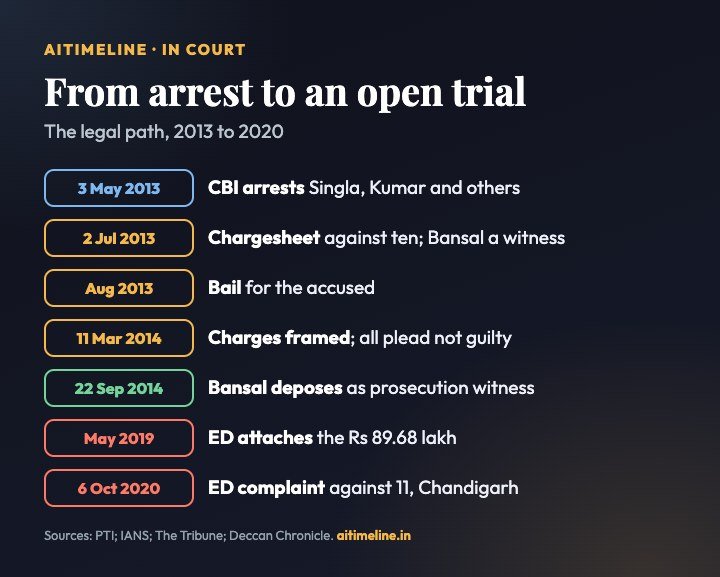
- October 2012: Bansal took Railways, the first Congress minister there in about 17 years.
- 1 May 2013: Mahesh Kumar was appointed Member (Staff) of the Railway Board.
- The allegation: Rs 10 crore for the more powerful post of Member (Electrical).
- 3 May 2013: the CBI arrested Bansal’s nephew Vijay Singla with Rs 89.68 lakh.
- 8 May 2013: Parliament rose early amid demands for Bansal’s resignation.
- 10 May 2013: Bansal resigned; Law Minister Ashwani Kumar quit the same night over a separate issue.
- 2 July 2013: ten people were chargesheeted. Bansal was a witness, not an accused.
- 11 March 2014: charges were framed; the accused pleaded not guilty.
- 22 September 2014: Bansal testified that his nephew never raised Kumar’s posting with him.
- 2019 and 2020: the ED attached the cash and filed a money-laundering complaint against 11.
Timeline: From the Alleged Deal to the Courtroom
Newest first. Colour shows which strand of the story each event belongs to.
Where things stand: no verdict found, Bansal never charged Money trail and after
The CBI case: Charges were framed against ten accused in March 2014 and the trial before a special CBI court in Delhi began recording evidence in September 2014. We found no published report of a final judgment convicting or acquitting the accused in the main bribery case.
Bansal: Pawan Kumar Bansal was never an accused. The CBI made him a prosecution witness, and he deposed in that capacity in September 2014. His resignation was political, not the result of any charge or conviction.
Bansal returns as Congress treasurer Money trail and after
The role: After the death of Ahmed Patel, the Congress named Pawan Kumar Bansal its interim treasurer on 28 November 2020. He held the post until October 2023, when Ajay Maken took over.
Why it matters here: The appointment showed the party did not treat the 2013 case as a bar to senior office, consistent with the CBI’s decision not to charge him.
ED files a money-laundering complaint against 11 Money trail and after
The complaint: The ED filed a prosecution complaint under the Prevention of Money Laundering Act, 2002, the PMLA equivalent of a chargesheet, against Mahesh Kumar, N. Manjunath, Sandeep Goyal, Vijay Singla, Ajay Garg, Rahul Yadav, Sameer Sandhir, Sushil Daga, C.V. Venugopal, M.V. Murali Krishna and a company, Venkateshwara Rail Nirman Pvt Ltd.
The allegation: The ED said the bribe money had been layered through the accounts of several companies and individuals, with hawala operators, to make it look like ordinary business transactions. It sought punishment and confiscation of assets.
ED attaches the Rs 89.68 lakh Money trail and after
The action: The ED provisionally attached Rs 89,68,000, the cash the CBI said was delivered to Vijay Singla in May 2013, treating it as proceeds of crime under the PMLA.
What it is not: A provisional attachment freezes property during an investigation. It is not a finding of guilt in the CBI’s bribery case.
Bansal deposes as a prosecution witness CBI case and trial
What he said: “Accused Vijay Singla never spoke to me about the appointment of accused Mahesh Kumar for any post,” Bansal told the court. He said Singla had visited him three times during his tenure as minister.
On Mahesh Kumar: He said Kumar had met him in the first week of April 2013, before his appointment as Member (Staff) on 1 May 2013, and that Kumar was the senior-most eligible officer for that post.
Trial evidence begins CBI case and trial
The stage: The court began recording prosecution evidence against the ten accused. Bansal was summoned as a witness.
The case: The CBI’s allegation was that Singla had demanded Rs 10 crore from Kumar for his appointment as Member (Electrical), Rs 5 crore before the appointment and the rest after, and was caught accepting the first tranche of about Rs 90 lakh.
Charges framed against ten accused CBI case and trial
The order: On 7 March the court said it had found prima facie evidence against all ten accused and ordered charges to be framed. On 11 March it framed charges of criminal conspiracy and corruption, including that the accused conspired to get Mahesh Kumar appointed Member (Electrical).
The plea: “We do not plead guilty and claim trial,” the accused told the court.
The accused get bail CBI case and trial
The orders: The Delhi High Court granted bail to accused including Vijay Singla and the suspended Railway Board member Mahesh Kumar. The trial court separately granted bail to Rahul Yadav, Sameer Sandhir and Sushil Daga on personal bonds of Rs 5 lakh each.
Why now: With the chargesheet filed, the investigation stage that justified custody was over.
Witness, not accused: the clean-chit row CBI case and trial
The list: The chargesheet named 90 prosecution witnesses. Bansal was number 39. The CBI said it had no tapped conversation showing he was involved in, or knew of, the deal.
The objections: The BJP said Bansal had not been charged to protect the government. Defence lawyers asked why, if the minister was not involved, the case against their clients should stand. The judge said that if the CBI chose to make Bansal a witness, the court could not question that at this stage, except during the trial.
CBI chargesheets ten; Bansal not among them CBI case and trial
The accused: Mahesh Kumar, Vijay Singla, middlemen Sandeep Goyal, Sameer Sandhir, Sushil Daga, Ajay Garg and Rahul Yadav, businessman Narayan Rao Manjunath of Bengaluru’s G.G. Tronics, and his aides M.V. Murali Krishna and C.V. Venugopal.
The timing: The CBI filed it on the 60th day after the arrests, just ahead of the deadline after which the accused would have been entitled to default bail.
The CBI questions Bansal CBI case and trial
The questioning: The CBI questioned Bansal about his nephew’s activities and his meetings with Mahesh Kumar. Earlier it had questioned officials in his office, including his private secretary.
His position: Bansal denied any knowledge of the alleged deal. Phone intercepts in the case were later reported to have been confirmed as genuine by forensic tests.
Chandigarh rejects him at the polls Political fallout
The result: Bansal, Chandigarh’s MP since 1999, lost the seat to the BJP’s Kirron Kher in the 2014 general election, in which the Congress-led UPA was swept from power.
The backdrop: Railgate was one of several corruption controversies the BJP used against the UPA in that campaign.
Resignations accepted; Joshi takes Railways Political fallout
The formalities: The President accepted the resignations of Pawan Kumar Bansal and Law Minister Ashwani Kumar on the Prime Minister’s advice. C.P. Joshi was given additional charge of Railways and Kapil Sibal of Law and Justice.
The tenure: Bansal’s time as Railway Minister had lasted a little over six months.
Bansal resigns Political fallout
The decision: After Congress president Sonia Gandhi met Prime Minister Manmohan Singh, Bansal resigned as Railway Minister. Law Minister Ashwani Kumar resigned the same evening, over a separate controversy about changes to a CBI status report on the coal-block allocations case.
His stand: Bansal continued to deny wrongdoing. The resignation was a political decision; he had not been charged.
Parliament rises; Karnataka results come in Political fallout
In Parliament: The Budget session ended two days early after repeated disruptions, with the opposition demanding the resignation of Bansal and of Ashwani Kumar.
In the party: The Congress had been reported to be deferring any decision on Bansal until the Karnataka Assembly results. That day it won Karnataka.
Bansal stays; the opposition demands he go Political fallout
The minister: Bansal met Prime Minister Manmohan Singh after his nephew’s arrest and publicly distanced himself from Singla, saying his relatives had no role in his official work.
The pressure: The BJP and other parties demanded his sacking and alleged a link between the minister and the deal. The Congress initially defended him.
The CBI arrests the minister’s nephew The CBI trap
In Chandigarh: CBI officers arrested Vijay Singla, the son of Bansal’s sister, after money allegedly sent on behalf of Mahesh Kumar was delivered to him. The CBI put the amount at Rs 89.68 lakh, close to Rs 90 lakh.
In Mumbai: Mahesh Kumar was detained at Mumbai airport on his return from Delhi, late on 3 May. Middleman Sandeep Goyal and others were also arrested, and the Railway Ministry suspended Kumar on receiving the CBI’s report.
The alleged Rs 10 crore deal The CBI trap
The post: According to the CBI, Kumar wanted to be Member (Electrical), a Railway Board post that deals with large contracts, and a deal of Rs 10 crore was struck through middlemen: Rs 5 crore before the appointment and the rest after.
The route: The CBI alleged that Bengaluru businessman N.R. Manjunath, whose company supplied railway equipment, arranged money for Kumar, and that middlemen including Sandeep Goyal linked the deal to Singla. The agency had been tapping phones.
Mahesh Kumar becomes Member (Staff) Background
The promotion: Mahesh Kumar, General Manager of Western Railway and a 1975-batch Indian Railway Service of Signal Engineers officer, was appointed Member (Staff) of the Railway Board, a post in charge of recruitment and personnel.
The meeting: Bansal later testified that Kumar had met him in the first week of April 2013 and that Kumar was the senior-most eligible officer for the post.
Bansal presents the Rail Budget Background
The budget: Bansal presented the 2013-14 Rail Budget, the first by a Congress Railway Minister in about 17 years, announcing new trains and passenger amenities.
The context: He was seen as a low-key minister who had brought the portfolio back to the Congress from its allies.
Bansal becomes Railway Minister Background
The appointment: Pawan Kumar Bansal, the Chandigarh MP and former Parliamentary Affairs Minister, took charge of Railways in a Cabinet reshuffle, succeeding C.P. Joshi.
The significance: For most of the previous 17 years Railways had been held by coalition partners, including the Trinamool Congress, the RJD and the JD(U).
What Was the Alleged Rs 10 Crore Railway Bribery Deal?
The CBI’s case, which is still an allegation.
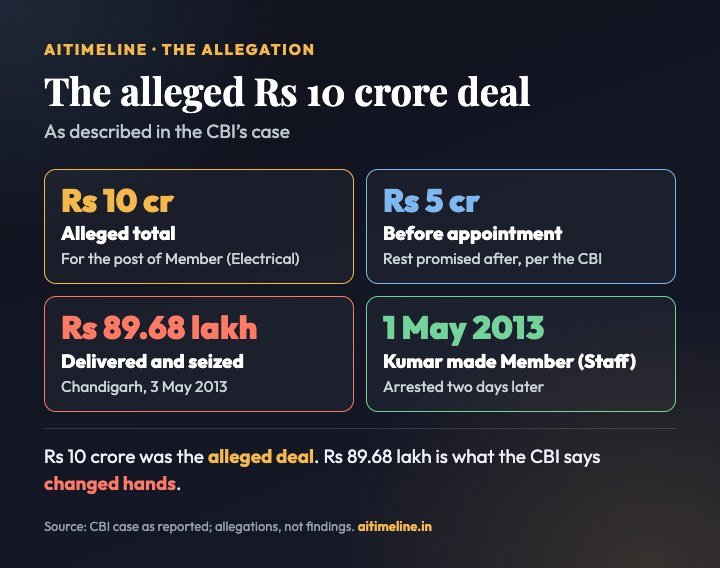
The Railway Board is the top management of Indian Railways. Its Members, each in charge of a function, sit at the level of a secretary to the Government of India. Mahesh Kumar had just been made Member (Staff), which covers recruitment and personnel. According to the CBI, he wanted to be Member (Electrical), which oversees large electrical contracts, and middlemen promised to arrange that through Vijay Singla for Rs 10 crore. The agency said the money was arranged by Bengaluru businessman N.R. Manjunath, whose company supplied the Railways, and that the first delivery, Rs 89.68 lakh, reached Singla on 3 May 2013. Two figures are often confused: Rs 10 crore was the alleged total; Rs 89.68 lakh was what the CBI said was actually handed over and seized.
Who Were the Accused?
Ten people in the CBI case, eleven in the ED’s.
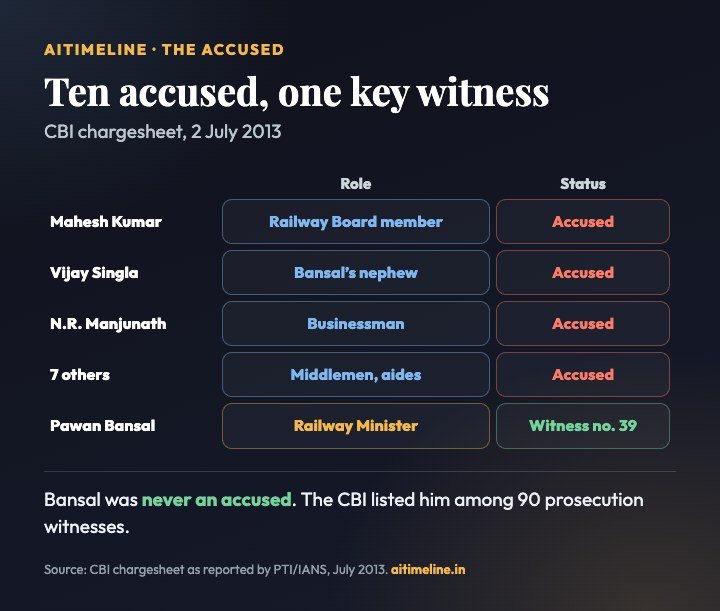
| Person | Role, as alleged or recorded |
|---|---|
| Pawan Kumar Bansal | Railway Minister, 28 Oct 2012 to 10 May 2013. Not accused; prosecution witness |
| Vijay Singla | Bansal’s nephew. Accused of accepting the alleged bribe |
| Mahesh Kumar | Member (Staff), Railway Board. Accused of paying for a better post; suspended |
| N.R. Manjunath | MD, G.G. Tronics India, Bengaluru. Accused of arranging the money |
| Sandeep Goyal, Ajay Garg | Alleged middlemen |
| Rahul Yadav, Sameer Sandhir, Sushil Daga | Accused of helping arrange or deliver payments |
| M.V. Murali Krishna, C.V. Venugopal | Aides of Manjunath, accused |
Why Did Pawan Bansal Resign?
Eight days, from arrest to resignation.
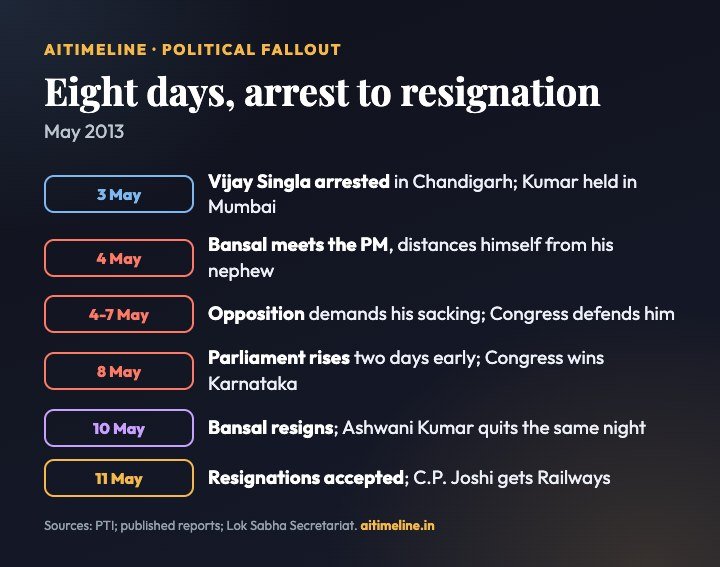
A close relative arrested
The money was allegedly delivered to the minister’s own nephew, which put the case inside his family whatever his own knowledge.
A Railway Board post
The alleged deal concerned a senior appointment in a ministry he headed, raising questions about influence over postings.
A session lost
Opposition protests over Bansal and Ashwani Kumar helped end the Budget session two days early, on 8 May.
The leadership decides
Once the Karnataka results were in, Sonia Gandhi met the Prime Minister and both ministers resigned that evening.
None of those reasons is a finding of guilt. Bansal resigned while saying he had done nothing wrong, and nothing the CBI later filed contradicted him. The resignation answered a political question, whether a minister could keep his job while his nephew was in custody over a posting in his own ministry, not a legal one.
Was Pawan Bansal Accused in the Case?
No. This is the distinction that matters most.
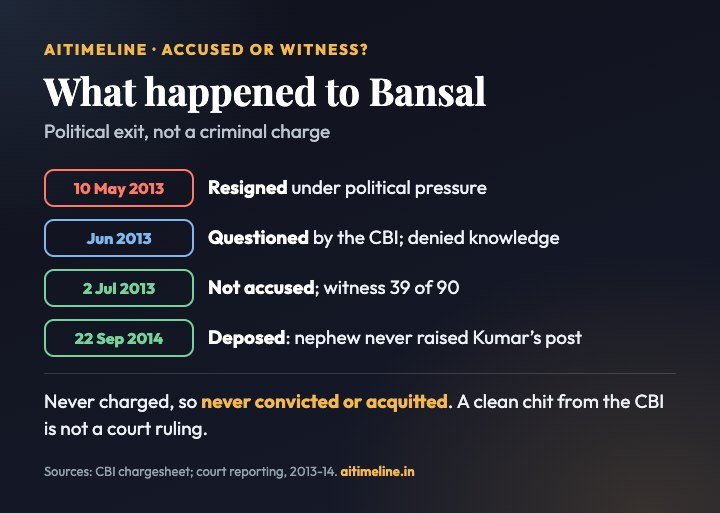
What happened to Bansal
- Resigned under political pressure.
- Questioned by the CBI.
- Not named as an accused.
- Listed as a prosecution witness.
- Deposed in September 2014.
What did not happen
- No charge was filed against him.
- No court found him guilty.
- No court acquitted him either: he was never tried.
- No tapped call linking him to the deal was produced, the CBI said.
A prosecution witness is someone the investigating agency expects to support its case against the accused. By putting Bansal on its witness list the CBI was, in effect, saying that it believed his nephew had used his name without his knowledge. The opposition called it a clean chit designed to protect the government, and defence lawyers argued that it undercut the case against their clients. The special judge said the court could not second-guess the CBI’s choice at that stage. In the witness box in September 2014, Bansal said Singla had never spoken to him about Mahesh Kumar’s appointment.
Three Tracks: Politics, the CBI Case and the ED Case
They moved at very different speeds.
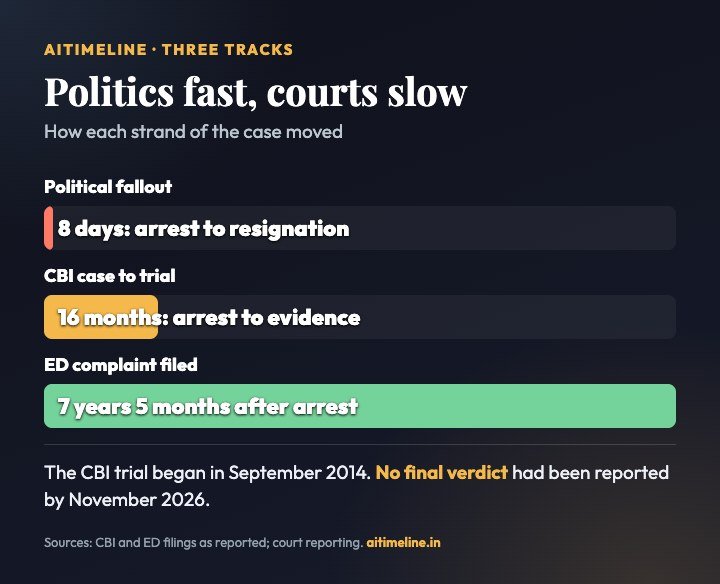
Closed in 8 days
- Arrest, 3 May 2013.
- Resignation, 10 May.
- Seat lost, 2014.
On trial
- Ten chargesheeted, 2013.
- Charges framed, 2014.
- No verdict found.
Filed 2020
- Cash attached, 2019.
- 11 accused, Chandigarh.
- Separate from the CBI case.
Why the Railgate Case Still Matters
Postings for sale
The allegation was that a top Railway Board post could be bought through people close to the minister.
Political vs criminal
A minister left office without being charged, a reminder that the two kinds of responsibility are separate.
One scandal among many
It came amid the 2G and coal-block controversies and fed the corruption narrative of the 2014 election.
Slow justice
More than thirteen years after the arrests, no final verdict in the main case has been reported.
The railway bribery scandal ended Pawan Bansal’s ministerial career in a week. The legal case it started has taken far longer and, on the public record, has not ended. The core lesson is the one that is easiest to lose in a headline: the minister resigned, but he was never accused. His nephew and nine others were.
Explore More Timelines
People Also Ask
Frequently Asked Questions
Dated facts from court reporting, the CBI and ED filings, and contemporary reports, 2012 to 2026.
⚠️ Editorial Note
This account draws on contemporary reporting of the CBI’s arrests, chargesheet and court proceedings (PTI, IANS, Deccan Chronicle, The Hans India, Business Standard, Millennium Post), the Enforcement Directorate’s complaint as reported by The Tribune, and parliamentary records. The CBI’s description of the deal is an allegation that has not been tested to a verdict. Checking the brief this page began from: the CBI’s naming of Bansal as a prosecution witness was part of its 2 July 2013 chargesheet (reported on 3 and 4 July), not a separate step on 5 July; the claim that the chargesheet placed a meeting at Bansal’s residence could not be confirmed and is not included; and the ED action of 2019 was followed by a prosecution complaint on 6 October 2020. An earlier draft’s claim that Singla and Kumar were convicted in February 2024 was not supported by any source we could find and has been removed. Status reflects published reports to 7 November 2026.
Related Reading on AiTimeline
Sources & further reading
Every dated entry above was checked against these references. Last reviewed 7 November 2026.
- Railgate: Former Railway Minister Pawan Bansal appears as witness (22 September 2014)
- Railgate scam: Witness Bansal 'spills the beans' (23 September 2014)
- CBI files charge sheet in railway bribery scam (July 2013)
- Bansal named witness in Railgate case trial
- Charges framed against Singla in railway bribery case (11 March 2014)
- ED attaches bribe cash seized from former rail minister Pawan Bansal's nephew (May 2019)
- ED files prosecution complaint against 11 in railway bribery case (October 2020)
- Ex-minister Pawan Bansal made Congress treasurer as interim measure
- Railway bribery scam