Krakatoa Eruption Timeline 1883-2026: Anak Krakatau, Tsunamis and Major Eruptions
Explore the Krakatoa eruption timeline from the 1883 catastrophe to Anak Krakatau, the 2018 tsunami, later eruptions and the 2026 ash disruption in Indonesia.
Latest Story
In August 1883, Krakatoa’s eruption became one of the most violent volcanic disasters in recorded history, destroying most of the island and sending deadly tsunamis crashing into the coasts of Java and Sumatra. But the story did not end when the island exploded. A new volcanic island, Anak Krakatau — “Child of Krakatoa” — later rose from the same caldera and has kept growing and erupting ever since. In September 2026, volcanic ash from Anak Krakatau disrupted flights around Jakarta, while Indonesian disaster authorities said there was no immediate tsunami threat. This Krakatoa timeline traces both stories — the ash hazard confirmed in 2026, and the tsunami hazard that remains closely watched but separate.
🧠 Short Answer: Why Is Anak Krakatau Still Dangerous?
Anak Krakatau is dangerous because it is an active volcanic island in Indonesia’s Sunda Strait, between Java and Sumatra. Its eruptions can produce ash clouds, lava and aviation hazards. In 2018, part of its flank collapsed into the sea and triggered a deadly tsunami. In 2026, the main reported disruption was volcanic ash affecting flights, with authorities saying there was no immediate tsunami threat.
Krakatoa & Anak Krakatau: Key Questions
Krakatoa and Anak Krakatau, in eight points
- Krakatoa’s 1883 eruption destroyed much of the volcanic island and generated deadly tsunamis.
- Anak Krakatau means “Child of Krakatoa” and emerged from the sea in the caldera left by the 1883 eruption.
- The 2018 Sunda Strait tsunami was linked to a flank collapse of Anak Krakatau.
- The 2026 eruption caused major ash disruption, including flight suspensions around Jakarta.
- Reuters reported ash plumes reaching up to about 50,000 feet and 209 flights affected.
- Authorities said the 2026 eruption presented no immediate tsunami threat.
- Ash clouds are especially dangerous for aviation because volcanic ash can damage aircraft engines and windshields.
- This article separates four distinct hazards: eruption, flank collapse, tsunami and ash-cloud risk — they are not the same thing.
Where Is Krakatoa?
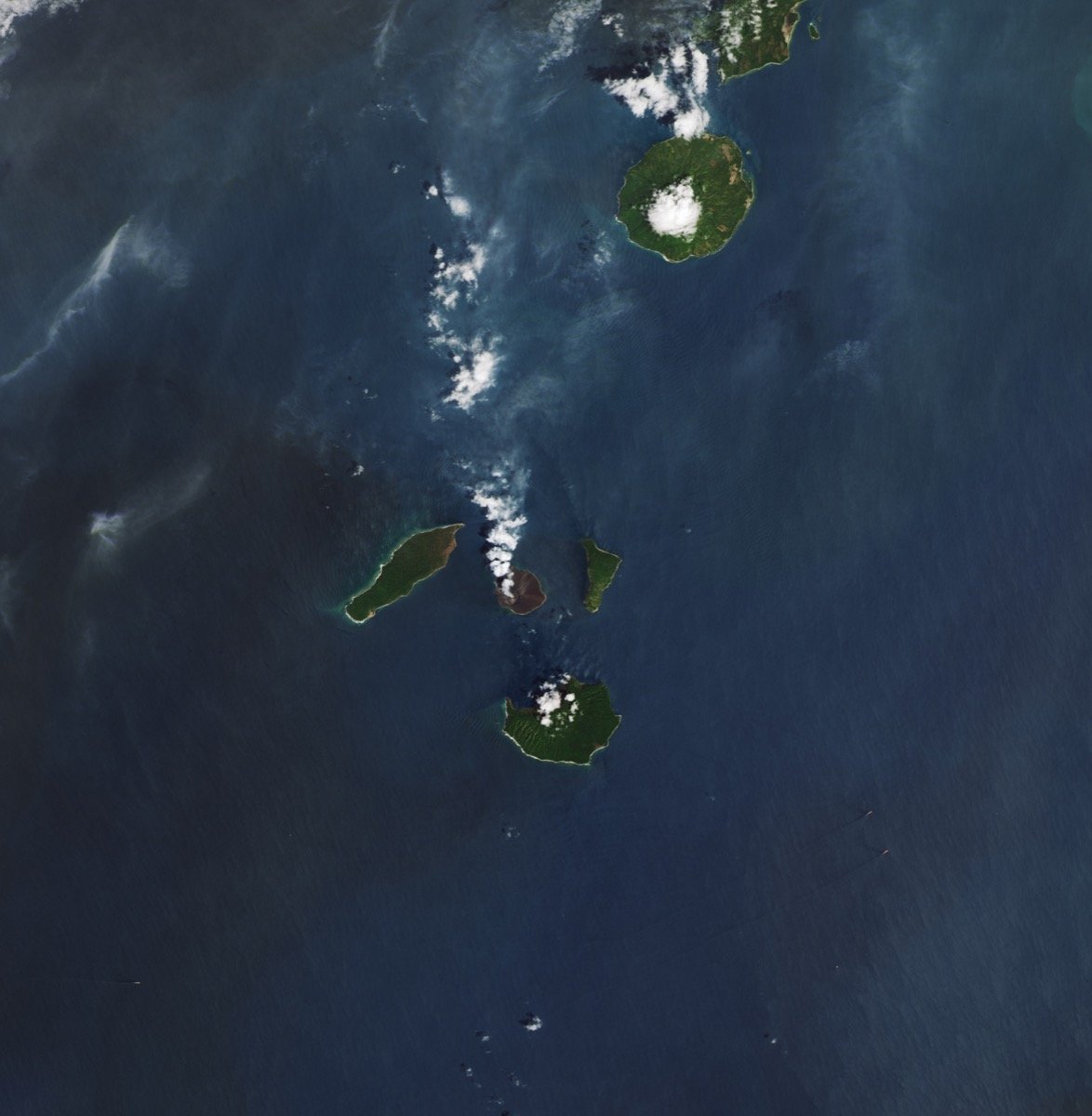
Anak Krakatau sits in the Sunda Strait, between Java and Sumatra, roughly 155km west of Jakarta.
Krakatoa Eruption Timeline: 1883-2026
From the 1883 catastrophe to Anak Krakatau’s latest ash disruption.
Krakatoa Catastrophe
What happened: Krakatoa erupted catastrophically over 26-27 August 1883 in the Sunda Strait. A series of explosions climaxed on the morning of 27 August, destroying much of the island and generating tsunamis that struck the coasts of Java and Sumatra, becoming one of the deadliest volcanic disasters in recorded history.
Why it matters: Per NOAA, the final blast is considered the loudest sound in recorded history, reportedly heard over 4,600km away near Rodrigues Island, and its atmospheric pressure wave circled the globe multiple times, recorded on barographs worldwide for days.
1883
The Island Is Reshaped
What happened: The eruption changed the geography of the Krakatoa island group. Much of the old volcanic structure collapsed into a submarine caldera, leaving behind only fragments of the original island — principally the remnant now known as Rakata — and a dramatically altered map of the strait.
Why it matters: The caldera left behind became the exact space where a new volcano would later be born — setting up the next chapter of the same volcanic system.
Anak Krakatau Emerges
What happened: Anak Krakatau — “Child of Krakatoa” — emerged from the sea in late 1927, rising from the same caldera left by the 1883 eruption. It was the next chapter of the same volcanic system, not a separate, unrelated volcano.
Why it matters: Every eruption discussed later in this timeline, including 2018 and 2026, happened at this same young island — not at the original 1883 Krakatoa, which no longer exists in its pre-1883 form.
2018
The Child Volcano Keeps Growing
What happened: Anak Krakatau continued erupting and building itself upward through repeated lava and ash activity across the 20th and early 21st centuries. Per the Smithsonian Global Volcanism Program, the volcano went through more than 40 recorded eruptive episodes between 1927 and December 2018, reaching a height of roughly 338 meters before that year’s collapse.
Why it matters: This decades-long buildup is what made the volcano tall and steep enough for a sudden flank failure to become possible in 2018.
Flank Collapse and Deadly Sunda Strait Tsunami
What happened: On the night of 22 December 2018, part of Anak Krakatau’s southwest flank collapsed into the sea during an ongoing eruption, displacing water and triggering a tsunami that struck the coasts of Banten (Java) and Lampung (Sumatra) with waves reported up to about 5 meters in places. There was no earthquake, so Indonesia’s seismically triggered tsunami-warning system did not detect it in advance.
Why it matters: This tsunami was caused by a volcanic flank collapse, not a typical earthquake-triggered tsunami — the peer-reviewed study by Ye and colleagues in Science Advances (2020) confirmed the collapse mechanism, and it remains the reason Anak Krakatau is treated differently from a “normal” eruption risk.
Monitoring and Repeated Eruptions
What happened: After 2018, Anak Krakatau remained closely monitored by Indonesia’s Geological Agency (PVMBG). The volcano produced further eruptions and ash plumes in the years that followed, as its cone slowly rebuilt itself, reminding authorities that the volcano was still very much active.
Why it matters: The 2018 collapse did not end Anak Krakatau’s activity — it reset the volcano’s shape and restarted the same growth-and-eruption cycle that had been running since 1927.
Alert Level and Ash Activity
What happened: Indonesian authorities raised Anak Krakatau’s alert status from Level II (Waspada/Caution) to Level III (Siaga/Alert) on 2 July 2026, after a surge in volcanic earthquakes, ground deformation and shallow magma accumulation. A 3km exclusion zone was enforced, and the volcano recorded 19 separate eruptions between early June and mid-July 2026.
Why it matters: This alert raise, two months before the September ash event, shows the volcano’s unrest built up gradually and was actively tracked by officials — not a sudden surprise.
Ash Cloud Disrupts Jakarta Flights
What happened: Anak Krakatau’s eruption led to the suspension of flights at Jakarta’s Soekarno-Hatta International Airport, with Reuters reporting 209 flights affected and ash plumes reaching up to about 50,000 feet in places. Schools in the area canceled outdoor activities and some residents reported eye irritation as ash drifted over the region.
Why it matters: BNPB spokesperson Berton Panjaitan stated there was no imminent risk of tsunami from this activity — the confirmed hazard was ash and aviation disruption, not a repeat of the 2018 flank-collapse tsunami.
beyond
Living With a Restless Volcano
What it means: Anak Krakatau sits in one of the world’s most volcanically active regions, on Indonesia’s stretch of the Pacific-adjacent Ring of Fire. Future risk depends on how the volcano’s next eruptions unfold — explosive versus effusive style, flank stability, how quickly monitoring detects change, and whether exclusion zones and aviation advisories keep pace.
Why it matters: The 2018 and 2026 events show the volcano can produce very different hazards from one active period to the next — which is why this article treats “eruption,” “flank collapse,” “tsunami” and “ash cloud” as four separate things to watch, not one single risk.
Krakatoa Before and After 1883
One eruption erased an island and, decades later, gave rise to a new one.
Why Anak Krakatau Can Cause Different Hazards
Not every eruption creates a tsunami — the flank matters as much as the eruption itself.
2018 Tsunami vs 2026 Ash Disruption
Same volcano, two very different hazards.
| Event | Main hazard | What happened | Key lesson |
|---|---|---|---|
| 2018 Anak Krakatau | Flank collapse and tsunami | Part of the volcano collapsed into the sea on 22 December 2018, generating a deadly tsunami in the Sunda Strait with no earthquake warning | Volcanic tsunamis can happen without a major earthquake warning |
| 2026 Anak Krakatau | Ash cloud and aviation disruption | Ash affected airspace and flights around Jakarta in September 2026, with authorities saying there was no immediate tsunami threat | Ash can shut down airports even when tsunami risk is not immediate |
🧠 Short Answer: Is Anak Krakatau a Tsunami Threat in 2026?
Authorities said the 2026 Anak Krakatau eruption presented no immediate tsunami threat, according to current reports. The main 2026 impact was volcanic ash disrupting flights and local activity. However, Anak Krakatau remains closely watched because in 2018 a flank collapse triggered a deadly tsunami in the Sunda Strait. The safest wording is: ash risk is confirmed in 2026; tsunami risk is monitored, not currently confirmed.
Why Volcanic Ash Can Stop Flights
Ash is not smoke — it is abrasive rock and glass.
Volcanic ash is not soft smoke. It is made of tiny, sharp particles of pulverized rock and volcanic glass. If an aircraft flies through a dense ash cloud, jet engines can be damaged or lose power, sensors can fail, and cockpit windshields can be scoured, badly reducing visibility. That is why airports and aviation authorities act cautiously the moment ash enters flight paths, even when the ground-level hazard is limited — the risk is highest thousands of meters up, exactly where aircraft cruise and climb.
This is also why the September 2026 Anak Krakatau event, despite carrying no confirmed tsunami risk, still forced Jakarta’s Soekarno-Hatta Airport to suspend 209 flights: the ash hazard and the tsunami hazard are evaluated separately, and one can be serious while the other is not.
Why the 2018 Tsunami Matters
The event that changed how Anak Krakatau is watched.
The 2018 disaster changed how people think about Anak Krakatau. It showed that the danger is not only explosive eruption — the shape and stability of the volcano’s flanks matter too. When a flank collapses into the sea, the displaced water can create a tsunami quickly, sometimes with little or no warning, because standard tsunami-detection systems are built around earthquakes, not sudden volcanic landslides.
That is the specific reason Indonesian authorities and international volcanologists still monitor Anak Krakatau’s flank stability closely alongside its eruption activity, even in years like 2026 when the confirmed hazard is ash rather than a repeat collapse.
⚠️ This Article Does Not Predict the Next Eruption
Volcanic activity can change quickly and unpredictably. This article describes confirmed past and current events, sourced to named outlets, agencies and peer-reviewed research. It does not forecast whether Anak Krakatau will erupt again, collapse again, or cause a future tsunami. For live conditions, always check Indonesia’s Geological Agency (PVMBG), MAGMA Indonesia, BNPB or BMKG rather than relying on any single article.
Explore More Timelines
People also ask
Frequently asked questions
Direct answers on Krakatoa, Anak Krakatau and the 2018-2026 events — concise enough for quick reference.
Related AiTimeline reading
⚠️ Editorial note & methodology
Author: The AI Timeline Editorial Team · Editor: AiTimeline Editorial · Last updated: 6 September 2026. Facts are drawn from Reuters reporting (via Jakarta Post/AP wire), Indonesia’s PVMBG/Geological Agency and BNPB, the Smithsonian Global Volcanism Program, NOAA’s historical eruption record, and the peer-reviewed 2018 flank-collapse study by Ye et al. (2020, Science Advances). This article is educational and editorial, not an official hazard alert; it does not predict future eruptions or guarantee any specific tsunami outcome. Corrections: corrections@aitimeline.in.
Sources & further reading
Every dated entry above was checked against these references. Last reviewed 15 September 2026.
- NOAA NCEI — On This Day: Historic Krakatau Eruption of 1883
- Smithsonian Global Volcanism Program — Krakatau
- Ye et al. (2020), Science Advances — The 22 December 2018 tsunami from flank collapse of Anak Krakatau volcano during eruption
- Antara News — Mount Anak Krakatau alert raised to Level III after activity surge
- Smithsonian GVP Weekly Volcanic Activity Report, 2-8 July 2026
- The Jakarta Post / Reuters — Soekarno-Hatta airport suspends flights due to ash from Anak Krakatau
- US News / AP — Indonesia's Jakarta airport suspends flights due to ash from Mount Anak Krakatau
- NASA Earth Observatory — Unrest at Anak Krakatau