Triumph Motorcycles: How a British Icon Survived Collapse
Triumph Motorcycles history: the 1902 first bike, the Meriden collapse, Bloor's 1983 revival, the Bonneville legend, Moto2 and India's Speed 400.
Latest Story
A Triumph parallel twin does not idle so much as it breathes — a slightly uneven, unhurried thump that most riders can pick out of a car park before they see the tank badge. It is a deliberately old-fashioned sound built into motorcycles with switchable traction control, ride-by-wire throttles and, on the flagship triples, more computing power than the entire company owned in 1970. That gap between what a Triumph sounds like and what it actually is turns out to be the whole story. Triumph Motorcycles is not one continuous company that has quietly built bikes in Coventry since the Victorian era — it is a name that was fought over, sold, occupied by its own workforce, driven into receivership, and then bought at auction by a Midlands housebuilder who had never built a motorcycle in his life. The badge survived; the company underneath it did not, at least not the same one. So the useful question about Triumph isn’t “how old is it” — it’s how a British motorcycle marque managed to die and get rebuilt as something else entirely, twice removed from its own factory, and still end up selling more motorcycles in 2024 than at any point in its 122 years of actually making them.
🧠 AI Overview Summary
Triumph began in 1885 in Coventry, England, as Siegfried Bettmann’s bicycle import business, built its first motorcycle in 1902, and grew into one of Britain’s largest motorcycle makers through two world wars. As Triumph Engineering Co. Ltd, it launched the 1959 Bonneville and dominated 1960s exports, but a 1973 corporate merger, a two-year workers’ sit-in at its Meriden factory, and a 1983 collapse ended that company entirely. Builder John Bloor bought the name and rebuilt it from scratch as Triumph Motorcycles Ltd, opening a new factory at Hinckley in 1990. The modern company — privately owned by the Bloor family, manufacturing in the UK, Thailand and, since 2023, India with Bajaj Auto — sold over 100,000 motorcycles in 2024, its best year ever.
Triumph Motorcycles: Key Questions
Who, What, Why, When, Where and How
What to Know About Triumph’s History
- Triumph is a badge, not a bloodline: the company that builds Triumphs today has no corporate continuity with the one that built the original Bonneville — it bought the name out of receivership.
- The parallel twin wasn’t Triumph’s first engine, but it was Triumph’s defining one: Edward Turner’s 1937 Speed Twin set a template every British rival scrambled to copy for two decades.
- The Bonneville is named after a controversial land-speed record, not a rider or a place Triumph is from — Johnny Allen’s 1956 run at Utah’s Bonneville Salt Flats on a Triumph-powered streamliner.
- Triumph had a faster, more advanced triple ready before Honda’s CB750 — the 1968 Trident — but management delayed its launch for a restyle, and Honda’s bike reached showrooms first with a better spec sheet.
- The Meriden sit-in (1973-1975) wasn’t a strike over pay, it was workers physically occupying the factory to stop it closing, which is precisely what forced the government-backed co-operative into existence.
- Steve McQueen didn’t perform the famous barbed-wire jump in The Great Escape — stunt rider Bud Ekins did, on the same disguised Triumph TR6 Trophy McQueen rode for the rest of the chase.
- John Bloor deliberately did not reopen Meriden — he built an entirely new factory at Hinckley designed around 1990s manufacturing standards, not the tooling the old company had used since the 1930s-50s.
- Bajaj Auto builds Triumph’s Speed 400 in India, but owns no part of Triumph — it’s a manufacturing and distribution alliance, not an acquisition or a joint-equity company.
- Most Triumphs sold worldwide today aren’t built in Britain — volume production shifted to Thailand between 2002 and 2020; Hinckley now builds roughly 4,500 specialist machines a year alongside doing all the engineering.
- Triumph’s 765cc triple has powered every Moto2 grid since 2019 under a contract now running to 2029 — a rare case of a road-bike maker becoming a spec-series racing supplier.
⚠️ How This Guide Separates Company History From Brand Mythology
Triumph’s story is unusually easy to blur because the name has outlived three distinct corporate entities, and because some of its best-known stories — the McQueen jump chief among them — have a documented version and a more flattering campfire version that don’t quite match. Wherever this guide states a corporate fact (who owned what, and when), it draws on company records, receivership and acquisition history, and independent reporting at the time. Wherever it covers a cultural legend, the gap between the popular version and the documented one is called out directly rather than smoothed over — including in a dedicated myth-vs-fact section further down.
10 Triumph Motorcycles That Changed the Brand
Ranked by how much each one actually altered the company’s direction, not by nostalgia
Cultural icon
Company rebirth
Engineering landmark
Origin point
Category creator
Market opener
Pivotal Moments: The Story, Not Just the Dates
The turning points that explain why Triumph exists in its current form — newest first
Triumph Sells 100,000+ Motorcycles for the First Time Ever
What happened: Triumph passed 100,000 motorcycles sold in a single year for the first time in its history, a record built on the modern classic range, adventure-touring Tigers and the newly global Speed 400/Scrambler 400 X family exported out of India.
Why it mattered: It is the clearest proof yet that the Bloor-era company, manufacturing across three countries, has outgrown the old company’s biggest sales years by a wide margin.
Speed 400 and Scrambler 400 X Launch, Built in India
What happened: Triumph launched its first-ever sub-500cc motorcycles, the Speed 400 and Scrambler 400 X, co-developed with Bajaj Auto and built at Bajaj’s Chakan plant near Pune, with the Speed 400 reaching Indian dealers from mid-July 2023 and the Scrambler following by October.
Why it mattered: It gave Triumph a genuinely affordable, accessible entry point for the first time in its modern history, aimed squarely at the segment Royal Enfield had owned largely uncontested.
Volume Production Moves Entirely to Thailand
What happened: Triumph moved its last remaining UK-built volume models, including the Speed Triple and Tiger 1200, to its Chonburi, Thailand facilities, leaving Hinckley to build only around 4,500 high-end Factory Custom and bespoke motorcycles a year.
Why it mattered: It formally separated “British-engineered” from “British-built” for the vast majority of the range, while Triumph simultaneously expanded its Hinckley design and engineering headcount.
Triumph Becomes Exclusive Moto2 Engine Supplier
What happened: Every Moto2 World Championship team began racing a spec 765cc triple derived from the Street Triple RS, ending Honda’s decade-long run as the class’s control-engine supplier.
Why it mattered: It put a genuinely road-derived Triumph engine on every grid in one of grand prix racing’s premier feeder categories, and the contract has since been extended twice, through 2029.
Triumph and Bajaj Auto Announce a Strategic Alliance
What happened: Triumph and Bajaj Auto announced a global, non-equity alliance to jointly develop and manufacture new mid-capacity motorcycles, with Bajaj handling India-based production for both companies’ emerging-market ranges.
Why it mattered: It set up everything that followed in India, six years before the first Speed 400 reached a showroom.
Fire Guts Part of the Hinckley Factory
What happened: A fire severely damaged production capacity at Hinckley, forcing Triumph to work around the loss while restoring output over subsequent months, in the same year it opened its first Thailand manufacturing operations in Chonburi.
Why it mattered: It’s a rarely told resilience story sitting right next to the start of Triumph’s most consequential manufacturing shift — the beginning of its move offshore.
Speed Triple Launches, Almost by Accident
What happened: Triumph stripped the bodywork off a batch of unsold faired Daytona 900s and sold the result as a naked “streetfighter,” creating the Speed Triple almost as a way to move inventory.
Why it mattered: The naked-triple format became one of Triumph’s most consistent identities, running in a direct line to today’s Speed Triple 1200 RS.
The New Triumph Motorcycles Ltd Launches at Cologne
What happened: Seven years after buying the name, John Bloor’s Triumph Motorcycles Ltd unveiled an all-new range built around modular 3- and 4-cylinder engines at the September 1990 Cologne show, with first deliveries for the 1991 model year.
Why it mattered: It proved a dead British marque could be rebuilt as a genuinely modern manufacturer rather than a nostalgia act — the single most consequential decision in Triumph’s post-1983 history.
Meriden Closes; John Bloor Buys the Name
What happened: The Meriden Workers’ Co-operative, unable to compete with a strong pound pricing its aging Bonneville out of the US market, collapsed. Property developer John Bloor bought the Triumph name and manufacturing rights from the receiver at auction for £150,000.
Why it mattered: This is the exact hinge point of Triumph’s entire story — the moment the original company genuinely ended and a new one, owned by someone with no motorcycle-industry background, acquired only the name.
The Meriden Workers’ Co-operative Is Formed
What happened: After an 18-month factory occupation, the UK government under Industry Secretary Tony Benn helped broker funding for Meriden’s workers to buy the factory themselves and resume building the Bonneville, mostly for US export.
Why it mattered: It bought the Triumph name eight more years of life, but on a shrinking, underfunded engineering base that couldn’t modernise fast enough to survive the early-1980s recession.
Meriden Workers Occupy the Factory
What happened: Days after a government-brokered merger created Norton Villiers Triumph, managing director Dennis Poore announced Meriden would close in stages with the loss of all 1,700 jobs. Workers responded by occupying the factory rather than allowing tooling to be removed.
Why it mattered: It’s the moment Triumph’s industrial crisis stopped being a boardroom problem and became a genuine labour standoff that lasted almost two years.
Trident Launches — Weeks Before Honda’s CB750
What happened: Triumph’s Trident T150, a genuinely advanced 750cc triple ready in prototype form as early as 1965, finally reached market in 1968 after management delayed it roughly 18 months for a restyle — only to be overshadowed weeks later by Honda’s CB750, which added a disc brake, electric start and five-speed gearbox the Trident lacked.
Why it mattered: Widely cited as the moment the British industry’s technical lead over Japanese manufacturers visibly ended, despite Triumph having the better-timed engineering underneath it.
The Bonneville T120 Goes on Sale
What happened: Following its Earls Court unveiling in late 1958, the twin-carburettor T120 Bonneville went on sale for the 1959 model year, named in honour of the 214.4mph record set on a Triumph-powered streamliner at Utah’s Bonneville Salt Flats in 1956.
Why it mattered: It became Triumph’s single most enduring model name, still in production on a completely different engine platform more than 65 years later.
BSA Acquires Triumph Engineering
What happened: BSA bought Triumph Engineering Co. Ltd from Jack Sangster, who became BSA’s chairman while Triumph continued operating with a distinct engineering and design identity under Edward Turner.
Why it mattered: It set up the corporate structure — two major brands, one group — that would eventually strain into the 1970s crisis and the Norton Villiers Triumph merger.
The Coventry Blitz Destroys the Priory Street Factory
What happened: German bombing destroyed Triumph’s Priory Street factory in the Coventry Blitz. The company rebuilt at a new, purpose-built factory at Meriden, which opened in 1942 and became Triumph’s home for the next four decades.
Why it mattered: Meriden wasn’t Triumph’s original home — it exists only because the Luftwaffe destroyed the original Coventry works.
Edward Turner’s Speed Twin Redefines the Company
What happened: A year after Jack Sangster’s buyout brought in Edward Turner as chief designer, his Speed Twin — light, fast and smoother than the single-cylinder machines it competed against — went on sale and became an immediate commercial and critical success.
Why it mattered: It set the parallel-twin format every major British rival scrambled to copy for the next two decades, and defined Triumph’s engine identity for generations.
Jack Sangster Buys the Motorcycle Business
What happened: As the original Triumph business struggled financially through the Depression, Ariel owner Jack Sangster bought the motorcycle division out of the group, forming Triumph Engineering Co. Ltd as a standalone company and hiring Edward Turner to lead design.
Why it mattered: It’s the first of Triumph’s corporate resets — and the point at which motorcycles and cars, which had shared a name since 1921, became fully separate businesses.
The “Trusty Triumph” Goes to War
What happened: Triumph’s Model H became the standard dispatch-rider motorcycle of the British and Allied forces through the First World War, with roughly 30,000 supplied under government contract.
Why it mattered: It built Triumph’s reputation for reliability at a scale peacetime sales never could have, and established it as one of Britain’s leading motorcycle makers by the war’s end.
The First Triumph Motorcycle Is Built
What happened: Triumph’s Coventry works fitted a Belgian Minerva engine to a strengthened bicycle frame, producing the company’s first powered two-wheeler, three years before it built a fully in-house engine of its own.
Why it mattered: It’s the true starting point of everything that follows — and a reminder that even the “original” Triumph motorcycle wasn’t built on entirely home-grown engineering.
Siegfried Bettmann Starts a Bicycle Import Business
What happened: German-born Siegfried Bettmann, who had settled in Coventry two years earlier, founded an import-export agency selling rebadged bicycles bought from other manufacturers — not yet making anything itself.
Why it mattered: Every later Triumph, motorcycle or otherwise, traces back to this trading business, not to a workshop or an engineer’s garage.
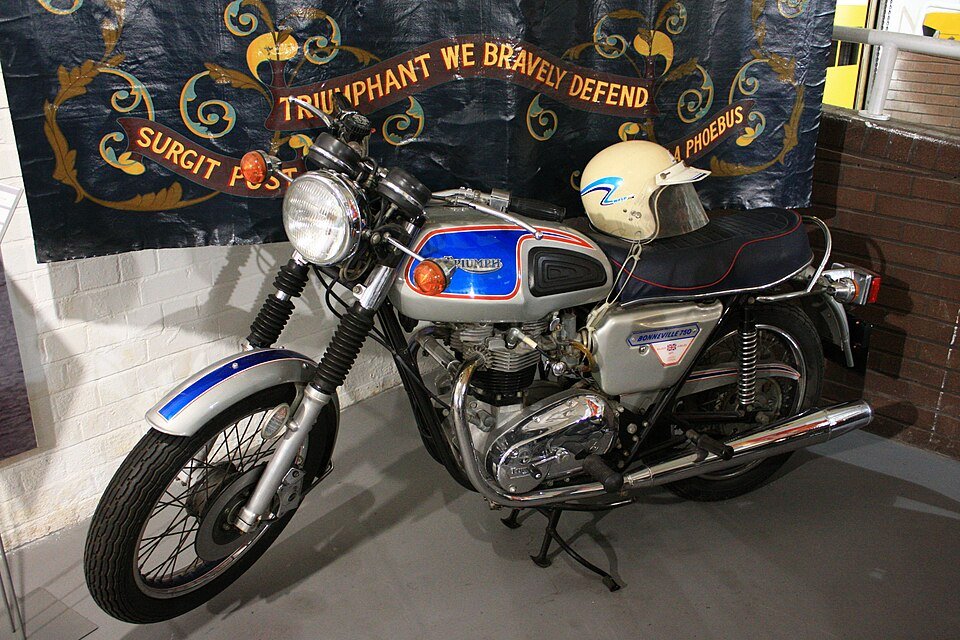
A Meriden-era Bonneville T140 preserved on display — the model that carried the original Triumph company through its final decade.
Origins: Siegfried Bettmann and the Bicycle Business
Triumph does not begin with an engineer. It begins with a 20-year-old trader. Siegfried Bettmann, born in Nuremberg, Germany, moved to England and settled in Coventry around 1883, then already establishing itself as Britain’s cycling manufacturing hub. In 1885 he founded an import-export agency in London, buying bicycles from established manufacturers and selling them on under his own brand name — a common enough business model in an era when “manufacturer” and “retailer” weren’t always the same thing. He also distributed sewing machines imported from Germany, a detail that undercuts any tidy myth of a born motorcycle man.
By 1886, Bettmann had settled on a more universal-sounding brand for his growing business: the Triumph Cycle Company. A year later, in 1887, Dunlop’s new pneumatic-tyre business invested in the firm, and Bettmann brought in a fellow Nuremberg native, Moritz Schulte, as a partner. It was Schulte, not Bettmann, who reportedly pushed the company toward actually manufacturing its own bicycles in Coventry rather than simply rebadging other people’s — a shift from trading to making that turned out to matter enormously once the same company started experimenting with engines. This guide does not overstate Bettmann’s personal engineering role, because the record doesn’t support it: he was the entrepreneur and financier who built the platform; the manufacturing push and, later, the motorcycle engineering came from the people he hired.
1902 — The First Triumph Motorcycle
Triumph’s first motorcycle, built in 1902 at the Coventry works, was exactly what you’d expect from a bicycle manufacturer’s first attempt at motorising a product: a reinforced bicycle frame with a proprietary engine bolted in, in this case a Belgian-made Minerva unit rather than anything Triumph had designed itself. This was standard practice across the early motorcycle industry — very few manufacturers in 1902 built their own engines, and Triumph’s decision to buy in a Minerva rather than delay the product waiting for in-house engineering was a pragmatic, commercially sensible one, not a sign of limited ambition.
That changed within three years. By 1905, Triumph had developed its own engine — a modest 225cc, 3-horsepower unit — and had sold roughly 500 machines, establishing the company as a genuine motorcycle manufacturer rather than an assembler of other firms’ engines. The distinction matters historically: the “first Triumph motorcycle” most enthusiasts picture, with a purpose-built Triumph engine, is really the 1905 machine, not the 1902 original. Both are part of the same continuous development, but conflating them slightly overstates how self-sufficient Triumph’s very first motorised product actually was.
Triumph Before the First World War
The decade before 1914 turned Triumph from a promising Coventry manufacturer into one of Britain’s largest motorcycle makers. Annual production climbed into four figures, reliability trials and endurance runs — a defining marketing tool of Edwardian motorcycling, long before organised circuit racing dominated the industry’s image — built the brand’s reputation, and Triumph machines began reaching export markets across the British Empire and continental Europe. Competition was already dense: Triumph shared the pre-war British market with Royal Enfield, BSA, Rudge, and dozens of smaller makers, most of which would not survive to see the 1930s, let alone the century. Triumph’s own early Isle of Man TT results — including Jack Marshall’s 1908 single-cylinder class win at an average of just over 40mph — gave the brand competitive credibility years before Bonneville-era racing glory.
World War I: The “Trusty Triumph”
Triumph’s Model H, a 550cc single-cylinder machine, became the war’s defining British military motorcycle. Roughly 30,000 were supplied to British and Allied forces as dispatch-rider machines — fast, relatively light vehicles used to carry messages and orders across terrain where telephone lines and motor vehicles couldn’t reliably operate. Soldiers reportedly nicknamed it the “Trusty Triumph,” and whether or not every version of that nickname’s origin story is precisely accurate, the underlying reputation for reliability under sustained, brutal use was genuinely earned at a scale no peacetime advertising campaign could have manufactured. The war years turned Triumph from a strong regional manufacturer into a nationally significant one, with the government contracts driving production volumes and manufacturing discipline that carried into the 1920s.
Between the Wars: Turner, Sangster and the Speed Twin
The interwar period is where Triumph’s corporate history first splits in a way that’s easy to miss. In 1921, the company launched into car manufacturing as the separate Triumph Motor Company — a distinct business from the motorcycle side, sharing a name and a founder but not, ultimately, a fate. (Triumph cars would go through their own separate ownership history, eventually ending up with British Leyland and later Standard-Triumph, entirely outside the scope of this guide.) The motorcycle business, meanwhile, struggled financially through the early 1930s Depression, and in 1936 Ariel’s owner Jack Sangster bought it out, forming Triumph Engineering Co. Ltd as a standalone company.
Sangster’s most consequential decision was hiring Edward Turner as chief designer and managing director. Turner’s 1937 Speed Twin — a light, smooth 498cc parallel twin — outperformed and outsold the single-cylinder machines that still dominated most rivals’ ranges, and the format became the industry’s template almost overnight. Norton, BSA, Royal Enfield, AJS and Matchless all developed their own parallel twins within a few years, chasing what Turner had built first. Only the comparisons the historical record actually supports are drawn here: Triumph didn’t simply out-market its rivals in this period, it had a genuine engineering lead that took the rest of the industry years to close.
World War II: The Coventry Blitz and Meriden
On the night of 14 November 1940, German bombing devastated Coventry, and Triumph’s Priory Street factory was destroyed in the raid. The company did not simply patch up the old site; it built an entirely new, purpose-built factory at Meriden, a village between Coventry and Birmingham, which opened in 1942 and produced motorcycles and other war material for the remainder of the conflict. Meriden would go on to be Triumph’s home for the next four decades — and it’s worth being precise about why: it exists because the original Coventry works was bombed out of existence, not because Triumph chose Meriden as an ideal manufacturing location from a blank slate.
The Golden Age of British Motorcycling
The two and a half decades after the war are the period most people actually picture when they think “classic Triumph.” Post-war demand, an aggressive export drive into the United States (partly a function of Britain’s own post-war currency and steel-allocation policy, which rewarded exporters), and a genuine engineering edge combined to make Triumph one of the most recognisable British brands in America by the 1950s.
Culturally, the timing was extraordinary. British twins arrived in the US just as post-war youth culture, returning servicemen with mechanical skills and disposable income, and an emerging rock-and-roll aesthetic were all colliding. Triumphs (and rival British twins) became the machines of choice for a new kind of American rider, reinforced by Hollywood: Marlon Brando’s character in 1953’s The Wild One rode a Triumph Thunderbird 6T, not a Harley-Davidson, despite a persistent popular misconception to the contrary. In Britain itself, the same machines powered a very different but related scene — café racer culture, built around all-night runs between transport cafés like London’s Ace Café, and the parallel rise of “Rocker” youth culture built almost entirely around British twins.
One especially telling artefact of that culture is the “Triton” — not an official Triumph product at all, but an enthusiast-built special combining a Triumph twin engine with a Norton Featherbed frame, chasing Norton’s superior handling reputation without giving up Triumph’s power and tuning potential. Machines like this, built in home garages rather than factories, say as much about Triumph’s cultural footprint in this era as any official model did.
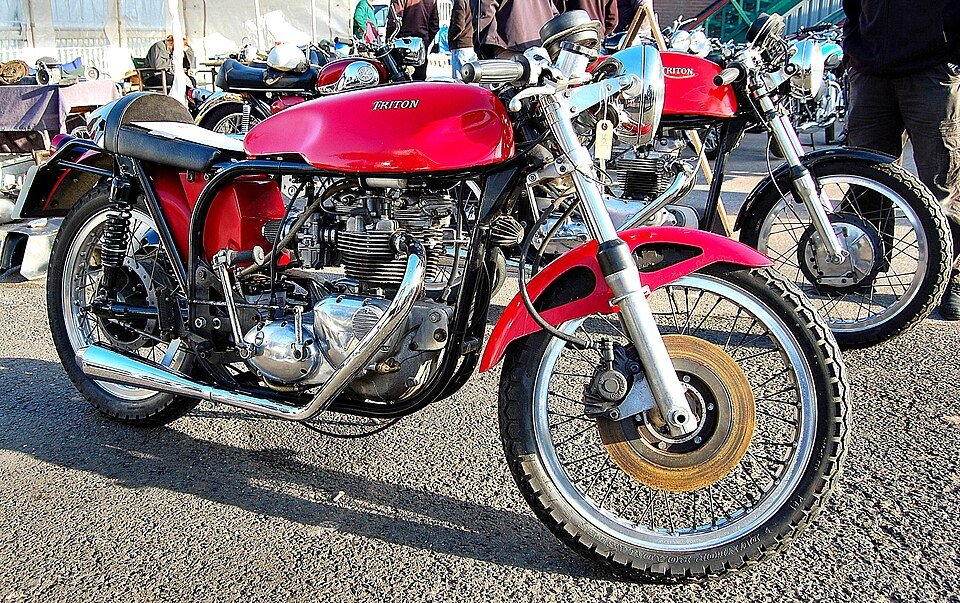
A “Triton” — a Triumph engine fitted into a Norton frame by enthusiasts chasing the best of both machines. Specials like this defined 1960s British café racer culture.
Why the Triumph Bonneville Became an Icon
The Bonneville’s name is the whole story in miniature. On 6 September 1956, rider Johnny Allen took a streamliner built around a Triumph Thunderbird 650 engine to 214.4mph on the Bonneville Salt Flats in Utah — a new motorcycle land-speed record, though one whose ratification was contested at the time between the AMA and FIM’s differing timing methods. Controversy aside, Triumph capitalised on the achievement directly: in 1958 it unveiled a new twin-carburettor performance version of its existing twin, the T120, named the Bonneville in the record’s honour, and put it on sale for the 1959 model year.
What made the original Bonneville succeed wasn’t just the name. It combined genuinely strong performance for its era, style that translated well into the emerging café racer aesthetic, and an engine format — the parallel twin — that by then was thoroughly associated with Triumph specifically. It became the default choice for riders who wanted the fastest realistic road-going British twin money could buy, and it stayed in production, through the Meriden years and the co-operative era, all the way to the original company’s 1983 collapse.
The name didn’t die with the company. When John Bloor’s new Triumph launched an air-cooled retro Bonneville in 2001 and then an all-new liquid-cooled platform in 2016, it wasn’t reviving a forgotten model — it was returning to the one nameplate that had never really stopped meaning something. It’s important not to confuse the generations: the current T120 shares a name and a general silhouette with the 1959 original, but nothing mechanical. The engine, frame, fuel system, brakes and electronics are all entirely modern designs built to 21st-century emissions and safety standards.
Triumph and Steve McQueen
Steve McQueen’s connection to Triumph is real, well-documented, and genuinely doesn’t need the exaggerated version that circulates around it. McQueen owned and rode Triumphs, including a 1962 TR6 Trophy, competed at an amateur level in off-road events, and was a serious enough rider that his friendship with stunt performer and motocross racer Bud Ekins was built on shared riding, not just a working relationship. In 1963’s The Great Escape, McQueen’s character rides a Triumph TR6 Trophy dressed up to look like a German military motorcycle, and McQueen performed a substantial amount of his own riding in the film’s chase sequences — he was a genuinely capable rider, and this part of the story is accurate.
The barbed-wire fence jump is the part that gets mythologised. The production’s insurers would not allow McQueen to perform that specific stunt himself, so it was performed by Ekins, McQueen’s friend and riding double, who was paid a reported $1,000 for the jump — calculated at the time to require roughly an 80mph run-up to clear a 12-foot fence onto a sloped landing area. The persistent version of the story where McQueen personally made that jump is Hollywood mythology, not documented fact, and it’s worth being precise about the distinction: McQueen’s riding skill was real and extensive, but this one specific, most-famous shot belonged to his stunt double. The actual motorcycle used in the sequence has been restored and is displayed at Triumph’s factory in Hinckley.
Triumph on the Race Track
Triumph’s competition record spans more than a century, and the entries below are the ones with a clear, checkable result attached to them — deliberately not padded with vague “successful racing history” claims.
| Year | Rider/Event | Machine | Result | Why it mattered |
|---|---|---|---|---|
| 1908 | Jack Marshall, Isle of Man TT | Triumph single | Won the single-cylinder class, ~40.5mph average | Triumph’s first major TT victory, established early racing credibility |
| 1956 | Johnny Allen, Bonneville Salt Flats, Utah | Triumph-powered streamliner | 214.4mph land-speed run (ratification contested between AMA/FIM) | Directly inspired the Bonneville model name |
| 1969 | Malcolm Uphill, Isle of Man TT Production race | Triumph Bonneville Thruxton, 750cc | Won the 750cc production class; first 100mph lap on a production motorcycle (100.37mph) | Dunlop renamed its tyre “TT100” in tribute; a genuine production-motorcycle landmark |
| 2019-present | Every Moto2 World Championship grid | Triumph 765cc spec triple | Exclusive control-engine supplier, contract extended to 2029 | Turned a road-bike-derived engine into the standard powerplant of a top-tier grand prix feeder class |
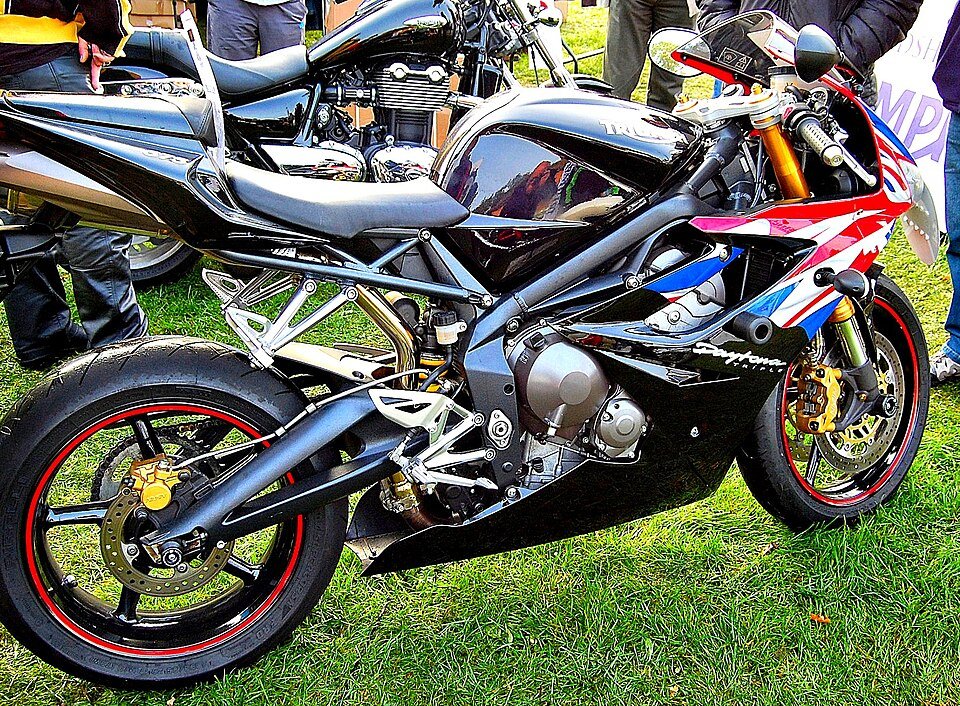
A modern Triumph Daytona, carrying the triple-cylinder supersport identity the nameplate has built since the mid-2000s.
The British Motorcycle Industry Crisis
Why “Japanese bikes were just better” isn’t the real explanation
It’s tempting to reduce the British motorcycle industry’s 1960s-70s collapse to a single sentence: Japanese manufacturers made better bikes, so British ones died. That’s not wrong, exactly, but it skips the structural reasons the industry couldn’t respond in time — and Triumph’s own Trident is the clearest single example of why.
The Trident T150 had a prototype running as early as 1965 — a genuinely advanced 750cc triple, years ahead of most rivals’ plans. But BSA/Triumph management delayed its launch roughly 18 months for a styling redesign by Ogle Design, and the bike didn’t reach market until 1968. Weeks later, Honda’s CB750 arrived with a disc brake, electric starter, five-speed gearbox and an overhead-camshaft engine — features the Trident lacked — and comprehensively outclassed it on the spec sheet despite arriving to market barely later. The engineering wasn’t the problem. Corporate decision-making speed was.
That pattern repeated across the industry: chronic under-investment in modern tooling and production engineering, fragmented corporate structures (BSA and Triumph nominally shared a parent group while running semi-independent, sometimes competing, engineering efforts), difficult industrial relations, and a management culture that had grown comfortable during decades of limited competition. Meanwhile Honda, Yamaha, Suzuki and Kawasaki were investing heavily in automated, high-precision manufacturing and building electric starters, disc brakes and oil-tight engines into mainstream models as standard, not premium options. British bikes retained a genuine performance and handling reputation into the late 1960s; what they lost was the reliability, refinement and manufacturing consistency race, and once Japanese manufacturers closed the performance gap too, there was very little left to compete on.
The Meriden Story: Industrial History, Not Nostalgia
By the early 1970s, the BSA Group’s finances were deteriorating badly, and in July 1973 a government-brokered restructuring merged the remaining businesses into Norton Villiers Triumph (NVT) under managing director Dennis Poore. Poore’s plan concentrated production at BSA’s Small Heath site in Birmingham and closed Meriden. On 14 September 1973 he announced the closure, with all 1,700 Meriden jobs to be lost.
Workers responded by occupying the factory rather than allowing it to close or its tooling to be removed — not a strike over pay or conditions, but a direct, physical attempt to stop the plant’s closure altogether. The occupation lasted nearly two years. In 1975, with government support arranged partly through Industry Secretary Tony Benn, the workers formed the Meriden Workers’ Co-operative, bought the factory, and resumed producing the Bonneville and T140, primarily for the American export market that had sustained Triumph for two decades.
The co-operative kept the name alive, but on a shrinking and underfunded base. NVT itself was wound up in 1976. By the early 1980s, a strong pound — reaching around $2.45 to the pound by 1980-81 — combined with a deep UK recession and high interest rates to price the aging, still fundamentally 1938-derived Bonneville out of its main US market just as Japanese manufacturers were flooding it with modern, reliable, well-specified alternatives. The co-operative could not modernise fast enough on the capital it had. The Meriden factory finally closed in 1983, and the site was cleared for housing the following year. This is industrial history, not romance: a genuinely admirable worker-led rescue effort that still could not overcome the structural economics working against it.
1983 — How John Bloor Rebuilt Triumph
John Bloor was, at the time, a Midlands property developer and the founder of what became Bloor Homes — not a motorcycle industry figure of any kind. In January 1983, he bought the Triumph name and manufacturing rights from the official receiver at auction for £150,000. Crucially, he did not attempt to reopen Meriden or restart the co-operative’s production. He bought the badge, the goodwill and the intellectual property — not a working factory.
What followed was seven years of largely private development. Bloor’s team reportedly studied Japanese manufacturers directly, touring factories and reverse-engineering rival Honda, Yamaha, Kawasaki and Suzuki motorcycles to understand the production standards Triumph would need to match. To maintain some brand continuity during this period, Bloor licensed a small-scale continuation of Bonneville production to a Devon-based firm between 1985 and 1988 — a stopgap, not a real revival. The actual rebuild happened at a newly constructed factory in Hinckley, Leicestershire, backed by a reported £80-100 million of Bloor’s own investment, built around an all-new modular engine family sharing common architecture across 3- and 4-cylinder, 750-1200cc configurations.
The new Triumph Motorcycles Ltd unveiled six models at the September 1990 Cologne Motorcycle Show — Trophy, Trident, Daytona and Tiger nameplates, borrowed from the old company but built on entirely new engineering — with the first machines reaching customers for the 1991 model year. This is the part of the story that’s easy to undersell: Bloor didn’t simply revive a name. He funded an entire modern motorcycle manufacturer from scratch, with no prior industry experience, and got it right on the first attempt.
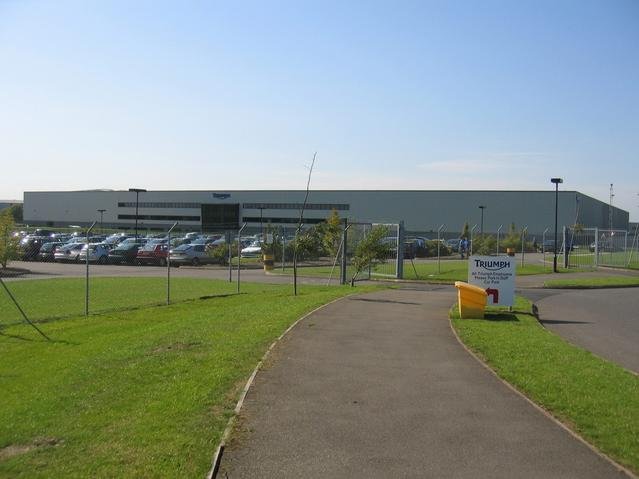
Triumph’s Hinckley, Leicestershire factory — built new by John Bloor from 1988-90, and still the company’s engineering and design headquarters today.
Hinckley Triumph: Old Company vs. Modern Company
Triumph Engineering Co. Ltd (1936-1983) vs. Triumph Motorcycles Ltd (1983-present)
The Modern Triumph Engine
The mechanical thread connecting old and new Triumph is the parallel twin’s basic layout — but almost everything around it has changed. Modern Triumphs run electronic fuel injection instead of carburettors, liquid cooling on most models instead of air cooling, and ride-by-wire throttle control that enables switchable rider modes and traction control on mid-range and flagship bikes alike. IMU-based cornering ABS and traction control, quickshifters and, on premium models, semi-active suspension have arrived over the past decade, largely driven by tightening global emissions and safety regulation as much as by competitive pressure. The point isn’t to overwhelm a casual reader with acronyms — it’s that a modern Bonneville T120 shares a name and a general silhouette with its 1959 namesake, and essentially nothing else underneath the tank.
Famous Modern Triumph Models
How each nameplate earned its place in the current range
Speed Triple: The Streetfighter That Became a Flagship
Born from stripped-down leftover Daytonas in 1994, the Speed Triple evolved from an improvised naked bike into Triumph’s flagship performance triple. The current Speed Triple 1200 RS and higher-spec RR carry a 1,160cc triple, full electronic rider-aid suites and genuinely track-capable chassis hardware — a long way from its stopgap origins, but still recognisably the same idea: a naked, aggressive, triple-powered performance bike built around attitude as much as outright top speed.
Daytona: From Race-Bred Supersport to Modern Sports-Triple
The Daytona name’s most celebrated era was the 675, launched in 2006 — a triple-cylinder supersport widely praised for its handling and regarded as one of the best-sorted middleweight sportbikes of its generation, before Triumph discontinued it as the traditional supersport category shrank industry-wide. The nameplate returned in 2024 as the Daytona 660, a sportier-faired version of Triumph’s 660cc triple platform aimed at road riders rather than the racetrack-focused 675. The two are different bikes for a different market, not a direct sequel, and this guide treats them as distinct generations rather than one continuous model.
Tiger: Building an Adventure-Touring Contender
The Tiger line evolved from the original Hinckley-era Tiger through the Tiger 800 (2010) into the current Tiger 900, which switched to a three-cylinder T-plane-crank engine in 2020 for a more torque-focused, off-road-friendly power delivery. The Tiger 1200 was fully re-engineered in 2022 with an aluminium frame and shaft drive, positioning it as a direct rival to the BMW GS, Honda Africa Twin, KTM Adventure range and Ducati Multistrada in one of the industry’s most competitive and profitable segments.
Bonneville Revival: Retro Looks, Thoroughly Modern Engineering
Triumph’s modern classic range — Bonneville T100 and T120, Speed Twin 900 and 1200, Bobber, Scrambler 900 and 1200, and Thruxton RS — all sit on the liquid-cooled Bonneville platform introduced in 2016, replacing the air-cooled architecture the retro range had used since its 2001 relaunch. Fuel injection, ride-by-wire and switchable traction control on higher trims sit underneath deliberately vintage-styled bodywork. It’s worth stating plainly: this is a design choice, not a limitation — the styling looks backward on purpose while the engineering underneath does not.
Rocket 3: An Unusually Large Statement
At 2,458cc, the Rocket 3’s inline triple is the largest-displacement engine fitted to any current production motorcycle, generating cruiser-rivalling torque from a configuration almost no other manufacturer uses at that scale — most large-displacement cruisers use V-twins. It exists largely as a deliberate engineering and marketing statement: proof Triumph’s triple architecture scales all the way from an accessible 660cc platform to the biggest engine in its class.
Model Evolution Timeline
Major current and historically important nameplates, generation by generation
| Year | Model | Engine | Category | Status today |
|---|---|---|---|---|
| 1959 | Bonneville T120 (original) | 649cc parallel twin, air-cooled | Performance twin | Discontinued 1983 with the original company |
| 1968 | Trident T150 | 740cc triple, air-cooled | Superbike | Discontinued 1975; name later reused |
| 1990 | Trophy, Trident, Daytona, Tiger (Hinckley range) | Modular 3/4-cyl, 750-1200cc | Sport, touring, adventure | Founding range of the modern company |
| 1994 | Speed Triple | 885cc-1160cc triple, liquid-cooled | Naked/streetfighter | Current: Speed Triple 1200 RS/RR |
| 2001 | Bonneville (retro relaunch) | 790-865cc twin, air-cooled | Modern classic | Replaced by liquid-cooled range in 2016 |
| 2004 | Rocket III | 2,294cc triple, liquid-cooled | Muscle cruiser | Replaced by Rocket 3 (2,458cc) in 2019 |
| 2006 | Daytona 675 | 675cc triple, liquid-cooled | Supersport | Discontinued ~2017; not sold today |
| 2007 | Street Triple | 675cc, later 765cc triple | Middleweight naked | Current: Street Triple 765 RS/R/Moto2 Edition |
| 2011 | Tiger Explorer 1200 | 1,215cc triple, shaft drive | Adventure touring | Evolved into current Tiger 1200 |
| 2016 | Street Twin / new Bonneville platform | 900-1200cc twin, liquid-cooled | Modern classic | Basis of current T100/T120/Speed Twin/Scrambler/Thruxton range |
| 2018 | Scrambler 1200 (XC/XE) | 1200cc twin, liquid-cooled | Off-road modern classic | Current, alongside Scrambler 900 |
| 2020 | Tiger 900 | 888cc triple, T-plane crank | Adventure touring | Current, replaced Tiger 800 |
| 2021 | Trident 660 | 660cc triple, liquid-cooled | Accessible middleweight naked | Current, entry point to the triple range |
| 2022 | Tiger 1200 (all-new) | 1,160cc triple, aluminium frame, shaft drive | Adventure touring flagship | Current |
| 2023 | Speed 400 / Scrambler 400 X | 398cc single, built with Bajaj Auto | Entry-level modern classic | Current; built in India, exported globally since 2024 |
| 2024 | Daytona 660 | 660cc triple, liquid-cooled | Road-focused sports triple | Current |
British Design vs. Global Manufacturing
“British engineering” and “built in Britain” are not the same claim, and modern Triumph is a genuinely useful case study in why that distinction matters. Design, engineering development and prototyping are concentrated at Hinckley, where Triumph has expanded its R&D and design headcount specifically as manufacturing has moved elsewhere. Actual production splits three ways: Hinckley itself builds roughly 4,500 specialist Factory Custom and bespoke machines a year; Chonburi, Thailand has built the bulk of the mainstream global range since volume production consolidated there in February 2020; and Chakan, India, operated by partner Bajaj Auto, builds the Speed 400 family, including units exported to Europe, the UK, the US and other markets.
None of this is unusual by contemporary motorcycle-industry standards — most global manufacturers, including several Japanese and European brands, split design, engineering and assembly across multiple countries for cost and market-access reasons. What’s specifically worth stating plainly, given how often the brand’s British identity is assumed to mean British assembly: the vast majority of Triumphs sold worldwide today are not physically built in the United Kingdom, even though every one of them is designed and engineered there.
Triumph’s Factories, Country by Country
| Location | Period | Role |
|---|---|---|
| Coventry, England | 1886-1940 | Original bicycle and motorcycle works; destroyed in the 1940 Coventry Blitz |
| Meriden, England | 1942-1983 | Post-war home of Triumph Engineering Co.; later the Meriden Workers’ Co-operative; closed in 1983 |
| Hinckley, England | 1990-present | John Bloor’s new factory; today, design/engineering HQ plus ~4,500 specialist builds/year |
| Chonburi, Thailand | 2002-present (expanded 2006, 2007; consolidated 2020) | Bulk of current global-volume production |
| Chakan, Pune, India | 2023-present | Bajaj Auto-operated plant building the Speed 400 and Scrambler 400 X, including export units |
Triumph Motorcycles in India
Triumph’s relationship with India runs deeper than a single model launch. The company first entered India through conventional CKD import and local retail before 2017, but the relationship changed fundamentally that year, when Triumph and Bajaj Auto announced a non-equity global strategic alliance to co-develop and manufacture new mid-capacity motorcycles — a deal explicitly modelled on the kind of success KTM had already found through its own long-running Bajaj partnership.
That alliance took six years to reach a showroom. In July 2023, Triumph launched the Speed 400 and Scrambler 400 X — its first-ever sub-500cc motorcycles — built on a new single-cylinder TR-series platform and manufactured at Bajaj’s Chakan plant near Pune, initially built with capacity for around 5,000 units a month. The Speed 400 reached Indian customers from mid-July 2023, with the Scrambler 400 X following by October, backed by a rapidly expanding network of dedicated “Triumph World” showrooms. By 2024, India had gone from a market Triumph sold into to a market Triumph manufactured in and exported from — Speed 400 and Scrambler 400 X units built at Chakan now reach Europe, the UK, the US and other global markets, a genuine reversal of the traditional assumption that a British brand’s “real” factory has to be in Britain.
Triumph Speed 400: Why It Exists
The Speed 400 is a deliberate strategic bet, not an incremental addition to the range. Triumph had never previously built anything under 660cc, leaving the entire accessible, affordable modern-classic segment — exactly the segment Royal Enfield had built its modern global business on — open to competitors. Partnering with Bajaj solved two problems at once: Bajaj’s manufacturing cost base made a genuinely competitively priced Triumph possible for the first time, and Bajaj’s existing Indian distribution network gave Triumph a route to market it could never have built alone in the timeframe. The resulting single-cylinder 398cc engine and modern-classic styling deliberately echo Triumph’s larger Bonneville-family design language, positioning the Speed 400 as a “real” Triumph rather than a badge-engineered budget model — a positioning choice that put it in direct, immediate competition with Royal Enfield’s core lineup. This guide does not cite specific sales figures for the Speed 400, since verified, up-to-date sales data changes too quickly to responsibly quote in a historical reference like this one.
Triumph vs. Royal Enfield
Two British-heritage brands, two very different modern structures
| Triumph | Royal Enfield | |
|---|---|---|
| British heritage | Founded Coventry, 1885/1902; British name and design HQ throughout | Founded Redditch, England, 1901; British origin, now India-owned |
| Current ownership | 100% private, Bloor family (UK) | Eicher Motors (India), owns the brand outright |
| India manufacturing | Partnership model — Bajaj builds Speed 400/Scrambler 400 X under alliance | Owns and operates its own Indian factories directly (Chennai) |
| Engine philosophy | Parallel twins and triples across the range; single only in the 400 family | Predominantly air/oil-cooled singles, with newer 650 parallel twins |
| Price positioning | Premium across most of the range; Speed 400 is the accessible entry point | Positioned as accessible/mid-range across almost its entire lineup |
| Global strategy | Premium performance/adventure brand, now adding an accessible tier via India | Built its global growth from the accessible tier upward |
Neither company is presented here as objectively superior — they compete for an overlapping but not identical customer, with genuinely different ownership structures and manufacturing philosophies.
Triumph vs. Harley-Davidson vs. BMW Motorrad
| Triumph | Harley-Davidson | BMW Motorrad | |
|---|---|---|---|
| Origin | Coventry, England, 1902 | Milwaukee, USA, 1903 | Munich, Germany, 1923 |
| Ownership today | Private (Bloor family) | Publicly traded (NYSE: HOG) | Division of BMW AG (publicly traded) |
| Signature engine | Parallel twin and inline triple | Air-cooled 45° V-twin | Boxer twin (plus inline-four/six on some models) |
| Core identity | Performance/heritage crossover, adventure, modern classic | American cruiser heritage | Adventure-touring pioneer, engineering-led |
For Harley-Davidson’s own full corporate history — including its AMF ownership era and 1981 management buyback, a genuinely close parallel to Triumph’s own near-death experience — see AiTimeline’s dedicated Harley-Davidson history guide, linked below.
Triumph and Moto2
Since the 2019 season, every Moto2 World Championship team has raced with an identical, spec 765cc Triumph triple — derived directly from the road-going Street Triple RS — ending Honda’s decade-long run as the class’s control-engine supplier. The arrangement was extended in 2021, then again in August 2023 through the 2029 season, alongside a new Moto2-specific gearbox that debuted for 2025. For Triumph, it’s a genuinely unusual marketing and engineering position: rather than sponsoring a team or building a one-off race special, its everyday road-bike engine architecture is literally what every rider on the grid competes on, feeding real racing development data back into a production engine family.
Triumph and Electric Motorcycles
Triumph’s electric programme is best understood as research, not a product line — and it’s worth being precise here, because the acronyms invite confusion. The TE-1 was a technology demonstrator, developed from 2019 with UK government (Innovate UK) backing alongside Williams Advanced Engineering, Integral Powertrain and WMG at the University of Warwick. Final prototype testing, completed in 2022-23, exceeded its original targets, including 0-60mph in 3.6 seconds and a roughly 100-mile real-world range. Triumph has stated explicitly that it has no plans to put the TE-1 itself into production; its purpose was to generate engineering knowledge for whatever electric motorcycles the company eventually does build.
Separately, and unrelated to electrification, Triumph launched TF 250-E and TF 450-E enduro models for the 2026 model year — the “E” here stands for Enduro, not electric, and these are conventional petrol-engined, race-focused off-road competition motorcycles developed with World Enduro Championship input. As of this guide’s last update, Triumph has not launched a mass-market production electric road motorcycle; anyone claiming otherwise is either confusing the TE-1 prototype with a production model, or confusing the TF 250-E/450-E naming with an electric powertrain.
Triumph’s Global Strategy and What Comes Next
Triumph’s current strategy is legible from its own recent decisions rather than from any single announcement: premium positioning and heritage styling in mature markets (UK, Europe, US, Australia), an adventure-touring range built to compete directly at the top of one of the industry’s most profitable segments, a modern-classic range that leans hard into 1960s-70s design language over genuinely modern engineering, and — via the Speed 400 family — a first real push into the accessible, high-volume segment that markets like India, and increasingly Southeast Asia and Latin America, actually run on. Triumph has indicated continued investment in its Hinckley design and engineering base even as manufacturing has globalised, and its TE-1 programme suggests electrification research will keep feeding into eventual production models, though the company has not committed to a specific electric road-bike launch date. One reasonable reading of the last decade’s decisions is that Triumph is deliberately building a two-tier global business — premium and British-designed at the top, accessible and India-manufactured at the entry point — rather than trying to be one thing in every market.
💡 Things Most People Get Wrong About Triumph
- The “original” 1902 Triumph motorcycle didn’t even use a Triumph-built engine — it used a bought-in Belgian Minerva unit.
- Triumph cars and Triumph motorcycles have been separate companies since 1936, despite sharing a name and founder.
- The Bonneville name has nothing to do with a person or a place Triumph is from — it’s named after a salt flat in Utah where a Triumph-powered streamliner set a speed record.
- The Meriden factory wasn’t Triumph’s original home — it only exists because German bombing destroyed the real original Coventry works in 1940.
- Norton, BSA, Triumph and Royal Enfield were rivals, not one company, despite briefly sharing group ownership structures at different points.
- The Speed Triple was originally a way to sell off unsold leftover Daytonas, not a planned flagship model.
Explore More Timelines
Triumph Motorcycles: Myth vs. Fact
People Also Ask
Frequently Asked Questions
32 questions on Triumph’s history, ownership, models, manufacturing and racing
Explore More on AiTimeline
⚠️ Editorial Note & Sources
This guide was researched and written by AiTimeline’s editorial team, compiled from Triumph Motorcycles’ own official history and current product pages, independent encyclopedic and journalistic sources, and documented industrial and racing records, with corporate-history facts, cultural mythology (particularly around Steve McQueen) and current company positioning clearly distinguished throughout. Figures describing current manufacturing locations, the Moto2 contract and India partnership were verified against recent official and journalistic reporting as of August 2026 and should be independently re-checked before being relied on for a business or purchase decision, since corporate arrangements and model ranges change. This article is editorial and historical in nature, not financial, legal or investment advice.
📚 Sources & Research Notes
Official sources: Triumph Motorcycles official brand history and Isle of Man TT/Bud Ekins pages (triumphmotorcycles.com); MotoGP/Dorna official Moto2 engine-partnership announcements; Bajaj Auto official press releases on the Speed 400/Scrambler 400 X launch.
Historical/encyclopedic records: Wikipedia entries for Triumph Motorcycles Ltd, Triumph Engineering, Triumph Cycle Company, Siegfried Bettmann, John Bloor, Norton Villiers Triumph, Triumph Bonneville, Malcolm Uphill and the 1908/1969 Isle of Man TT — cross-referenced for dates and figures.
Independent journalism: Motorcycle News’ “30 years on” feature on Triumph’s rebirth; Coventry Telegraph on the Meriden occupation; Business Standard and BusinessToday on the Bajaj/Speed 400 launch; RevZilla, Crash.net, Roadracing World and MotoGP.com on the TE-1 project and Moto2 contract extensions; Cycle News on 2026 leadership changes.
Where sources gave slightly different figures (for example, Bloor’s total investment in Hinckley, cited in different places as roughly £80-100 million), this guide states the most widely corroborated range rather than a single precise figure presented as certain.
How Did Triumph Survive?
Not because it made good motorcycles, though it often did. The honest answer is stranger and more specific than that: a brand can survive a company’s actual death, because a name and a reputation turn out to be separable from the factory, the workforce and the balance sheet that built them. The parallel twin Edward Turner drew up in 1937 outlived the company that made it famous. The Bonneville name outlived Meriden. Meriden’s own workers, in the strangest and most human chapter of the whole story, bought a dying factory with their own labour and kept a name alive for eight more years than the accountants would have given it, even though that effort ultimately couldn’t be enough on its own. And when the original company finally, genuinely ended in 1983, what got rebuilt afterward wasn’t a restoration project — it was a completely new manufacturer, funded by someone from outside the industry, that happened to buy the rights to put the same word on a fuel tank.
What connects the Coventry bicycle trade of 1885 to a Chakan, India assembly line building Speed 400s for European export in 2024 isn’t unbroken continuity. It’s the opposite: a badge that has been sold, occupied, liquidated and rebuilt from a standing start, and somehow kept meaning the same thing to riders each time. British motorcycle manufacturing, as an unbroken industrial tradition, arguably did not survive the 1970s. British motorcycle identity did — not because it stayed in one factory, but because enough people, from a German immigrant bicycle trader to a housebuilder who’d never made an engine, kept deciding the name was worth building around again.
Sources & further reading
Every dated entry above was checked against these references. Last reviewed 15 September 2026.
- Triumph Motorcycles Official: The Isle of Man TT (Our Story)
- Triumph Motorcycles Official: Bud Ekins (Cultural Icons)
- MotoGP/Dorna: Triumph Motorcycles Extends Partnership With Moto2 Until 2029
- Wikipedia: Triumph Motorcycles Ltd
- Wikipedia: Norton Villiers Triumph
- Business Standard: Bajaj Auto Launches Two Co-Developed Motorcycles With Triumph in India
- RevZilla: Triumph Completes TE-1 Electric Motorcycle Final Prototype, Begins Testing
- Coventry Telegraph: Remembering the NV Triumph Occupation in Meriden
- Motorcycle News: 30 Years On - The Story Behind Triumph's Rebirth